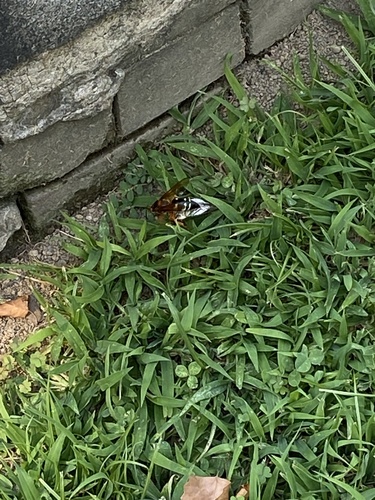
Cicada Killer Wasp

Gloria Dei (Old Swedes') Church is a timeless portal to America's colonial past.
Gloria Dei (Old Swedes') Church is a timeless portal to America's colonial past.
This venerable institution, a National Historic Site, holds the distinction of being the oldest church in Pennsylvania and the second oldest Swedish church in the United States, built by Swedish colonists between 1698 and 1700. Its enduring architecture and serene churchyard offer a tangible link to the earliest European settlements in the Delaware Valley, providing a profound sense of history and heritage. As an active Episcopal parish, it continues to serve its community while preserving centuries of stories within its walls and grounds.
Visitors can explore the church's exquisite interior, marveling at the 1731 Swedish baptismal font, one of the oldest in continuous use, and the magnificent chandelier gifted by renowned Swedish artist Carl Milles. Look up to admire the miniature wooden replicas of the *Fogel Grip* and *Kalmar Nyckel*, the ships that carried the first Swedish settlers, suspended from the ceiling. The church also houses intricate wood carvings of cherubs with an open Bible, brought from Sweden before 1646, and a carving of the Angel Gabriel, an exact replica of an 11th-century Swedish original.
Stepping outside, the expansive and tranquil churchyard invites contemplation amidst historic gravestones dating back to the late 17th century, providing a peaceful retreat from the bustling city. It's a place where visitors can not only appreciate the architectural beauty and historical artifacts but also connect deeply with the narratives of colonial America and the enduring legacy of its Swedish founders. Turn your visit into a safari! Use the Snappit app to scan and log wildlife sightings here.
The origins of Gloria Dei (Old Swedes') Church trace back to Swedish colonists who settled the Delaware Valley in 1638, establishing the colony of New Sweden. A predecessor log church was established in Tinicum in 1646, marking the first Christian church in the Delaware Valley, and the congregation later moved to the present Wicaco site in 1677. The current brick church, showcasing English vernacular style with medieval and Gothic influences, was constructed between 1698 and 1700, with additions like the tower (c. 1733) enhancing its iconic silhouette. Initially a Swedish Lutheran church, it joined the Episcopal Church in 1845. Its historical significance is further underscored by its designation as a National Historic Site in 1942, recognizing its pivotal role in American history. Notable figures associated with its past include Reverend Andrew Rudman, who helped build the church, and Reverend Nicholas Collin, a close friend of Benjamin Franklin, whose lightning rod remnants can still be seen on the church's exterior.
Step inside to absorb the serene atmosphere and admire the colonial craftsmanship and Swedish artistic contributions. Wander through the churchyard, discovering the graves of notable historical figures and enjoying the tranquil, park-like setting.
The churchyard is particularly beautiful in spring and fall. In December, the church hosts the traditional Swedish Lucia Fest, featuring candlelight, costumes, and songs.
The historic church building is accessible via a permanent ramp at the entrance. However, visitors with mobility challenges should note that the historic cemetery grounds are not accessible, and there are no accessible restrooms on-site.
The striking Flemish bond brick exterior and unique steeple.
The 1731 Swedish Baptismal Font and the Carl Milles chandelier.
Miniature wooden ship models suspended from the ceiling.
Ancient wood carvings of cherubs and the Angel Gabriel.
Each card links to a full Explore page with photos, traits, and fun facts.
Start with the big picture, then zoom in to explore individual wildlife observations around this place.
Check Operating Hours
Before visiting, confirm the most up-to-date operating hours on the official website or by calling, especially if you wish to see the interior or access the office for National Park Passport stamps.
Wear Comfortable Shoes
The historic churchyard has uneven pathways and terrain, so comfortable footwear is recommended for exploring the grounds and gravestones.
Respectful Visitation
Remember that Gloria Dei is an active place of worship; be mindful and respectful of any services or congregational activities occurring during your visit.
Parking Information
On-site parking is available in a lot at 8 Christian Street, and public parking can also be found on adjacent city streets.
Photography Etiquette
Photography is generally permitted, but always be discreet and avoid disturbing worshippers or private ceremonies.
Combine with Other Sites
The church is a short drive from other major Philadelphia historical attractions like Independence Hall, making it easy to incorporate into a broader historical tour of the city.
Aug 22, 2022
Photo attribution
(c) tkr421, some rights reserved (CC BY)
License: CC BY 4.0 ↗
Image may be shown cropped inside the card frame.
Jul 31, 2021
Photo attribution
no rights reserved
License: CC0 1.0 ↗
Image may be shown cropped inside the card frame.
Jul 12, 2025
Jul 12, 2025
Jun 6, 2024

Maryland, US
You might spot White-Tailed Deer and Eastern Gray Squirrel.
View guide →
.jpg)
District of Columbia, US
You might spot Eastern Gray Squirrel, Duck, and House Sparrow.
View guide →

Illinois, US
You might spot American Robin, Canada Goose, and House Sparrow.
View guide →

Virginia, US
You might spot Spotted Lanternfly and Northern Cardinal.
View guide →
Take the discovery with you
Identify the wildlife you spot, learn as you go, and keep a collection of the adventure.