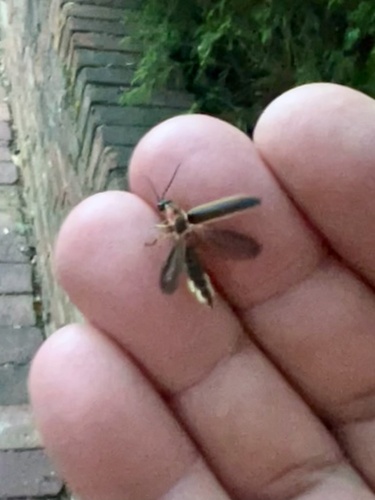




Firefly
Photinus pyralis
The common eastern firefly, or big dipper firefly (Photinus pyralis), is a soft-bodied beetle of North America east of the Rocky Mountains and one of the continent’s most familiar fireflies. On early-summer evenings males flash yellow-green light while swooping upwards in a J shape, and females answer from the grass. Its larvae glow too and live in and under the soil, where they hunt earthworms.
Also known as Common eastern firefly, Big dipper firefly, Eastern firefly
Rarity: Common
J shaped flash path
≈0.3 s male flash
2–3 s answer delay
41% reactions that make light
2 spots larval lightsStill debated
Adults + larvae carry bitter steroids
Earthworms main larval prey
≈30–50 eggs per female
Tap a pin on the model or a part below.
1 black spot on a pink shield
2–3 s a female waits, then answers
Usually none adult meals
J shaped flash path
2 segments of male lantern
41% of reactions make light
Male and female common eastern fireflies carry different lanterns, and the larva looks nothing like the adult. Pick one to repaint the model, or compare a look-alike predator.
Fireflies say most things with light. These are the signals scientists have recorded in common eastern fireflies and their relatives.
Photos from Wikimedia Commons. Some of them can repaint the 3D model.
Measured by scientists in the field and the lab, with comparisons you can picture.
Tap Myth or Fact for each claim, then check the answer.
0 of 8 answered
Fireflies are beetles, in the family Lampyridae. Like other beetles they have front wings that cover the flying wings.[1, 3]
That idea came from a 1959 measurement of 88%. A 2008 re-measurement found that about 41% of reacting luciferin molecules give off light. That is still very high for a chemical glow.[13, 9]
Larvae glow from two small spots near the tail end. Their glow rises and falls slowly instead of flashing.[7]
Female Photuris fireflies copy the answer flashes of Photinus females, then catch and eat the males that fly in.[17, 18]
Adult common eastern fireflies are usually thought not to feed, though some have been seen sipping milkweed nectar. They live on energy stored as larvae.[3]
Only some species flash together, such as the synchronous firefly of the Great Smoky Mountains. Common eastern firefly males each flash on their own rhythm.[20, 3]
In feeding tests thrushes rejected two Photinus species, partly because of bitter steroids called lucibufagins. Common eastern fireflies carry them too.[15, 3]
In field experiments, added night lighting reduced courtship and mating success in common eastern fireflies.[5]
A firefly courtship is a quick conversation in light. Each species has its own code of flash length, gap and shape.
≈0.3 s
Male flash
A patrolling male gives one short flash, about 0.3 s long.[3]
5–10 s
Gap
He repeats it every 5–10 s while flying low over the grass.[3]
J
Shape
He flashes while dipping and climbing, so the light draws a J.[3, 2]
2–3 s
Female’s delay
A female answers with one flash after 2–3 s. The delay tells the male she is his species.[3]
35
Photinus codes
North America has 35 described Photinus species, each with simple on-off signals of its own.[10]
82%
Sync helps
In the synchronous firefly, females answered 82% of in-step flashes but as few as 3% of out-of-step ones.[20]
Photuris “femme fatale” females can fake the female answer of Photinus fireflies, so answering is not always safe for the males.
Superlatives and record holders, each checked against its source.
Most of a firefly’s life is spent underground. The flashing adult lasts only a few weeks.
Three North American fireflies, three very different ways of using light.
| Common eastern firefly | Synchronous firefly | Photuris fireflies | |
|---|---|---|---|
| Scientific name[23, 20, 17] | Photinus pyralis | Photinus carolinus | Photuris (a genus of many species) |
| Famous for[3, 20, 17] | The J-shaped “big dipper” flash | Males flashing in step together | The femme fatale trick |
| Male flashing[3, 20] | ≈0.3 s flash every 5–10 s, on his own rhythm | In sync with other males, to within milliseconds | Varies by species |
| Most active[5, 24] | Twilight | Night displays in late May–June (Great Smoky Mountains) | After dark (e.g. Photuris versicolor) |
| Adult females eat other fireflies?[18, 17] | No: it is prey | No: it is prey | Yes: they hunt Photinus males |
| Bitter lucibufagins[3, 18, 16] | Makes its own | Photinus fireflies make their own | Can’t make them; steals them from prey |
| IUCN Red List[25] | Least Concern | Least Concern | Varies: Bethany Beach firefly is Critically Endangered |
Synchronous firefly flashing is famous in Great Smoky Mountains National Park, where the park runs a lottery for viewing nights to protect the fireflies.
No: this firefly is listed as Least Concern and is still common in lawns and fields. But some North American fireflies are in real trouble, and light pollution affects even common ones.
IUCN Red List
Least Concern (LC)
Widespread east of the Rocky Mountains, in fields, meadows, suburban lawns, woodland edges and even cities.[25, 23, 26, 3, 2]
IUCN Red List, March 2021
Red light only
When watching fireflies, cover your torch with red film, use it only while walking, point it at the ground and switch it off when you arrive.[24]
Bethany Beach firefly (Photuris bethaniensis)Critically Endangered
Critically Endangered.[25]
Southwest spring firefly (Bicellonycha wickershamorum)Vulnerable
Vulnerable.[25]
Synchronous firefly (Photinus carolinus)Least Concern
Least Concern, but its famous displays draw so many people that viewing is managed by lottery.[25, 24]
Twelve questions. Every answer is somewhere on this page.
Question 1 of 12Score 0
Answer: A beetle. Fireflies are beetles, in the family Lampyridae.
Answer: A J. He dips and then climbs while flashing, drawing a J. That is why it is called the big dipper firefly.
Answer: 0.3 s. Each patrol flash lasts about 0.3 s and is repeated every 5–10 s.
Answer: 2–3 s. She answers with one flash after a 2–3 s delay.
Answer: Under abdominal segments 6 and 7. The male’s lantern fills the underside of segments 6 and 7. The female’s is a smaller spot on segment 6.
Answer: Earthworms. The larvae live in the soil and seem to specialise in earthworms.
Answer: 2–3 weeks. Adults live only about 2–3 weeks.
Answer: Photuris. Female Photuris fireflies fake Photinus female answers, then eat the males.
Answer: Bitter defence chemicals. They gain lucibufagins, which they can’t make themselves and which put off spiders.
Answer: About 41%. About 41%. The older figure of 88% came from 1959.
Answer: Photinus carolinus. Males of the synchronous firefly, Photinus carolinus, flash in step to within milliseconds.
Answer: Red. Use a red torch, or cover yours with red film, only while walking, and point it at the ground.
Diet, food web, safety and badges from the Snappit field guide.
Firefly larvae are hunters that eat mostly earthworms. Adults usually don't feed, though some have been seen sipping nectar.
Primary Foods
Age differences: Larvae are predators and eat mostly earthworms. Adults usually don't feed and live on energy stored as larvae.
Photuris firefliesEaten by
Female Photuris fireflies copy the answer flashes of Photinus females, then catch and eat the males that fly in.
EarthwormsHunts
Firefly larvae live in and under the soil and seem to specialise in eating earthworms.
Danger 0/5 · No known danger
Fireflies are harmless: they don't sting or bite. Watch them where they are instead of catching them, and keep lights low so they can find each other.
Look for hard wing covers meeting in a line down the back, then compare the antennae, body shape, legs and markings. Metallic colors shift a lot with lighting. Beetle Identifier: upload a photo and compare the visible details.
14-30 mm
9-19 mm
14-21 days
Firefly larvae are hunters that eat mostly earthworms. Adults usually don't feed, though some have been seen sipping nectar.
Fields, meadows, lawns and woodland edges, even in towns and cities.
6
No. Common eastern fireflies have no sting, and adults usually don’t even eat. Their defence is bitter-tasting chemicals in their blood. Watch them rather than catch them, and never put one in your mouth.
Mostly to find a mate. Males flash a species-specific code and females answer, so each can recognise their own species. Larvae glow too, probably to warn predators that they taste bad.
Light cells in the lantern use the enzyme luciferase, with ATP, magnesium and oxygen, to change a molecule called luciferin. About 41% of the reacting molecules give off light, according to a 2008 measurement.
Common eastern firefly larvae live in the soil and mainly eat earthworms. Adults usually don’t eat, though some have been seen drinking milkweed nectar.
Adults live only about 2–3 weeks. Most of the life cycle is spent as a larva in the soil, which may take up to 2 years.
Some are. Of 132 North American fireflies assessed for the IUCN Red List, at least 18 are threatened. The common eastern firefly is listed as Least Concern. Habitat loss, light pollution and pesticides are the main threats.
Switch off or dim outdoor lights at night, since bright lights cut firefly courtship and mating. Avoid pesticides, and use a red light if you go out to watch them.
Firefly larvae are often called glowworms, and they do glow. The common eastern firefly larva has two small lights near its tail end.
Zoom in to split clusters and explore where this object has been snapped.
Jun 19, 2026
BloomingdalePhoto attribution
(c) Frederick Nunley, some rights reserved (CC BY)
License: CC BY 4.0 ↗
Image may be shown cropped inside the card frame.
Take the discovery with you
Snap it with Snappit to identify it, learn what makes it special, and add the discovery to your collection.