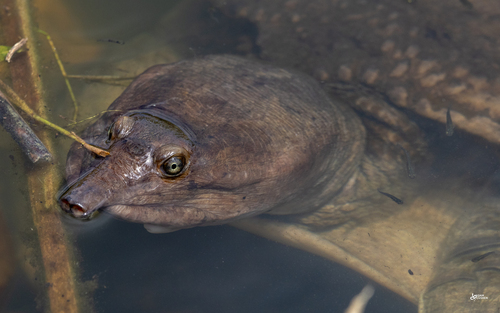




Florida Softshell Turtle
Apalone ferox
The Florida Softshell Turtle is a unique turtle with a soft, leathery shell instead of a hard one. They are great swimmers and love to bask in the sun on warm days.
Habitat: Wetlands
The Florida Softshell Turtle has a remarkably flat, leathery, olive-brown to dark green-grey shell, not hard like typical turtles. Its long, snorkel-like snout and fully webbed feet make it visually distinct from other freshwater turtles.
Category
ReptilesRarity
Common
Danger
2/5 · Low
Snaps
16
Female Florida Softshells grow much bigger than the males!
Some can breathe underwater using special lining in their throat!
These turtles can be surprisingly aggressive if they feel threatened!
They often hide completely under sand with only their eyes showing!
Florida Softshell Turtle can swim incredibly fast because of its flat, lightweight shell and strong, webbed feet.
Florida Softshell Turtle can bury itself quickly in mud or sand that helps them ambush prey and hide from predators.
Florida Softshell Turtle has powerful jaws and a sharp beak that helps them easily crush the shells of snails and crayfish.
This opportunistic omnivore munches on fish, insects, crustaceans, frogs, and sometimes plants it finds underwater.
Age differences: Young turtles eat more insects, while adults have a broader diet that includes more fish and crustaceans.
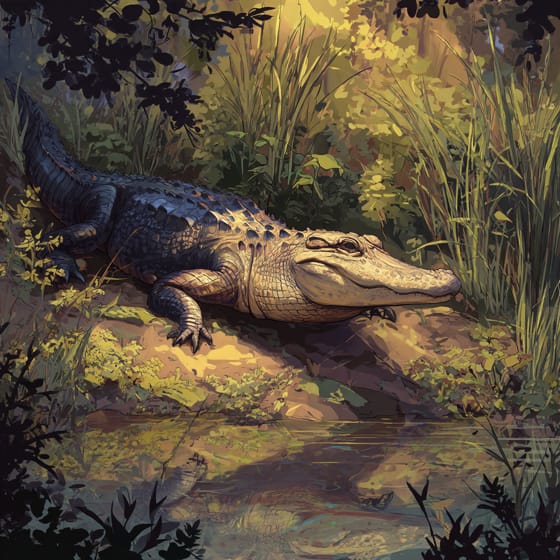
Alligator mississippiensis
Young turtles are often prey for this large reptile.
Gambusia holbrooki
Actively hunts and eats small fish like mosquitofish.
Procambarus clarkii
Crushes the shells of these crustaceans with strong jaws.
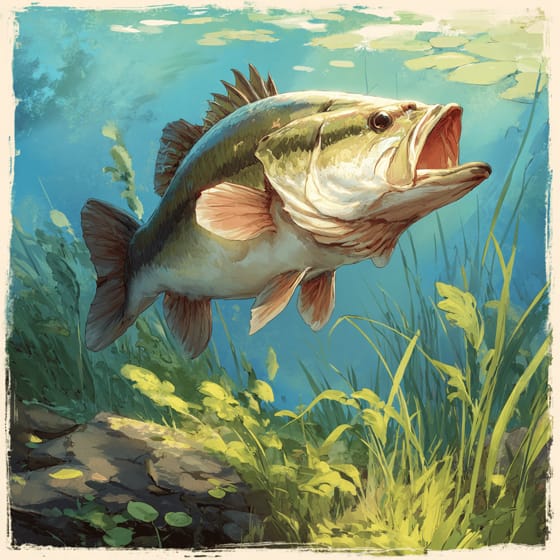
Micropterus salmoides
Ambush predator that often catches this common freshwater fish.
Characterized by having toes connected by a membrane, typically aiding in swimming.
This trait identifies organisms whose diet includes both plant and animal matter.
Piscivorous organisms are animals that primarily subsist on a diet of fish.
This habitat trait identifies species found in wetlands, which are areas of land saturated with water, either permanently or seasonally, including marshes, swamps, and bogs.

This trait identifies organisms whose diet consists entirely or primarily of animal tissue.

Diurnal animals are primarily active during daylight hours, typically resting or sleeping at night.

This trait identifies organisms that exhibit exceptional swiftness in movement for hunting, escape, or travel.

Aquatic habitats encompass environments where organisms live predominantly in water, including oceans, rivers, lakes, and wetlands.

Endangered status indicates a species is at a very high risk of extinction in the wild in the near future.
No aliases listed yet.
Danger
2/5 · Low
Always watch from a distance and never try to touch or pick up a turtle.
The easiest way to identify Florida Softshell Turtle is to use the Snappit nature identifier app.
15-76 cm
0.5-20 kg
20-30 years
5 km/h
This opportunistic omnivore munches on fish, insects, crustaceans, frogs, and sometimes plants it finds underwater.
24 km/h
Wetlands
Zoom in to split clusters and explore where this object has been snapped.
Apr 24, 2024
Monroe Lake Archeological DistrictPhoto attribution
(c) Adam Cushen, some rights reserved (CC BY)
License: CC BY 4.0 ↗
Image may be shown cropped inside the card frame.

Florida, US
You might spot Atala, Monarch, and Brown Anole.
View guide →

California, US
You might spot Western Fence Lizard and Eastern Fox Squirrel.
View guide →

Florida, US
You might spot Brown Anole, White Ibis, and Anhinga.
View guide →
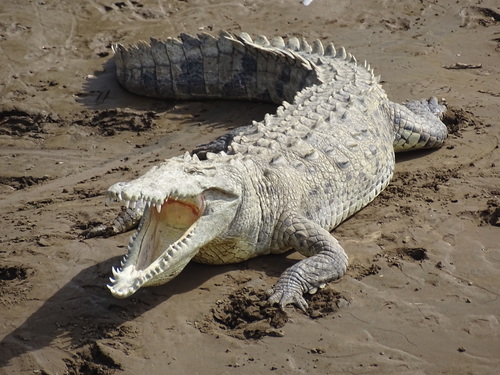
Florida, US
You might spot American Crocodile and American Alligator.
View guide →

Florida, US
You might spot Brown Anole, Great Egret, and Snowy Egret.
View guide →

Florida, US
You might spot Baobab, African Elephant, and Giraffes.
View guide →
Take the discovery with you
Snap it with Snappit to identify it, learn what makes it special, and add the discovery to your collection.