





golden Alexanders
Zizia aurea
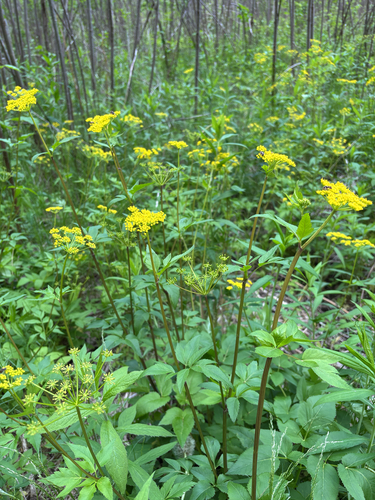
Golden Alexanders are bright yellow flowers that bloom in the spring. They grow in clusters and are loved by many insects, especially butterflies and bees!
Habitat: Wetlands
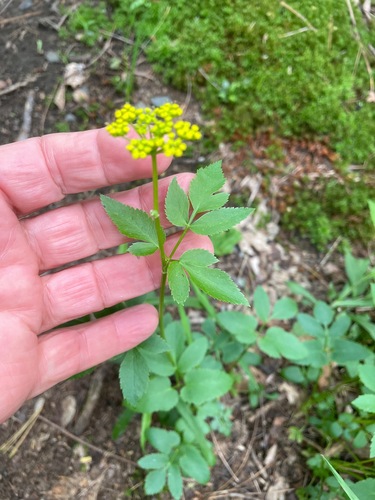
The golden Alexanders has bright yellow, tiny flowers clustered in flat-topped groups, which appear vibrant against its dark green, parsley-like leaves. Its sturdy, ridged stems support these cheerful blooms, making it stand out early in the season.
Category
PlantsRarity
Common
Danger
1/5 · Very low
Snaps
30
Before blooming, its young leaves were traditionally eaten like parsley or celery!
Its scientific name, Zizia, honors a German botanist named Johann Ziz!
Many tiny flowers in a cluster create a giant yellow welcome mat for hungry insects!
This plant is a powerhouse for nature, supporting over 60 different insect species!
golden Alexanders can bloom early in spring, giving hungry insects a vital first meal when other flowers are still dormant.
golden Alexanders has roots that can thrive in both sunny meadows and dappled forest edges, helping it colonize many habitats.
golden Alexanders has flat, open flower clusters that act like landing pads, making it super easy for small insects to visit and pollinate.
Apis mellifera
Gathers nectar and pollen

Bombus impatiens
Visits flowers for nectar
Papilio polyxenes
Feeds on flower nectar

Odocoileus virginianus
Browses on foliage
Flowering plants are any plants that produce flowers as part of their reproductive cycle.
Biennial plants complete their life cycle over two growing seasons, typically forming foliage in the first year and flowering/seeding in the second.
Cluster flowers are inflorescences where individual flowers are arranged closely together on a common stem.
Shade tolerant plants are adapted to grow and thrive in areas with low light levels, requiring less direct sunlight.

Spring blooming plants produce their flowers during the spring season, often signifying the end of winter and the start of new growth.

Edible plants are those parts of a plant that are considered safe for human consumption.

Describes plants that are particularly attractive and beneficial to a wide range of pollinating organisms.

This habitat trait identifies species found in wetlands, which are areas of land saturated with water, either permanently or seasonally, including marshes, swamps, and bogs.
Danger
1/5 · Very low
Always look but don't pick flowers unless an adult says it's okay.
The easiest way to identify golden Alexanders is to use the Snappit nature identifier app.
30-90 cm
30-60 cm
0.2-0.4 cm
Late spring to early summer
Yes
None
Perennial
Zoom in to split clusters and explore where this object has been snapped.
Jun 1, 2026
North Conway stationPhoto attribution
(c) Sarah Courchesne, some rights reserved (CC BY)
License: CC BY 4.0 ↗
Image may be shown cropped inside the card frame.
May 29, 2026
Barre Downtown Historic DistrictPhoto attribution
(c) Tom Scavo, some rights reserved (CC BY)
License: CC BY 4.0 ↗
Image may be shown cropped inside the card frame.

Connecticut, US
You might spot Bold Jumping Spider and American Tuliptree.
View guide →

Vermont, US
You might spot Asian Bittersweet, Alder Buckthorn, and Eastern Newt.
View guide →

Vermont, US
You might spot Japanese Knotweed and Red-Bellied Woodpecker.
View guide →

New York, US
You might spot Dame's Rocket, American Pokeweed, and American Toad.
View guide →

Vermont, US
You might spot Eastern White Pine, Staghorn Sumac, and Box Elder.
View guide →

Connecticut, US
You might spot American Nursery Web Spider and Common Eastern Bumble Bee.
View guide →
Take the discovery with you
Snap it with Snappit to identify it, learn what makes it special, and add the discovery to your collection.







.jpg&width=800)



_001.jpg&width=800)


