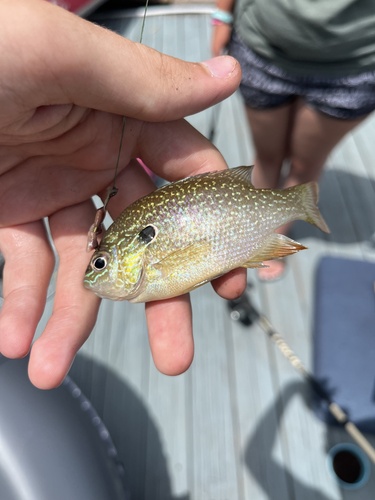


Gulf Longear Sunfish
lepomis solis
The Gulf Longear Sunfish is a stunningly vibrant freshwater fish native to the coastal plains of the Gulf of Mexico. Renowned for its brilliant coloration, this species features intricate patterns of iridescent blue, orange, and emerald scales that make it a favorite among freshwater snorkelers and anglers. Like other sunfishes, it is a highly territorial and active species, particularly during the breeding season when males construct circular nests in shallow water. These fish play an important ecological role as both predators of small invertebrates and prey for larger aquatic predators.
Habitat: Found in slow-moving streams, rivers, swamps, and vegetated lake margins with sandy or gravelly substrates across the Gulf Coast drainage.
This small, deep-bodied fish is distinguished by its extremely long, black opercular flap (the 'ear' lobe), which is typically edged in bright white or pale blue. Its body is covered in a dazzling mosaic of turquoise-blue spots and wavy lines overlaying an orange or olive-yellow background. The breast and belly of mature adults, especially spawning males, glow with a vibrant orange or reddish-orange hue. It possesses a continuous dorsal fin with spiny and soft rays, and typically reaches lengths of 10 to 18 centimeters.
Category
FishRarity
Common
Danger
1/5 · Very low
Snaps
1
Because of their incredibly bright, iridescent blue and orange scales, they are often referred to as the 'living jewels' of freshwater ecosystems.
Male Gulf Longear Sunfishes are devoted fathers; they build the nest, court the female, and then guard the eggs and newly hatched fry from any intruders.
The prominent black flap on their gill cover is called an opercular flap, and its elongated shape helps mimic a larger eyespot to deter potential predators.
Males aggressively defend their circular gravel nests from predators and competitors, displaying high territoriality and bravery relative to their size.
Rapidly expands its oral cavity to create a powerful vacuum, drawing in small aquatic insects, larvae, and crustaceans from the water or substrate.
Alters the intensity of its iridescent blue and orange markings to signal dominance to rivals or attract potential mates during courtship.
Primarily carnivorous, feeding on a wide variety of aquatic invertebrates, insect larvae, and small crustaceans found along the riverbeds and aquatic vegetation.
Age differences: Juveniles feed almost exclusively on microcrustaceans like copepods, transitioning to larger insect larvae and small mollusks as they grow.

Pachydiplax longipennis
Preys heavily on the larvae of this common aquatic insect.

Micropterus salmoides
Larger predatory fish that frequently hunts adult and juvenile sunfish in river channels.

Lepomis macrochirus
Competes for similar nesting sites and aquatic insect prey in shallow waters.
No trait badges are assigned for this object yet.
No aliases listed yet.
Collections for this object will appear here as more themes are added.
Danger
1/5 · Very low
No special safety notes yet.
Look at body shape, where the fins sit and their outline, mouth position, stripes and spots. Young fish and breeding adults can wear different patterns, and aquarium color varieties can look nothing like wild fish. Fish Identifier: upload a photo and compare the visible details.
8-18 cm
0.05-0.35 kg
4-8 years
8 km/h
Primarily carnivorous, feeding on a wide variety of aquatic invertebrates, insect larvae, and small crustaceans found along the riverbeds and aquatic vegetation.
Found in slow-moving streams, rivers, swamps, and vegetated lake margins with sandy or gravelly substrates across the Gulf Coast drainage.
Foraging
Zoom in to split clusters and explore where this object has been snapped.
Take the discovery with you
Snap it with Snappit to identify it, learn what makes it special, and add the discovery to your collection.