





Hutton's Vireo
Vireo huttoni
Hutton's Vireo is a small, cheerful bird that loves to sing! With its bright yellow belly and greenish back, it can often be seen hopping around in trees and bushes, looking for tasty insects to eat.
Habitat: Forests
The Hutton's Vireo is a small, plain olive-green bird with a dull white eye-ring and two faint wing bars. Its underside is pale grayish-white, subtly contrasting with its darker back. It closely resembles the Ruby-crowned Kinglet but lacks its red crown patch and constant wing-flicking.
Category
BirdsRarity
Common
Danger
1/5 · Very low
Snaps
1
Hutton's Vireos are known for having a remarkably similar song to the Ruby-crowned Kinglet.
Some populations never leave their breeding grounds, staying put all year long!
Their intricate cup nests are often woven with spider silk, allowing them to stretch as chicks grow!
They use their strong, short beaks like tweezers to snatch tiny insects from leaves and branches.
Hutton's Vireo has strong feet and flexible joints that help them hang upside down to find hidden insects.
Hutton's Vireo has subtle olive-green plumage that helps them blend perfectly with tree leaves, hiding from predators.
Hutton's Vireo can listen intently for tiny insect movements, helping them locate prey in dense foliage.
These tiny birds mostly eat small insects and spiders, especially caterpillars and beetles!
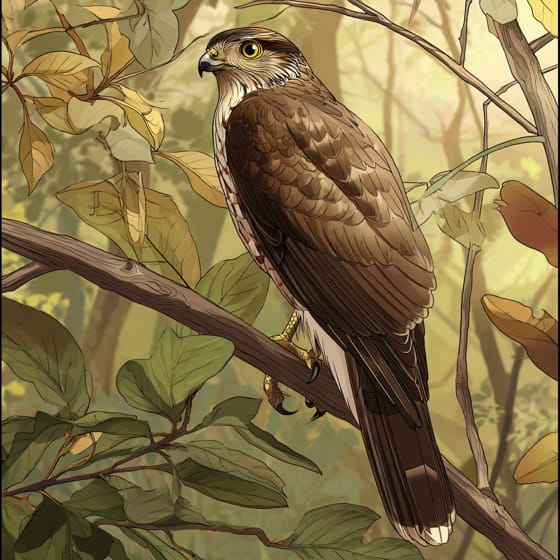
Accipiter cooperii
A common raptor that preys on small birds like vireos.

Megascops kennicottii
A nocturnal predator of small birds and mammals.
Malacosoma californicum
Eats larvae and eggs of various moth and butterfly species.

Quercus agrifolia
Provides critical habitat for nesting and insect foraging.
Feathered describes animals, primarily birds, possessing a covering of feathers.
Social animals live in organized groups, cooperating for survival benefits such as foraging, defense, and raising offspring.
Singing animals produce complex vocalizations, often for purposes of attracting mates, defending territory, or communicating within their species.
Arboreal animals live primarily in trees, utilizing them for shelter, food, and protection from predators.

This trait identifies organisms whose diet primarily consists of insects and other small invertebrates.

Forest habitats are terrestrial environments dominated by dense tree cover, supporting a high diversity of plant and animal life.

Diurnal animals are primarily active during daylight hours, typically resting or sleeping at night.
No aliases listed yet.
Danger
1/5 · Very low
Enjoy watching birds from a distance and don't disturb their nests.
The easiest way to identify Hutton's Vireo is to use the Snappit nature identifier app.
11-13 cm
17-19 cm
0.008-0.012 kg
2-5 years
35 km/h
These tiny birds mostly eat small insects and spiders, especially caterpillars and beetles!
Forests
Zoom in to split clusters and explore where this object has been snapped.

Washington, US
You might spot Pacific Banana Slug and Oregon Forestsnail.
View guide →

California, US
You might spot Western Fence Lizard and Canyon Sunflower.
View guide →

Texas, US
You might spot Evergreen Sumac, Lindheimer's Silktassel, and Ashe Juniper.
View guide →
Take the discovery with you
Snap it with Snappit to identify it, learn what makes it special, and add the discovery to your collection.




.jpg&width=800)








