





Italian arum
Arum italicum
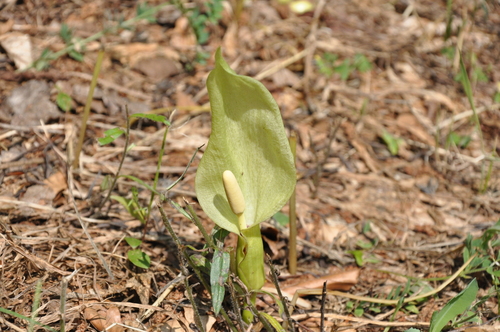
The Italian arum is a unique plant with large, arrow-shaped leaves and a striking flower that looks like a hood. It grows in shady places and can be found in gardens and woodlands.
Habitat: Woodlands
The Italian arum has glossy, dark green, arrow-shaped leaves with prominent cream or silver veins, often appearing in autumn. Its unique flower consists of a large, pale green-yellow, hood-like spathe surrounding a yellow flower spike, followed by striking clusters of bright red-orange berries.
Category
PlantsRarity
Common
Danger
3/5 · Moderate
Snaps
6
It smells like rotting meat or dung to trick flies into visiting its flowers!
Its bright red-orange berries look tasty but are super poisonous if eaten!
The Italian arum's leaves sprout in fall and stay green all through the winter!
The plant's special flower can actually make its own heat, like a tiny heater!
Italian arum flowers can warm themselves up to attract tiny flies and beetles, helping them pollinate the plant.
The plant emits a foul, carrion-like odor that draws in specific insect pollinators, helping it reproduce.
Italian arum has irritating calcium oxalate crystals in all its parts, protecting it from most hungry animals.
Psychoda alternata
Attracted by warmth and smell

Arion ater
Can graze on the plant's leaves
Turdus merula
Disperses seeds by consuming berries
Deciduous plants periodically shed all their leaves, typically during autumn or dry seasons.
Flowering plants are any plants that produce flowers as part of their reproductive cycle.
Ornamental plants are cultivated primarily for their aesthetic appeal, enhancing landscapes and gardens with their attractive foliage, flowers, or form.
Shade tolerant plants are adapted to grow and thrive in areas with low light levels, requiring less direct sunlight.

Forest habitats are terrestrial environments dominated by dense tree cover, supporting a high diversity of plant and animal life.
No aliases listed yet.
Danger
3/5 · Moderate
Don't touch or eat any part of the Italian arum, as it can make you feel sick.
The easiest way to identify Italian arum is to use the Snappit nature identifier app.
15-45 cm
30-60 cm
15-25 cm
Spring
No
High
Perennial
Zoom in to split clusters and explore where this object has been snapped.

Washington, US
You might spot African Lion, Giraffes, and Gorilla.
View guide →

District of Columbia, US
You might spot Eastern Carpenter Bee and Common Eastern Bumble Bee.
View guide →

California, US
You might spot Western Fence Lizard and Bee.
View guide →

California, US
You might spot Gray Buckeye and California Buckeye.
View guide →

New York, US
You might spot Ivy, Common Milkweed, and White Snakeroot.
View guide →
Virginia, US
You might spot Italian Arum, Common Mugwort, and Japanese Barberry.
View guide →
Take the discovery with you
Snap it with Snappit to identify it, learn what makes it special, and add the discovery to your collection.






.jpg&width=800)



_001.jpg&width=800)



