





Jack-in-the-Pulpit
Arisaema triphyllum
Jack-in-the-Pulpit is a unique plant with a tall, green hood that looks like a little tent. It grows in shady forests and has a special flower that attracts curious insects.
Habitat: Forests
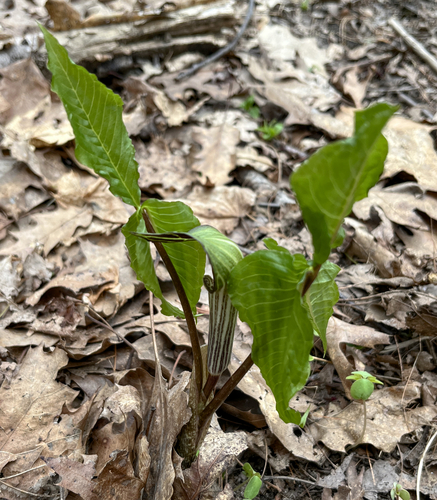
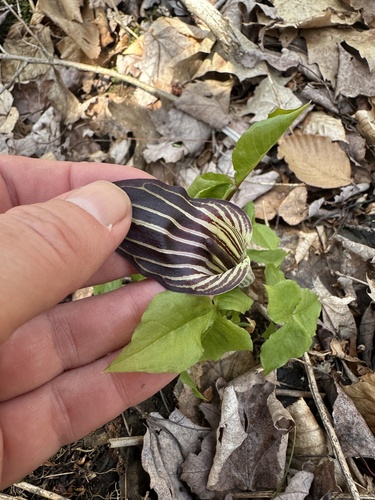
The Jack-in-the-Pulpit has a unique flower structure, featuring a hooded, often striped 'pulpit' (spathe) that arches over a central column, the 'jack' (spadix). Its large, green trifoliate leaves, resembling a three-part umbrella, emerge distinctively from the forest floor.
Category
PlantsRarity
Common
Danger
3/5 · Moderate
Snaps
72
Ancient people used to dry and prepare its root for months to make it edible!
Its 'flower' actually makes its own heat, attracting flies like a warm invitation!
The plant's red berries are shiny and taste like spicy fire if eaten raw!
This amazing plant can live for many decades, possibly even a century underground!
Jack-in-the-Pulpit can change sex from male to female (and back!) as it grows, helping it adapt to resources.
Jack-in-the-Pulpit has a clever hooded structure that temporarily traps small flies, helping it get pollinated.
Jack-in-the-Pulpit produces irritating calcium oxalate crystals, protecting it from being eaten by most animals.
Bradysia impatiens
Attracted and temporarily trapped by the unique spathe.
Meleagris gallopavo
Feasts on its bright red, late-season berries.

Peromyscus leucopus
May dig up and consume the underground corms.
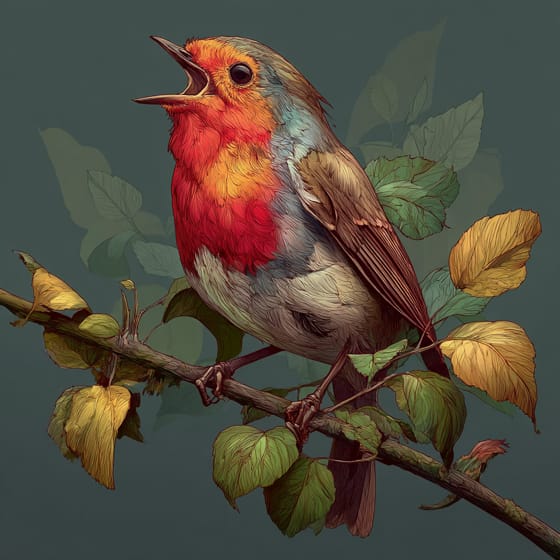
Turdus migratorius
Enjoys the plant's distinctive, ripe red berries.
Aromatic plants produce and emit fragrant volatile organic compounds, often for defense or to attract pollinators.
Bell-shaped flowers possess petals fused or arranged to form a cup-like or campanulate structure resembling a bell.
Deciduous plants periodically shed all their leaves, typically during autumn or dry seasons.
Flowering plants are any plants that produce flowers as part of their reproductive cycle.

Shade tolerant plants are adapted to grow and thrive in areas with low light levels, requiring less direct sunlight.

Fruit-bearing plants produce fruits, which are the mature ovaries of flowering plants containing seeds.

Medicinal plants possess chemical compounds that can be used for therapeutic purposes to treat illnesses or maintain health.

Describes plants that are particularly attractive and beneficial to a wide range of pollinating organisms.

This trait signifies organisms belonging to a very old evolutionary group with ancestors dating back millions of years.

Forest habitats are terrestrial environments dominated by dense tree cover, supporting a high diversity of plant and animal life.
Danger
3/5 · Moderate
Don't touch the berries or leaves, as they can be harmful if eaten.
The easiest way to identify Jack-in-the-Pulpit is to use the Snappit nature identifier app.
30-60 cm
20-40 cm
5-20 cm
Spring
No
Moderate
Perennial
Zoom in to split clusters and explore where this object has been snapped.
Jun 6, 2026
East Windsor Hill Historic DistrictPhoto attribution
(c) Mark Apgar, some rights reserved (CC BY)
License: CC BY 4.0 ↗
Image may be shown cropped inside the card frame.
May 9, 2026
Norway Historic DistrictPhoto attribution
(c) Dawn Nelson, some rights reserved (CC BY)
License: CC BY 4.0 ↗
Image may be shown cropped inside the card frame.
May 5, 2026
CheshamPhoto attribution
(c) Jaime McGuigan, some rights reserved (CC BY)
License: CC BY 4.0 ↗
Image may be shown cropped inside the card frame.

Massachusetts, US
You might spot Common Eastern Bumble Bee and Eastern Skunk Cabbage.
View guide →
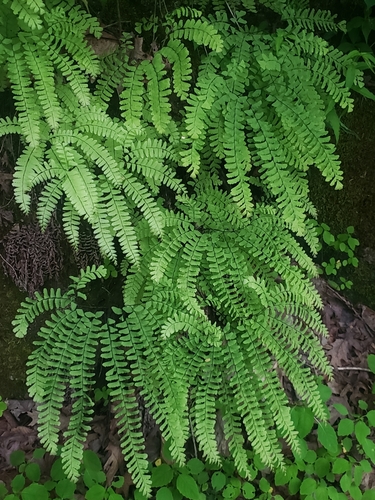
Iowa, US
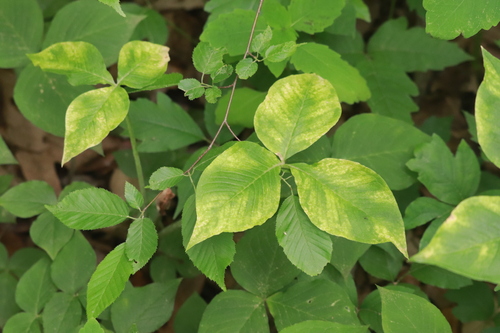
You might spot Northern Maidenhair Fern and Wood Nettle.
View guide →

New York, US
You might spot American White Waterlily, Buttonbush, and Common Milkweed.
View guide →

New Hampshire, US
You might spot Eastern Red-Backed Salamander and Eastern Newt.
View guide →

Connecticut, US
You might spot Eastern Gray Squirrel, Dark-Eyed Junco, and House Sparrow.
View guide →

Massachusetts, US
You might spot Hemlock Woolly Adelgid, Eastern Newt, and Red Trillium.
View guide →
Take the discovery with you
Snap it with Snappit to identify it, learn what makes it special, and add the discovery to your collection.






.jpg&width=800)



_001.jpg&width=800)



