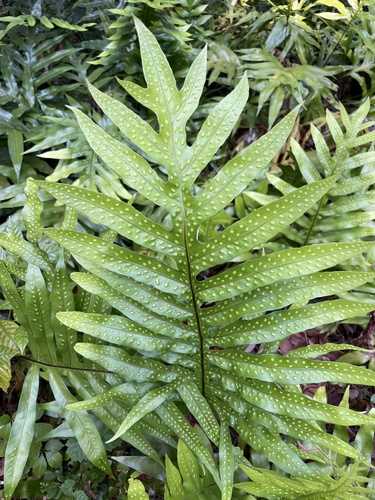


Musk Fern
microsorum grossum
The Musk Fern, scientifically known as Microsorum grossum, is a fascinating and often fragrant fern species belonging to the Polypodiaceae family. Renowned for its distinctive musky scent, which is particularly noticeable when its fronds are bruised or after rainfall, this plant adds an aromatic dimension to its lush tropical habitats. It's primarily an epiphyte, meaning it grows harmlessly on other plants, usually tree trunks and branches, but can also be found growing on rocks (lithophyte) or occasionally on the forest floor. Its robust nature and ability to thrive in humid, shaded conditions make it a notable component of many rainforest ecosystems, contributing significantly to biodiversity and visual appeal.
Habitat: Found primarily in humid tropical and subtropical rainforests, often growing as an epiphyte on trees, a lithophyte on rocks, or terrestrial in moist, shaded environments.
Musk Ferns typically display glossy, leathery green fronds that can grow up to 60 centimeters in length, though usually ranging between 20-40 cm. The fronds are simple, entire, and lanceolate to narrowly elliptic in shape, often with slightly undulating margins. A prominent, creeping rhizome, covered in fine scales, anchors the plant to its substrate. The undersides of mature fronds bear distinct, round sori (spore-producing structures) arranged in a single, neat row on either side of the midrib, which are a key identification feature. The rhizome can be quite thick and woody, providing a firm attachment.
Category
PlantsRarity
Common
Danger
1/5 · Very low
Snaps
2
Despite its name, the Musk Fern is not a true 'musk' plant (plants from the genus Mimulus) but rather refers to its distinctive aroma.
Indigenous cultures in parts of its native range have traditionally used the Musk Fern for various purposes, including medicinal applications and as a source of fragrance.
Its spores are dispersed by wind, allowing it to colonize new substrates and contribute to its wide geographic distribution.
The 'musk' scent of the fern is often compared to a blend of vanilla and fresh earth, making it unique among ferns.
The Musk Fern emits a characteristic musky fragrance, especially when its fronds are bruised or after rain, an unusual trait among ferns that helps deter certain herbivores.
It possesses a strong creeping rhizome that allows it to anchor firmly to tree trunks and branches, accessing sunlight higher in the canopy without being a parasite.
Despite preferring humid conditions, Microsorum grossum can endure periods of drought by curling its fronds to reduce water loss, recovering quickly once moisture returns.
As an autotroph, the Musk Fern produces its own food through photosynthesis, converting light energy into chemical energy. It absorbs water and dissolved nutrients from its environment, primarily through its rhizome and root-like structures.
Ficus spp.
Provides structural support for epiphytic growth.
_and_beneficial_bacteria_on_plant_performance_and_soil_fertility.webp&width=800)
Rhizophagus irregularis
May form symbiotic relationships to enhance nutrient uptake.
Helix aspersa
Feeds on fern fronds.
No trait badges are assigned for this object yet.
No aliases listed yet.
Collections for this object will appear here as more themes are added.
Danger
1/5 · Very low
No special safety notes yet.
The easiest way to identify Musk Fern is to use the Snappit nature identifier app.
20-60 cm
0.1-0.5 kg
5-15 years
As an autotroph, the Musk Fern produces its own food through photosynthesis, converting light energy into chemical energy. It absorbs water and dissolved nutrients from its environment, primarily through its rhizome and root-like structures.
Found primarily in humid tropical and subtropical rainforests, often growing as an epiphyte on trees, a lithophyte on rocks, or terrestrial in moist, shaded environments.
Absorption/photosynthesis
Zoom in to split clusters and explore where this object has been snapped.
Take the discovery with you
Snap it with Snappit to identify it, learn what makes it special, and add the discovery to your collection.













.jpg&width=800)



_001.jpg&width=800)




