





narrow-leaved bittercress
Cardamine impatiens
Narrow-leaved bittercress is a small plant with long, thin leaves. It often grows in wet places and has tiny white flowers that can brighten up any garden!
Habitat: Wetlands
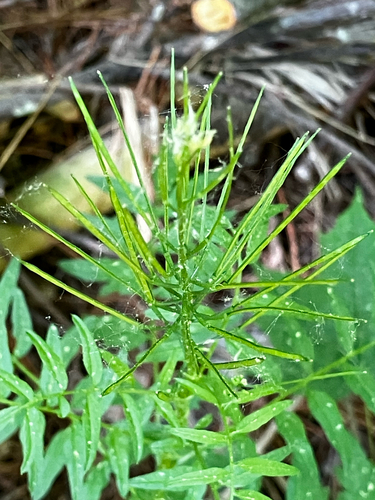
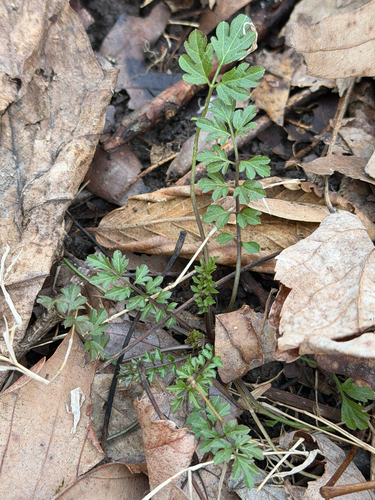
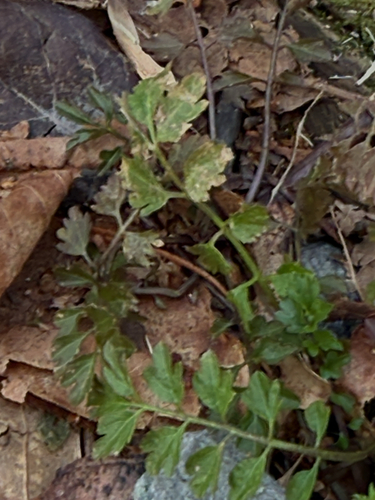
The narrow-leaved bittercress is a slender plant with delicate white flowers, each having four tiny petals. Its distinctive basal leaves are deeply lobed or toothed, while stem leaves are noticeably narrower and often clasp the stem. This upright plant features long, thin seed pods that stand erect.
Category
PlantsRarity
Common
Danger
1/5 · Very low
Snaps
27
Its scientific name 'impatiens' means 'impatient,' because its seeds burst out so quickly!
Some people call it 'flea cress' because of its incredibly tiny, dark seeds!
This wild plant is a surprising relative of familiar vegetables like broccoli and cabbage!
You might find this tenacious plant growing even in cracks in pavements or walls!
Narrow-leaved bittercress can explosively eject its seeds when pods are touched, scattering them far from the parent plant.
Narrow-leaved bittercress can quickly sprout and grow in disturbed areas, rapidly colonizing new patches of ground.
Narrow-leaved bittercress has a peppery taste due to mustard oils, deterring some herbivores while making it appealing to humans.
Deroceras reticulatum
Slugs enjoy its tender leaves, especially when young.
Pieris rapae
Its leaves are a food source for caterpillars.
Apis mellifera
Honey bees occasionally visit its tiny flowers for nectar.
Aromatic plants produce and emit fragrant volatile organic compounds, often for defense or to attract pollinators.
Flowering plants are any plants that produce flowers as part of their reproductive cycle.
Biennial plants complete their life cycle over two growing seasons, typically forming foliage in the first year and flowering/seeding in the second.
Spring blooming plants produce their flowers during the spring season, often signifying the end of winter and the start of new growth.

Edible plants are those parts of a plant that are considered safe for human consumption.

Describes plants that are particularly attractive and beneficial to a wide range of pollinating organisms.

This habitat trait identifies species found in wetlands, which are areas of land saturated with water, either permanently or seasonally, including marshes, swamps, and bogs.
No aliases listed yet.
Danger
1/5 · Very low
Always check with an adult before touching or eating any plants.
The easiest way to identify narrow-leaved bittercress is to use the Snappit nature identifier app.
10-60 cm
0.2-0.3 cm
Spring-Summer
Yes
None
Annual
Self
Zoom in to split clusters and explore where this object has been snapped.
Jun 2, 2026
Central Village Historic DistrictPhoto attribution
(c) Bryan Connolly, some rights reserved (CC BY)
License: CC BY 4.0 ↗
Image may be shown cropped inside the card frame.
Mar 15, 2026
South Mountain ReservationPhoto attribution
(c) Tom Pollard, some rights reserved (CC BY)
License: CC BY 4.0 ↗
Image may be shown cropped inside the card frame.
Mar 15, 2026
South Mountain ReservationPhoto attribution
(c) Tom Pollard, some rights reserved (CC BY)
License: CC BY 4.0 ↗
Image may be shown cropped inside the card frame.

Massachusetts, US
You might spot Maidenhair Spleenwort and Red Trillium.
View guide →

Connecticut, US
You might spot Striped Wintergreen and Common Eastern Bumble Bee.
View guide →

Connecticut, US
You might spot Bold Jumping Spider and American Tuliptree.
View guide →

Vermont, US
You might spot Asian Bittersweet, Alder Buckthorn, and Eastern Newt.
View guide →

New York, US
You might spot Dame's Rocket, American Pokeweed, and American Toad.
View guide →

Connecticut, US
You might spot Striped Wintergreen and Common Eastern Bumble Bee.
View guide →
Take the discovery with you
Snap it with Snappit to identify it, learn what makes it special, and add the discovery to your collection.








.jpg&width=800)



_001.jpg&width=800)



