





Question Mark
Polygonia interrogationis
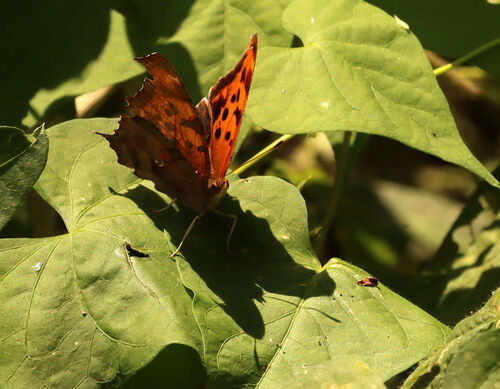
The Question Mark butterfly is a colorful insect with a unique shape. It has orange and brown wings with a special mark that looks like a question mark on the underside.
Habitat: Forests
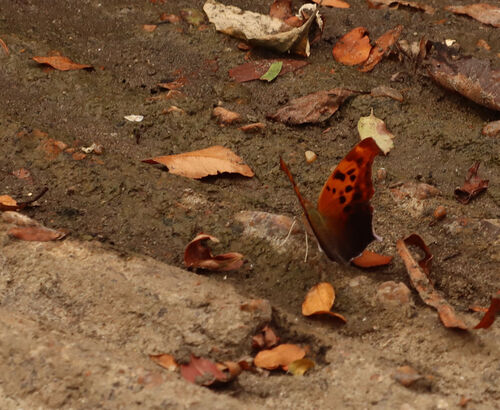
The Question Mark is a medium-sized butterfly with deeply jagged, irregular wing edges. Its upper wings are orange-brown with dark spots, while the undersides are dull brown, resembling dead leaves. A distinctive silver comma-shaped mark, sometimes broken, on the underside of its hindwing gives it its name.
Category
InsectsRarity
Common
Danger
1/5 · Very low
Snaps
59
Wow! Its ragged wing edges make it look exactly like a torn, brown leaf!
Wow! The tiny silver symbol on its underwing really looks like a question mark!
Wow! They love to drink juice from mushy, rotting fruit!
Wow! This butterfly can hibernate through winter as a grown-up!
Question Mark has jagged wings and dull undersides that help them blend perfectly with dead leaves or tree bark.
Question Mark can survive cold winters by hibernating as an adult, allowing them to emerge early in spring.
Question Mark can sip tree sap and rotting fruit, providing them with essential sugars when nectar is scarce.
Adults sip tree sap and rotting fruit, while caterpillars munch on plant leaves.
Age differences: Caterpillars eat leaves of host plants, while adults primarily feed on tree sap and rotting fruit.
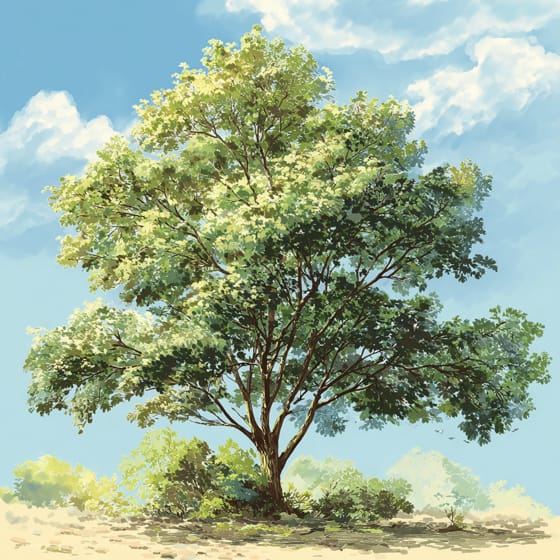
Ulmus americana
Caterpillars feed on its leaves as a primary host.

Celtis occidentalis
Another important host plant for its caterpillars.
Urtica dioica
Caterpillars also consume its foliage.
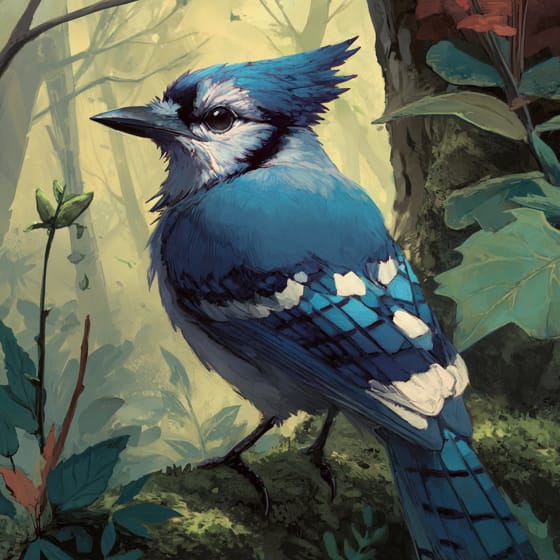
Cyanocitta cristata
A common bird that preys on adult butterflies.
Camouflaged describes organisms that possess coloring or patterns that allow them to blend into their environment.
Colorful describes organisms or objects displaying a wide range of bright and distinct colors.
This trait characterizes organisms whose diet consists entirely or primarily of plant material.
Describes plants that are particularly attractive and beneficial to a wide range of pollinating organisms.

Forest habitats are terrestrial environments dominated by dense tree cover, supporting a high diversity of plant and animal life.

Hibernating animals enter a state of metabolic depression during cold periods or when food is scarce, characterized by reduced body temperature and activity.

Diurnal animals are primarily active during daylight hours, typically resting or sleeping at night.

Describes organisms that transfer pollen, enabling the fertilization and reproduction of plants.
Danger
1/5 · Very low
Butterflies are gentle creatures, but it's best to watch them from a distance.
The easiest way to identify Question Mark is to use the Snappit nature identifier app.
45-76 mm
20-30 mm
30-240 days
15 km/h
Adults sip tree sap and rotting fruit, while caterpillars munch on plant leaves.
Forests
Foraging
Zoom in to split clusters and explore where this object has been snapped.
Sep 9, 2025
Marked Tree Lock and SiphonsPhoto attribution
(c) hr_dragonfly, some rights reserved (CC BY)
License: CC BY 4.0 ↗
Image may be shown cropped inside the card frame.
Sep 9, 2025
Marked Tree Lock and SiphonsPhoto attribution
(c) hr_dragonfly, some rights reserved (CC BY)
License: CC BY 4.0 ↗
Image may be shown cropped inside the card frame.

Illinois, US
You might spot Common Eastern Bumble Bee and Brown-Belted Bumble Bee.
View guide →

Illinois, US
You might spot Carolina Mantis and Goldenrod Soldier Beetle.
View guide →

Arkansas, US
You might spot Widow's-Cross, Yucca Giant-Skipper, and Outis Skipper.
View guide →

New Jersey, US
You might spot Brant, Laughing Gull, and Great Black-Backed Gull.
View guide →

New York, US
You might spot White Snakeroot, Rock Pigeon, and Eastern Gray Squirrel.
View guide →

Arkansas, US
You might spot Pear-Shaped Puffball and American Beautyberry.
View guide →
Take the discovery with you
Snap it with Snappit to identify it, learn what makes it special, and add the discovery to your collection.







.jpg&width=800)


