





Red-bellied Woodpecker
Melanerpes carolinus
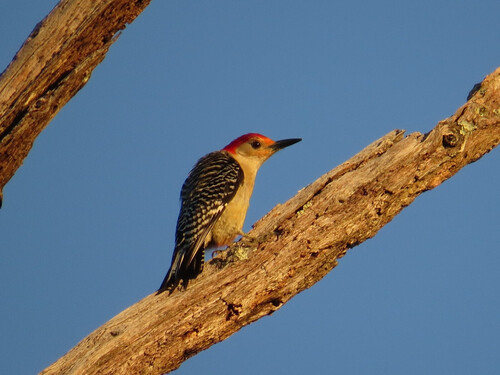
The Red-bellied Woodpecker is a colorful bird with a bright red cap and a lovely belly. They love to drum on trees to find bugs and make their homes in the wood.
Habitat: Forests
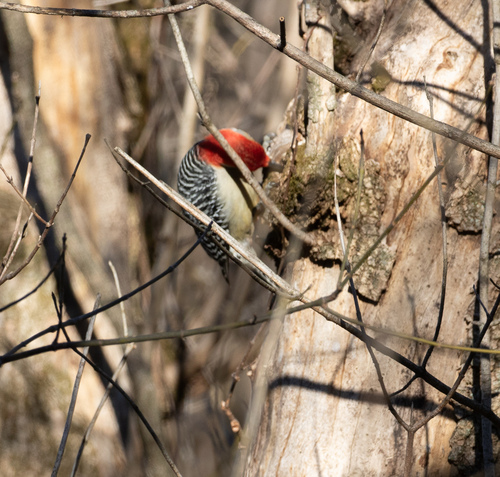
The Red-bellied Woodpecker has a distinctive black and white barred 'ladder-back' pattern on its wings and back. Males sport a striking red cap extending from forehead to nape, while females only have red on the nape. Its belly often shows only a faint reddish wash, which can be hard to spot.
Category
BirdsRarity
Common
Danger
1/5 · Very low
Snaps
105
Their "red belly" is often just a pale blush, tricky to spot!
Their unique skull absorbs pecking shock, protecting their brain!
They sometimes steal food from other bird's nests, even eggs!
This bird's stiff tail feathers act like a tripod for climbing trees!
Red-bellied Woodpecker has a long, barbed tongue that helps them reach deep into tree crevices to extract hidden insects.
Red-bellied Woodpecker can store acorns and nuts in tree bark because of their strong bill, helping them save food for later.
Red-bellied Woodpecker can rapidly tap their beak on trees and metal objects to communicate with other woodpeckers or claim territory.
These busy birds are omnivores, eating bugs, nuts, seeds, and fruits found in trees.
Feathered describes animals, primarily birds, possessing a covering of feathers.
Social animals live in organized groups, cooperating for survival benefits such as foraging, defense, and raising offspring.
Arboreal animals live primarily in trees, utilizing them for shelter, food, and protection from predators.
Colorful describes organisms or objects displaying a wide range of bright and distinct colors.

This trait identifies organisms whose diet primarily consists of insects and other small invertebrates.

This trait describes organisms that manipulate external objects to achieve a specific goal.

Forest habitats are terrestrial environments dominated by dense tree cover, supporting a high diversity of plant and animal life.

Diurnal animals are primarily active during daylight hours, typically resting or sleeping at night.
No aliases listed yet.
Danger
1/5 · Very low
Enjoy watching birds from a distance and don't disturb their nests.
The easiest way to identify Red-bellied Woodpecker is to use the Snappit nature identifier app.
22-26 cm
38-46 cm
0.056-0.091 kg
2-12 years
40 km/h
These busy birds are omnivores, eating bugs, nuts, seeds, and fruits found in trees.
Forests
Zoom in to split clusters and explore where this object has been snapped.
Jun 3, 2026
RugbyPhoto attribution
(c) Evan M. Raskin, some rights reserved (CC BY)
License: CC BY 4.0 ↗
Image may be shown cropped inside the card frame.
Dec 22, 2024
Fincastle Historic DistrictPhoto attribution
(c) kirk gardner, some rights reserved (CC BY)
License: CC BY 4.0 ↗
Image may be shown cropped inside the card frame.

New York, US
You might spot Sundial Lupine, Spotted Horsemint, and New Jersey Tea.
View guide →

Georgia, US
You might spot Gulf Fritillary, Anole, and American Beautyberry.
View guide →

Vermont, US
You might spot Japanese Knotweed and Red-Bellied Woodpecker.
View guide →

Virginia, US
You might spot Pharaoh Cicada, Lesser Celandine, and Eastern Box Turtle.
View guide →

US
You might spot Wharf Louse, Osprey, and Ruddy Turnstone.
View guide →

New Jersey, US
You might spot White-Tailed Deer and Eastern Gray Squirrel.
View guide →
Take the discovery with you
Snap it with Snappit to identify it, learn what makes it special, and add the discovery to your collection.





.jpg&width=800)







