





Red-breasted Sapsucker
Sphyrapicus ruber
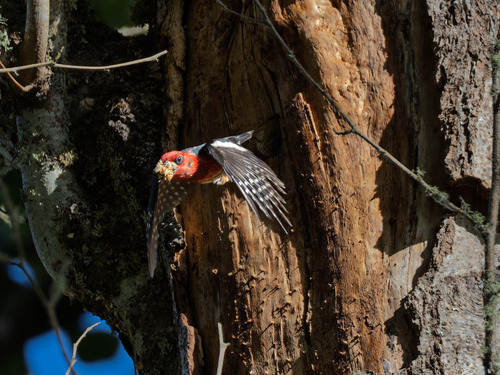
The Red-breasted Sapsucker is a colorful woodpecker with a bright red chest. It loves to drill holes in trees to drink the sweet sap and catch bugs. These birds are fun to watch as they hop around the trunks of trees!
Habitat: Forests
The Red-breasted Sapsucker has a distinctive vibrant red head and breast, contrasting with a barred black-and-white back. It features a prominent white stripe on its folded wing and a pale yellowish belly, making it visually distinct from other sapsuckers.
Category
BirdsRarity
Common
Danger
1/5 · Very low
Snaps
8
Baby sapsuckers are fed a diet mostly of insects, not sap!
Other birds, like hummingbirds, also drink sap from their tree wells!
Their long tongue has a brush-like tip to slurp up tree sap quickly.
They drum on metal objects, like street signs, to find a mate!
Red-breasted Sapsucker can drill neat rows of tiny holes in trees because this creates 'sap wells' for them to drink sweet sap.
Red-breasted Sapsucker has sap wells that help them catch insects, as bugs get stuck in the sugary liquid.
Red-breasted Sapsucker has stiff tail feathers that help them brace against tree trunks while climbing and drilling.
They mainly drink sweet tree sap and eat insects caught in their sap wells.
Pinus ponderosa
Drills sap wells in its bark for food.
Formica argentea
Catches ants attracted to sap wells.

Accipiter striatus
Is a prey item for this agile forest hawk.
Feathered describes animals, primarily birds, possessing a covering of feathers.
Social animals live in organized groups, cooperating for survival benefits such as foraging, defense, and raising offspring.
Arboreal animals live primarily in trees, utilizing them for shelter, food, and protection from predators.
Colorful describes organisms or objects displaying a wide range of bright and distinct colors.

This trait identifies organisms whose diet primarily consists of insects and other small invertebrates.

Forest habitats are terrestrial environments dominated by dense tree cover, supporting a high diversity of plant and animal life.

Diurnal animals are primarily active during daylight hours, typically resting or sleeping at night.

Migratory animals undertake seasonal movements from one region to another, typically in response to changes in climate or food availability.
No aliases listed yet.
Danger
1/5 · Very low
Enjoy watching birds from a distance and don't disturb their nests.
The easiest way to identify Red-breasted Sapsucker is to use the Snappit nature identifier app.
20-22 cm
34-39 cm
0.043-0.061 kg
4-7 years
40 km/h
They mainly drink sweet tree sap and eat insects caught in their sap wells.
Forests
Zoom in to split clusters and explore where this object has been snapped.
Jun 7, 2026
Photo attribution
no rights reserved
License: CC0 1.0 ↗
Image may be shown cropped inside the card frame.
Jun 7, 2026

US
You might spot Variable Carpet Moth, Bald Eagle, and Red Huckleberry.
View guide →
British Columbia, CA
You might spot Vanilla Leaf, Western Maidenhair Fern, and Salal.
View guide →

Washington, US
You might spot Cascade Oregon-Grape, Douglas Fir, and Salal.
View guide →

Oregon, US
You might spot Duck, Wood Duck, and Douglas Fir.
View guide →

California, US
You might spot California Scrub-Jay and Acorn Woodpecker.
View guide →

Oregon, US
You might spot Pacific Trillium, Pacific Banana Slug, and Dark-Eyed Junco.
View guide →
Take the discovery with you
Snap it with Snappit to identify it, learn what makes it special, and add the discovery to your collection.




.jpg&width=800)






