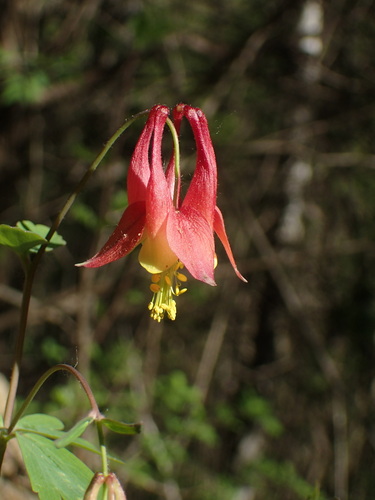


Red Columbine
aquilegia canadensis
The Red Columbine (Aquilegia canadensis) is a captivating native wildflower that brings a splash of brilliant red and yellow to the woodland gardens and rocky slopes of eastern North America. Renowned for its delicate, nodding blossoms and fern-like foliage, this herbaceous perennial is a favorite among nature enthusiasts and botanists alike. Its unique floral architecture, featuring elongated, upward-pointing spurs, is an evolutionary marvel designed specifically to attract long-tongued pollinators like hummingbirds and specialized butterflies. Beyond its striking aesthetic appeal, the Red Columbine is highly adaptable, capable of thriving in both dappled shade and rocky, nutrient-poor soils. It provides a crucial early-season nectar source for returning migrating birds and emerging insects, making it an essential and beautiful component of its native ecosystems.
Habitat: Found in partially shaded, rocky woodlands, often growing on steep slopes or limestone outcrops.
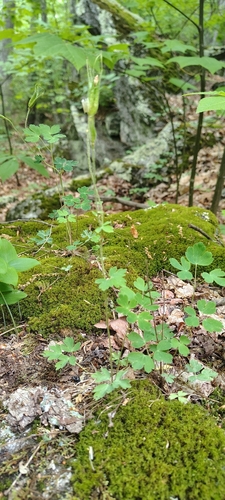
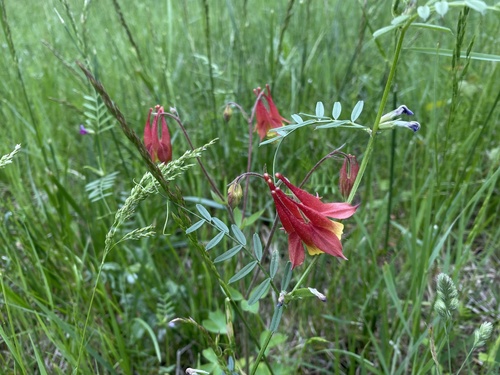
Red Columbine is easily identified by its distinctive, drooping, bell-like flowers that measure about 3 to 5 centimeters long. The blooms feature an outer ring of five upward-sweeping red sepals and spurs, which contrast sharply with the inner yellow petals. The long, hollow spurs contain a sweet nectar reward at their rounded tips. The plant's foliage is equally recognizable, consisting of compound, lobed, blue-green leaves that closely resemble ferns or meadow rue. The delicate, wiry stems typically grow 30 to 90 centimeters tall, often emerging dramatically from rocky crevices or shaded forest floors.
Category
PlantsRarity
Common
Danger
1/5 · Very low
Snaps
43
Despite its delicate appearance, Red Columbine is incredibly tough and is often one of the first plants to colonize disturbed areas or rocky cliff faces where soil is scarce.
Native American tribes historically used crushed Columbine seeds to create perfumes, love charms, and traditional medicinal washes for various ailments.
The genus name 'Aquilegia' is derived from the Latin word for eagle, 'aquila', because the plant's distinctive nectar spurs were thought to resemble the talons of a bird of prey.
The plant's specialized floral shape physically restricts access to its nectar, ensuring only pollinators with exceptionally long tongues or beaks can reach the reward.
Produces long, tubular nectar spurs that specifically cater to long-tongued or long-beaked pollinators, ensuring specialized pollination.
Contains cyanogenic glycosides in its foliage, rendering the plant toxic and highly unpalatable to deer, rabbits, and other mammalian herbivores.
Utilizes a hardy underground rhizome system that allows the plant to survive harsh winter conditions or wildfires, quickly regenerating when spring arrives.
As a photosynthetic plant, it synthesizes its own food using sunlight, carbon dioxide, and water.

Archilochus colubris
Relies on the hummingbird for pollination, as the bird's long beak perfectly reaches the nectar at the end of the flower's spurs.
Erynnis lucilius
Serves as the primary host plant for the caterpillars of this specific butterfly species.

Bombus impatiens
Large bees may bypass the pollination mechanism by chewing holes in the spurs to steal nectar.
No trait badges are assigned for this object yet.
No aliases listed yet.
Collections for this object will appear here as more themes are added.
Danger
1/5 · Very low
No special safety notes yet.
The easiest way to identify Red Columbine is to use the Snappit nature identifier app.
30-90 cm
3-5 years
As a photosynthetic plant, it synthesizes its own food using sunlight, carbon dioxide, and water.
Found in partially shaded, rocky woodlands, often growing on steep slopes or limestone outcrops.
Zoom in to split clusters and explore where this object has been snapped.
May 23, 2026
Canton Center Historic DistrictPhoto attribution
no rights reserved
License: CC0 1.0 ↗
Image may be shown cropped inside the card frame.
May 16, 2024
Morris ArboretumPhoto attribution
(c) josephine schirling, some rights reserved (CC BY)
License: CC BY 4.0 ↗
Image may be shown cropped inside the card frame.

Pennsylvania, US
You might spot Mountain Laurel, Ghost Pipe, and Sweetfern.
View guide →

Massachusetts, US
You might spot Maidenhair Spleenwort and Red Trillium.
View guide →

Massachusetts, US
You might spot Eastern Newt, Purple Pitcher Plant, and Hobblebush.
View guide →

Massachusetts, US
You might spot Common Eastern Bumble Bee and Eastern Skunk Cabbage.
View guide →
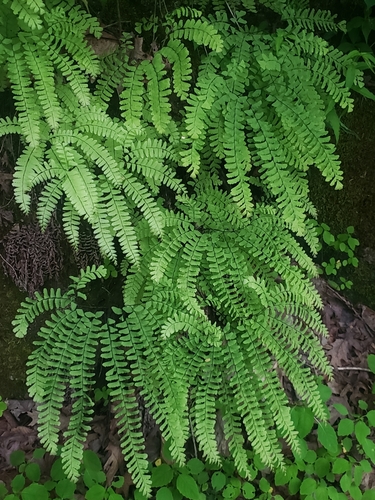
Iowa, US
You might spot Northern Maidenhair Fern and Wood Nettle.
View guide →

Vermont, US
You might spot Japanese Knotweed and Red-Bellied Woodpecker.
View guide →
Take the discovery with you
Snap it with Snappit to identify it, learn what makes it special, and add the discovery to your collection.












.jpg&width=800)



_001.jpg&width=800)




