

Sierra Gooseberry
ribes roezlii
The Sierra Gooseberry is a highly distinctive deciduous shrub native to the mountainous regions of California, Oregon, Nevada, and northern Baja California. It is well known for its resilience and unique appearance in montane forests, rocky slopes, and chaparral ecosystems. During the late spring, the plant displays striking bicolored flowers that hang gracefully from its spiny branches, drawing in early-season pollinators.
Habitat: Found in montane coniferous forests, chaparral, and rocky slopes at elevations between 1,000 and 2,600 meters.
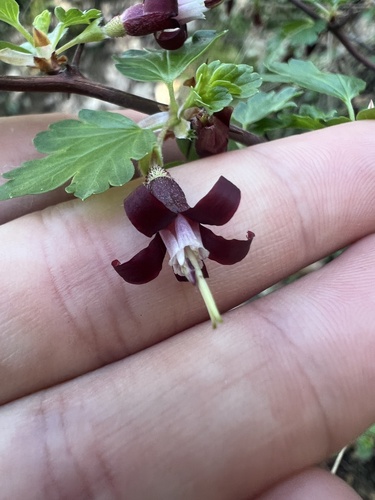
Growing as an upright or spreading shrub up to 1.2 meters tall, the Sierra Gooseberry is heavily armed with sharp, 1 to 3-branched nodal spines along its reddish-brown stems. Its light-green leaves are deeply lobed and palmate, measuring up to 4 centimeters across. The flowers feature reflexed, deep crimson-purple sepals surrounding smaller, white petals. Its round, bright red to purple fruits are easily recognized by being densely covered in stiff, gland-tipped prickles.
Category
PlantsRarity
Common
Danger
1/5 · Very low
Snaps
Be the first to snap!
Its scientific name 'roezlii' honors Benedikt Roezl, a prolific 19th-century Czech botanist and plant collector who traveled extensively in the Americas.
Native American tribes like the Miwok historically harvested the prickly fruits, rolling them inside baskets or pine needles to safely break off the sharp spines before eating them.
The gooseberry fruit's soft, sweet interior becomes quite palatable once the outer armor of gland-tipped spines is bypassed.
Stiff nodal spines and bristly, prickly fruit casings deter herbivores like deer and rodents from consuming vulnerable leaves and premature seeds.
It can vigorously resprout from its root crown or establish from heat-stimulated seed banks in the soil following forest wildfires.
It can drop its leaves prematurely during severe mid-summer droughts to conserve vital moisture and survive in dry rocky soils.
As a photoautotrophic plant, the Sierra Gooseberry produces its own sugars and energy through photosynthesis using solar radiation, water, and carbon dioxide.

Calypte anna
The tubular, nodding flowers of the Sierra Gooseberry are a key nectar source and are primarily pollinated by hummingbirds.

Tamiasciurus douglasii
Small mammals forage on the ripened, spiny berries on the ground, consuming the pulp and subsequently dispersing the seeds.

Odocoileus hemionus
The leaves and young shoots are occasionally browsed despite the protective spines, especially when other vegetation is scarce.
No trait badges are assigned for this object yet.
No aliases listed yet.
Collections for this object will appear here as more themes are added.
Danger
1/5 · Very low
No special safety notes yet.
Compare how the fruit is clustered, the leaves and their arrangement, the stems and any thorns. Red, blue and black fruits grow on lots of unrelated plants, and the same color can show up on both edible and poisonous species. Berry Identifier: upload a photo and compare the visible details.
50-120 cm
10-30 years
As a photoautotrophic plant, the Sierra Gooseberry produces its own sugars and energy through photosynthesis using solar radiation, water, and carbon dioxide.
Found in montane coniferous forests, chaparral, and rocky slopes at elevations between 1,000 and 2,600 meters.
Zoom in to split clusters and explore where this object has been snapped.
Recent snaps will appear here as new observations are added.
Take the discovery with you
Snap it with Snappit to identify it, learn what makes it special, and add the discovery to your collection.