





staghorn sumac
Rhus typhina
Staghorn sumac is a bushy plant with bright red berries and fuzzy, antler-like branches. It grows in sunny spots and is great for attracting birds and butterflies!
Habitat: Open fields and sunny areas
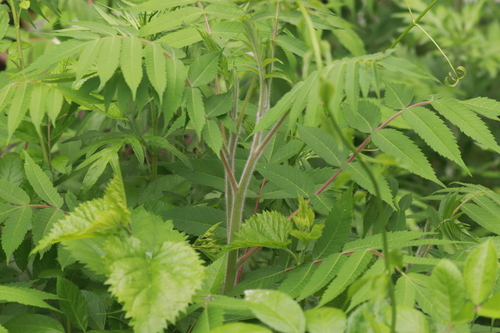
The staghorn sumac is a striking plant characterized by its thick, fuzzy branches resembling deer antlers in velvet. It produces dense, upright, cone-shaped clusters of bright red berries that persist through winter. Its large leaves transform into vibrant shades of orange, red, and purple in autumn.
Category
PlantsRarity
Common
Danger
1/5 · Very low
Snaps
18
Even when winter arrives, its bright red berry clusters often remain, adding color to snowy landscapes!
Its fuzzy branches feel soft like velvet, reminding people of a deer's antlers!
This hardy plant is often one of the first to grow in places where the ground has been disturbed!
You can steep the tart red berries in water to make a refreshing "sumac-ade" drink!
Staghorn sumac can quickly colonize disturbed areas and poor soils, helping other plants grow later.
Staghorn sumac has persistent, tart red berries that provide a crucial food source for birds and small mammals in winter.
Staghorn sumac can spread extensively underground using rhizomes, allowing it to form dense thickets and expand its territory.

Turdus migratorius
Eats the berries in winter

Procyon lotor
Consumes berries for food
Apis mellifera
Visits flowers for nectar

Odocoileus virginianus
Uses dense thickets for cover
Deciduous plants periodically shed all their leaves, typically during autumn or dry seasons.
A shrub is a woody plant smaller than a tree, typically with multiple stems branching from or near the ground.
Fruit-bearing plants produce fruits, which are the mature ovaries of flowering plants containing seeds.
Edible plants are those parts of a plant that are considered safe for human consumption.

Fall color refers to the seasonal change in foliage pigmentation, primarily in deciduous plants, displaying vibrant hues.

Grassland habitats are terrestrial biomes dominated by grasses and herbaceous plants, supporting a variety of grazing animals.

Describes plants that are particularly attractive and beneficial to a wide range of pollinating organisms.

Rapid growing plants exhibit accelerated growth rates, quickly increasing in size and biomass within a short period.
Danger
1/5 · Very low
Always be careful not to touch the berries too much, as they can be sour!
The easiest way to identify staghorn sumac is to use the Snappit nature identifier app.
300-450 cm
300-600 cm
Late spring to early summer
Yes
None
Perennial
Insect
Zoom in to split clusters and explore where this object has been snapped.
Jun 7, 2026
East Windsor Hill Historic DistrictPhoto attribution
(c) Mark Apgar, some rights reserved (CC BY)
License: CC BY 4.0 ↗
Image may be shown cropped inside the card frame.

Maine, US
You might spot American Bullfrog and Three-Toothed Cinquefoil.
View guide →

Connecticut, US
You might spot Eastern Gray Squirrel, Dark-Eyed Junco, and House Sparrow.
View guide →

Pennsylvania, US
You might spot Tree-Of-Heaven, Spotted Lanternfly, and American Tuliptree.
View guide →

New York, US
You might spot White Snakeroot, Common Mugwort, and Eastern Gray Squirrel.
View guide →

Quebec, CA
You might spot Eastern Gray Squirrel, House Sparrow, and Rock Pigeon.
View guide →

Québec, CA
You might spot Common Eastern Bumble Bee and Asian Lady Beetle.
View guide →
Take the discovery with you
Snap it with Snappit to identify it, learn what makes it special, and add the discovery to your collection.








.jpg&width=800)



_001.jpg&width=800)



