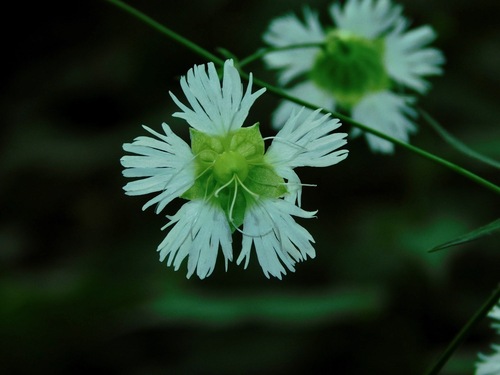


Starry Campion
silene stellata
Starry Campion (Silene stellata) is a striking woodland perennial native to eastern and central North America, celebrated for its uniquely fringed, star-like white blossoms. Belonging to the pink family (Caryophyllaceae), this elegant wildflower is a favorite of both native plant enthusiasts and nocturnal pollinators. In the wild, it forms elegant, upright stalks characterized by distinct whorls of leaves that maximize light capture along shaded forest edges. As dusk falls, Starry Campion comes alive, relying on its pale, glowing blooms to attract sphinx moths and other night-flying insects. Its delicate appearance and ecological role as a late-summer nectar source make it a vital and enchanting component of North America's deciduous forest ecosystems.
Habitat: Found in dappled sunlight along the edges of open deciduous woodlands, dry upland forests, thickets, and native tallgrass prairies.
Starry Campion typically stands between 30 and 100 centimeters tall, featuring upright, slender green stems. Its most distinguishing visual characteristic is its brilliant white, five-petaled flowers, each deeply fringed to resemble a multi-pointed star. These delicate blossoms emerge from a pale green, slightly inflated, bell-shaped calyx. Below the floral clusters, the plant's lance-shaped, vibrant green leaves are distinctively arranged in whorls of exactly four around the stem at regular intervals.
Category
PlantsRarity
Common
Danger
1/5 · Very low
Snaps
5
Its bright white, deeply fringed flowers act like natural reflectors, easily catching the moonlight to guide night-flying pollinators.
The genus name 'Silene' is believed to derive from Silenus, the mythological Greek tutor of Bacchus, possibly nodding to the foamy, sticky secretions of other plants in this group.
Unlike many closely related 'catchfly' plants in the Silene genus, Starry Campion lacks the sticky, glandular stems meant to trap crawling insects.
Utilizes its bright white, fringed petals to stand out in low light, successfully attracting night-flying moths.
Arranges its leaves in distinctive tiers of four around the stem to efficiently capture dappled sunlight in shaded woodland environments.
Features deeply lobed, feathery petals that create a specialized landing surface for hovering nocturnal pollinators.
As a photosynthetic plant, Starry Campion produces its own sustenance using sunlight, water, and atmospheric carbon dioxide.
Manduca sexta
Pollinates the flowers while foraging for nectar at night.

Odocoileus virginianus
Browses on the foliage, stems, and flowers of the plant.

Bombus impatiens
Collects nectar and pollen during the day, occasionally facilitating pollination.
No trait badges are assigned for this object yet.
No aliases listed yet.
Collections for this object will appear here as more themes are added.
Danger
1/5 · Very low
No special safety notes yet.
The easiest way to identify Starry Campion is to use the Snappit nature identifier app.
30-100 cm
3-15 years
As a photosynthetic plant, Starry Campion produces its own sustenance using sunlight, water, and atmospheric carbon dioxide.
Found in dappled sunlight along the edges of open deciduous woodlands, dry upland forests, thickets, and native tallgrass prairies.
Photosynthesis
Zoom in to split clusters and explore where this object has been snapped.

Illinois, US
You might spot Brown-Belted Bumble Bee and Eastern Gray Squirrel.
View guide →
Virginia, US
You might spot Virginia Bluebells and Virginia Springbeauty.
View guide →

Missouri, US
You might spot Painted-Cup Paintbrush and Great Spangled Fritillary.
View guide →

Missouri, US
You might spot Blackjack Oak, Bird's Foot Violet, and Starry Campion.
View guide →

Minnesota, US
You might spot Hairy Puccoon, Lanceleaf Figwort, and Ohio Spiderwort.
View guide →
Take the discovery with you
Snap it with Snappit to identify it, learn what makes it special, and add the discovery to your collection.











.jpg&width=800)



_001.jpg&width=800)




