





straggler daisy
Calyptocarpus vialis
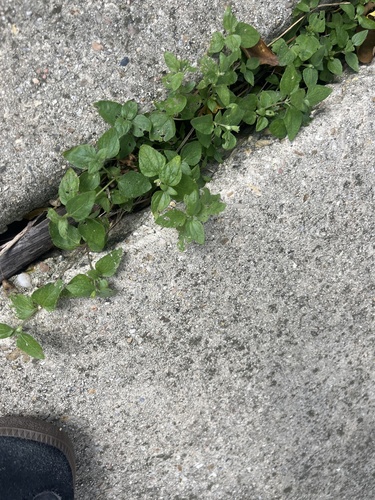
Straggler daisies are cheerful little flowers that often grow in groups. They have bright yellow petals and can be found blooming along sidewalks and in gardens.
Habitat: Urban areas
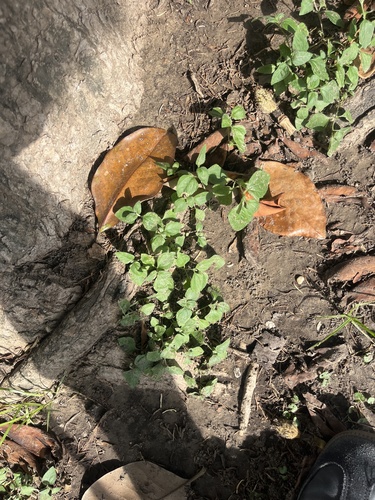
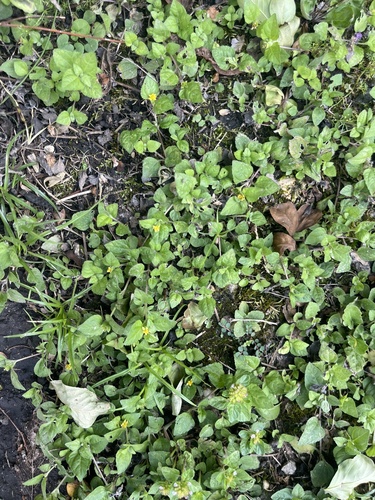
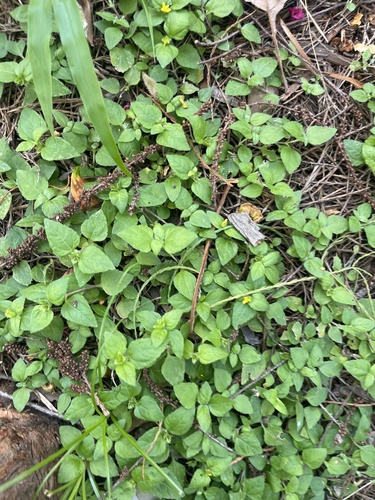
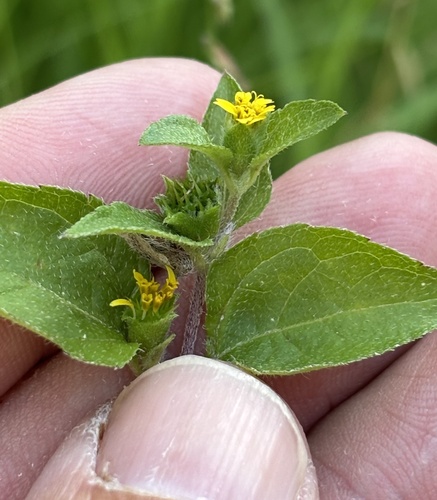
The straggler daisy is a low-growing plant with dark green, often heart-shaped leaves that spread along the ground. It has tiny, bright yellow, sunflower-like flowers with 4-8 short petals, emerging singly from leaf axils. Its small size and creeping habit make it blend easily into lawns.
Category
PlantsRarity
Common
Danger
1/5 · Very low
Snaps
18
It's sometimes called 'lawn flower' because it pops up so commonly in grassy areas!
Its tiny flowers open in the sunshine, looking like miniature versions of big sunflowers!
Straggler daisies are super tough and can even survive being mowed in your lawn.
The plant's scientific name 'vialis' means 'of roads,' reflecting where it often grows.
Straggler daisy can quickly spread its stems to form a dense green mat, helping it cover ground and outcompete other plants.
Straggler daisy has tiny yellow flowers that can bloom almost continuously, ensuring it always attracts pollinators and produces seeds.
Straggler daisy seeds have tiny hooks that allow them to attach to fur or clothes, hitching rides to new locations.
Apis mellifera
visits small yellow flowers for nectar and pollen
Syrphus ribesii
attracted to its simple flower structure for nectar

Bos taurus
grazed by livestock in pastures
Flowering plants are any plants that produce flowers as part of their reproductive cycle.
Cluster flowers are inflorescences where individual flowers are arranged closely together on a common stem.
Everblooming plants produce flowers continuously or in repeated flushes over a long period.
Drought-tolerant plants can survive and flourish in conditions with limited water availability.

Describes plants that are particularly attractive and beneficial to a wide range of pollinating organisms.

This habitat trait indicates species that can coexist with humans in urban and suburban environments, utilizing man-made structures and green spaces.

Describes organisms that transfer pollen, enabling the fertilization and reproduction of plants.
No aliases listed yet.
Danger
1/5 · Very low
Always look but don't pick flowers in parks to help them grow.
The easiest way to identify straggler daisy is to use the Snappit nature identifier app.
5-15 cm
30-90 cm
0.5-1 cm
Year-round
No
None
Perennial
Zoom in to split clusters and explore where this object has been snapped.
Jun 19, 2026
BroadmoorPhoto attribution
(c) Elliot Greiner, some rights reserved (CC BY)
License: CC BY 4.0 ↗
Image may be shown cropped inside the card frame.
Jun 19, 2026
BroadmoorPhoto attribution
(c) Elliot Greiner, some rights reserved (CC BY)
License: CC BY 4.0 ↗
Image may be shown cropped inside the card frame.
Jun 19, 2026
BroadmoorPhoto attribution
(c) Elliot Greiner, some rights reserved (CC BY)
License: CC BY 4.0 ↗
Image may be shown cropped inside the card frame.
Jun 19, 2026
BroadmoorPhoto attribution
(c) Elliot Greiner, some rights reserved (CC BY)
License: CC BY 4.0 ↗
Image may be shown cropped inside the card frame.
Jun 9, 2026
Botanical Research Institute of TexasPhoto attribution
(c) Sam Kieschnick, some rights reserved (CC BY)
License: CC BY 4.0 ↗
Image may be shown cropped inside the card frame.

Texas, US
You might spot Anole, Monarch, and Pinkladies.
View guide →

Louisiana, US
You might spot Brown Anole, White Ibis, and Duck.
View guide →

Texas, US
You might spot Eastern Fox Squirrel and Great-Tailed Grackle.
View guide →
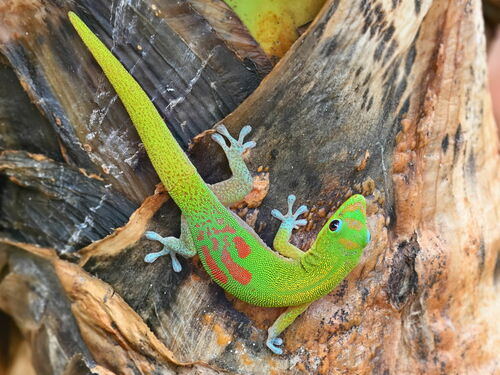
Hawaii, US
You might spot Gold Dust Day Gecko, Sea Turtle, and Brown Anole.
View guide →

Texas, US
You might spot African Elephant, Reticulated Giraffe, and African Lion.
View guide →

Texas, US
You might spot Eastern Fox Squirrel, Duck, and American Robin.
View guide →
Take the discovery with you
Snap it with Snappit to identify it, learn what makes it special, and add the discovery to your collection.







.jpg&width=800)



_001.jpg&width=800)




