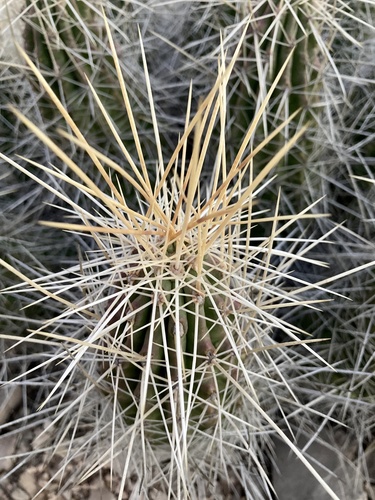


Strawberry Hedgehog Cactus
echinocereus stramineus
The Strawberry Hedgehog Cactus (Echinocereus stramineus) is a striking, multi-stemmed desert succulent native to the Chihuahuan Desert of the southwestern United States and Mexico. Characterized by its dense clusters, a single plant can form massive mounds containing dozens of individual stems. This species is famous for its vibrant, magenta-to-pink blossoms that burst into color during late spring, contrasting beautifully with its straw-colored spines. These spectacular flowers attract a variety of native pollinators, transforming the arid landscape into a lively desert garden. Beyond its visual appeal, this cactus produces edible, strawberry-flavored fruits that have historically served as a valuable food source for both desert wildlife and indigenous peoples. Its resilience in harsh, arid climates makes it a hallmark species of North American deserts and a popular choice for xeriscaping.
Habitat: Found on rocky limestone slopes, gravelly flats, and desert grasslands within arid environments.
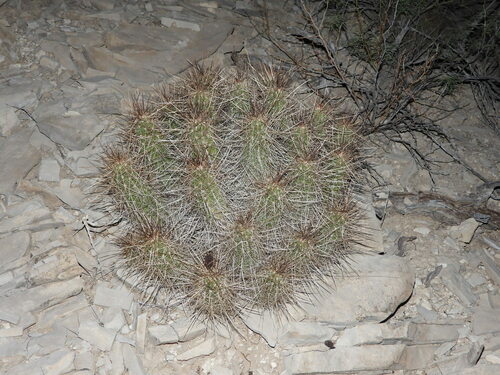
This cactus forms large, rounded mounds of 10 to over 100 tightly packed, cylindrical, pale green stems. Each stem is heavily guarded by long, slightly curved, straw-colored to white spines that can reach up to 5 to 10 centimeters in length, giving the plant a shaggy appearance. In late spring, large, funnel-shaped flowers of brilliant magenta or deep pink open near the stem tips. These are followed by small, spherical, spiny fruits that ripen to a dark red or greenish-red, resembling strawberries.
Category
PlantsRarity
Common
Danger
1/5 · Very low
Snaps
1
A single well-established plant can form a massive dome containing up to several hundred individual stems, measuring over a meter across.
The common name Strawberry Hedgehog refers to both the prickly, hedgehog-like appearance of its spiny stems and its edible, sweet red fruits which taste like strawberries.
The straw-colored spines are so dense that they can almost completely obscure the green, photosynthetic stem underneath, protecting the plant from both intense sun and hungry herbivores.
Using CAM photosynthesis, this plant opens its stomata at night to capture carbon dioxide, drastically reducing water loss during scorching desert days.
Its dense, straw-colored spines reflect intense solar radiation and create a cooling microclimate over the stem surface.
Its ribbed, expandable stems act as natural reservoirs, absorbing and storing massive amounts of water during rare rain events.
As a photosynthetic plant, it produces its own energy using sunlight, water, and carbon dioxide, while absorbing essential minerals from the rocky desert soil.
Diadasia rinconis
The cactus bee visits the magenta flowers to collect pollen and nectar, acting as a primary pollinator.

Campylorhynchus brunneicapillus
The cactus wren feeds on the ripe, sweet red fruits and aids in dispersing the seeds across the desert.

Neotoma albigula
Packrats construct complex middens using the spiny joints of the cactus for protection against predators.
No trait badges are assigned for this object yet.
No aliases listed yet.
Collections for this object will appear here as more themes are added.
Danger
1/5 · Very low
No special safety notes yet.
The easiest way to identify Strawberry Hedgehog Cactus is to use the Snappit nature identifier app.
10-45 cm
1-15 kg
20-50 years
As a photosynthetic plant, it produces its own energy using sunlight, water, and carbon dioxide, while absorbing essential minerals from the rocky desert soil.
Found on rocky limestone slopes, gravelly flats, and desert grasslands within arid environments.
Zoom in to split clusters and explore where this object has been snapped.
Oct 27, 2022
Mariscal MinePhoto attribution
(c) Jared Shorma, some rights reserved (CC BY)
License: CC BY 4.0 ↗
Image may be shown cropped inside the card frame.

Texas, US
You might spot Texas Rainbow Cactus, Ocotillo, and Greater Earless Lizard.
View guide →

Texas, US
You might spot Greater Earless Lizard and Tree Cholla.
View guide →

US
You might spot Mexican Palo Verde, Ocotillo, and Giant Reed.
View guide →

New Mexico, US
You might spot Ocotillo, Texas Mountain Laurel, and Agarita.
View guide →
Take the discovery with you
Snap it with Snappit to identify it, learn what makes it special, and add the discovery to your collection.











.jpg&width=800)



_001.jpg&width=800)




