





tree cholla
Cylindropuntia imbricata
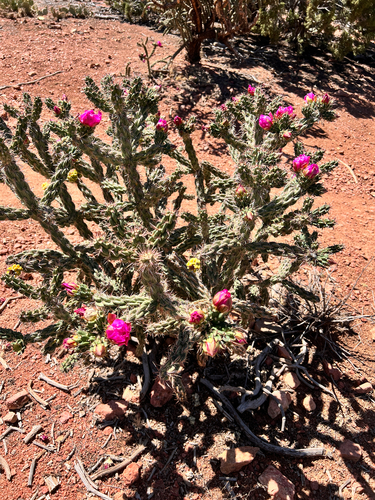
The tree cholla is a unique cactus that looks like a tree with many branches. It has spiky pads that can be green or gray, and it blooms beautiful flowers in the spring.
Habitat: Desert
The tree cholla is a shrubby cactus with striking jointed, cylindrical stems covered in dense, silvery-white spines. Its vibrant magenta or purple flowers stand out against the green-grey stems, giving it a distinctive, thorny, tree-like appearance.
Category
PlantsRarity
Common
Danger
3/5 · Moderate
Snaps
20
Animals like javelinas love to munch on its juicy pads and fruit.
Its fruit looks like tiny green or yellow pineapples!
Its spines have tiny barbs that make them really hard to pull out!
The woody skeleton of old chollas is used to make beautiful crafts.
Tree cholla has very sharp, barbed spines that protect it from hungry animals and help it grab onto anything for support.
Tree cholla can drop stem segments that easily root and grow into new plants, helping it spread quickly.
Tree cholla has a waxy coating on its stems and thick, succulent tissues that store water to survive dry conditions.
Pecari tajacu
Javelinas enjoy eating its juicy fruit and pads.

Toxostoma curvirostre
This bird builds its nests safely within its spiny branches.
Apis mellifera
Honeybees depend on its bright flowers for delicious nectar.

Neotoma albigula
Woodrats gather its fruit and stems for their food.
Flowering plants are any plants that produce flowers as part of their reproductive cycle.
Spring blooming plants produce their flowers during the spring season, often signifying the end of winter and the start of new growth.
Drought-tolerant plants can survive and flourish in conditions with limited water availability.
Succulent plants have thickened, fleshy parts, usually leaves or stems, adapted to store water in arid climates.

Describes plants that are particularly attractive and beneficial to a wide range of pollinating organisms.

Desert habitats are arid regions characterized by extremely low precipitation and often extreme temperatures, supporting specialized flora and fauna.

Possessing sharp, pointed projections or spines on the body or surface.

Describes a species whose presence and role have a disproportionately large effect on its environment.
Danger
3/5 · Moderate
Stay a safe distance from the spines to avoid getting hurt.
The easiest way to identify tree cholla is to use the Snappit nature identifier app.
60-300 cm
60-200 cm
3-5 cm
Late spring to early summer
Yes
Mild
Perennial
Zoom in to split clusters and explore where this object has been snapped.
Jun 16, 2026
Barrio De Analco Historic DistrictPhoto attribution
no rights reserved
License: CC0 1.0 ↗
Image may be shown cropped inside the card frame.

New Mexico, US
You might spot Tree Cholla, Colorado Pinyon, and House Finch.
View guide →

Colorado, US
You might spot Common Starlily and Wholeleaf Paintbrush.
View guide →

Texas, US
You might spot Texas Rainbow Cactus, Ocotillo, and Greater Earless Lizard.
View guide →

New Mexico, US
You might spot Sunflower, Sideoats Grama, and Tree Cholla.
View guide →

New Mexico, US
You might spot Tree Cholla, Mule Deer, and Sacred Datura.
View guide →

New Mexico, US
You might spot Tree Cholla, Colorado Pinyon, and Apache Plume.
View guide →
Take the discovery with you
Snap it with Snappit to identify it, learn what makes it special, and add the discovery to your collection.








.jpg&width=800)



_001.jpg&width=800)




