





Stripe-legged Robber Fly
Dioctria hyalipennis
The Stripe-legged Robber Fly is a cool insect with long legs and big eyes! It loves to catch other bugs in mid-air, making it a great hunter in the garden.
Habitat: Grasslands
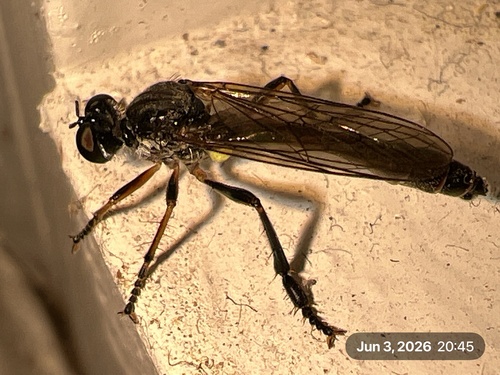
The Stripe-legged Robber Fly is a slender insect with a shiny black body and clear, delicate wings. Its black legs feature distinct bright yellow or orange bands, giving it its striped appearance. It has large, prominent eyes that dominate its head.
Category
InsectsRarity
Common
Danger
1/5 · Very low
Snaps
24
After catching prey, it injects a special digestive fluid to liquefy its meal from the inside!
Its huge eyes have thousands of tiny lenses, making it a super sharp hunter!
Its larvae live in the soil and are also fierce predators, hunting tiny worms and other grubs!
Some species even mimic buzzing bees or wasps, tricking predators into leaving them alone!
Stripe-legged Robber Fly can dart out from a perch to snatch flying prey directly from the air with incredible speed and agility.
Stripe-legged Robber Fly has a strong, dagger-like proboscis that delivers paralyzing venom to quickly subdue its insect victims.
Stripe-legged Robber Fly has large, multifaceted compound eyes that help them track and pinpoint even the fastest moving prey.
A fierce hunter of other insects, catching them right out of the air!
Age differences: Larvae are predators of small soil invertebrates, while adults hunt flying insects.
Musca domestica
Preys on adult flies
Aphis fabae
Eats various small insects
%2C_Parc_de_Woluw%C3%A9%2C_Brussels_(13042792905).jpg&width=800)
Parus major
Preyed upon by birds
Araneus diadematus
Can get caught in webs
Marked with parallel bands or lines of color.
Solitary animals live alone for most of their lives, only interacting with others for mating or parental care.
Aerial creatures spend a significant portion of their lives airborne, utilizing flight for various activities such as hunting, migration, or nesting.
Grassland habitats are terrestrial biomes dominated by grasses and herbaceous plants, supporting a variety of grazing animals.

An ambush predator hunts by patiently waiting and concealing itself, then launching a sudden attack when unsuspecting prey comes within range.

This trait identifies organisms whose diet consists entirely or primarily of animal tissue.

Diurnal animals are primarily active during daylight hours, typically resting or sleeping at night.

This trait identifies organisms that exhibit exceptional swiftness in movement for hunting, escape, or travel.
No aliases listed yet.
Danger
1/5 · Very low
These flies are not dangerous, but it's best to watch them from a distance.
The easiest way to identify Stripe-legged Robber Fly is to use the Snappit nature identifier app.
15-30 mm
8-15 mm
30-60 days
25 km/h
A fierce hunter of other insects, catching them right out of the air!
Grasslands
Ambush
Zoom in to split clusters and explore where this object has been snapped.
Jun 4, 2026
Bedford Village Historic DistrictPhoto attribution
(c) Healthy Yards, some rights reserved (CC BY)
License: CC BY 4.0 ↗
Image may be shown cropped inside the card frame.

Massachusetts, US
You might spot Eastern Cottontail and American Robin.
View guide →

Rhode Island, US
You might spot Common Eastern Bumble Bee and Osprey.
View guide →

Massachusetts, US
You might spot Common Eastern Bumble Bee and Asian Lady Beetle.
View guide →

Rhode Island, US
You might spot Spotted Lanternfly, American Robin, and Duck.
View guide →

Rhode Island, US
You might spot Common Eastern Bumble Bee and Asian Lady Beetle.
View guide →

Massachusetts, US
You might spot Turkey, Garter Snake, and Multiflora Rose.
View guide →
Take the discovery with you
Snap it with Snappit to identify it, learn what makes it special, and add the discovery to your collection.







.jpg&width=800)




