.jpg&width=800)





tall thimbleweed
Anemone virginiana
Tall thimbleweed is a pretty flower that grows tall and has soft, white petals. It loves to bloom in sunny spots and can be found in fields and forests.
Habitat: Fields and forests
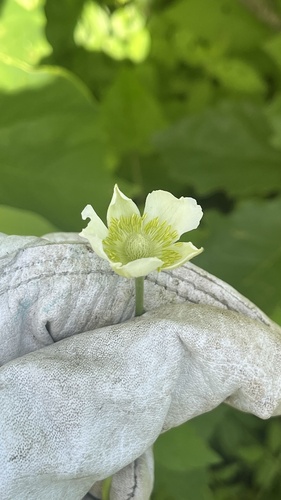
The tall thimbleweed has distinct white to greenish-white flowers, which are actually sepals, not petals. These give way to prominent, egg-shaped, fuzzy green seed heads that resemble a sewing thimble. Its stems are often hairy, supporting deeply lobed, palm-shaped leaves.
Category
PlantsRarity
Common
Danger
1/5 · Very low
Snaps
9
After flowering, a fuzzy green thimble full of seeds forms, which turns silvery-white!
Its genus name, *Anemone*, comes from a Greek word meaning "windflower"!
Native Americans used its strong fibers to make twine and string!
The white "petals" are actually sepals, modified leaves protecting the true flower parts!
Tall thimbleweed develops fuzzy seed heads that help wind carry its seeds far away to spread.
Tall thimbleweed contains irritating compounds that deter many herbivores from eating its foliage.
Tall thimbleweed develops rhizomes that allow it to spread vegetatively and survive harsh conditions.
Apis mellifera
collects nectar and pollen.
Bombus impatiens
gathers nectar from its flowers.
Rhizophagus irregularis
exchanges nutrients with its roots.
Deciduous plants periodically shed all their leaves, typically during autumn or dry seasons.
Flowering plants are any plants that produce flowers as part of their reproductive cycle.
Fragrant flowers emit a pleasant aroma, often to attract pollinators or for defense.
Grassland habitats are terrestrial biomes dominated by grasses and herbaceous plants, supporting a variety of grazing animals.

Describes plants that are particularly attractive and beneficial to a wide range of pollinating organisms.

Forest habitats are terrestrial environments dominated by dense tree cover, supporting a high diversity of plant and animal life.

Describes organisms that transfer pollen, enabling the fertilization and reproduction of plants.
No aliases listed yet.
Danger
1/5 · Very low
Always look but don't touch flowers without asking an adult first.
The easiest way to identify tall thimbleweed is to use the Snappit nature identifier app.
60-120 cm
30-60 cm
2-3 cm
Summer
No
Mild
Perennial
Zoom in to split clusters and explore where this object has been snapped.
Jun 1, 2026
Shaw Nature ReservePhoto attribution
(c) diana schwartz, some rights reserved (CC BY)
License: CC BY 4.0 ↗
Image may be shown cropped inside the card frame.

Missouri, US
You might spot Painted-Cup Paintbrush and Great Spangled Fritillary.
View guide →

Minnesota, US
You might spot Rue Anemone, Bloodroot, and White-Tailed Deer.
View guide →

Illinois, US
You might spot Silver-Spotted Skipper, Eastern Fox Squirrel, and Monarch.
View guide →
Tennessee, US
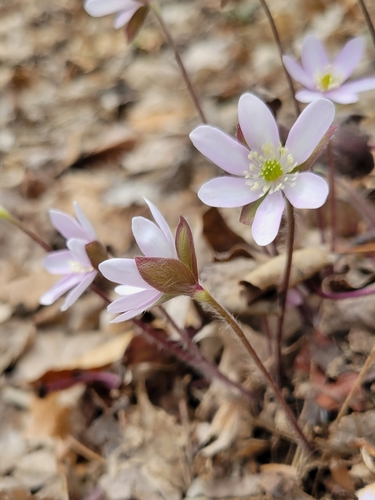
You might spot Sharp-Lobed Hepatica and Northern Slimy Salamander.
View guide →
Indiana, US
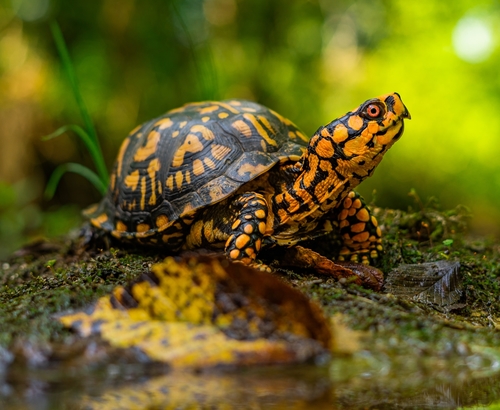
You might spot Eastern Box Turtle, American Beech, and Common Coral Slime.
View guide →
Arkansas, US
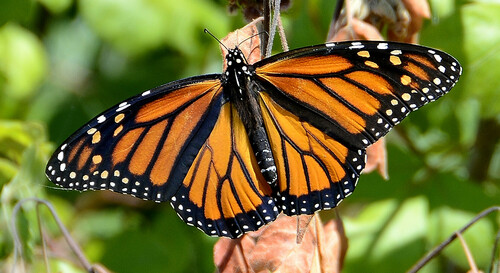
You might spot Monarch, Amur Honeysuckle, and Eastern Gray Squirrel.
View guide →
Take the discovery with you
Snap it with Snappit to identify it, learn what makes it special, and add the discovery to your collection.






.jpg&width=800)


_001.jpg&width=800)




