





Two-spotted Longhorn Bee
Melissodes bimaculatus
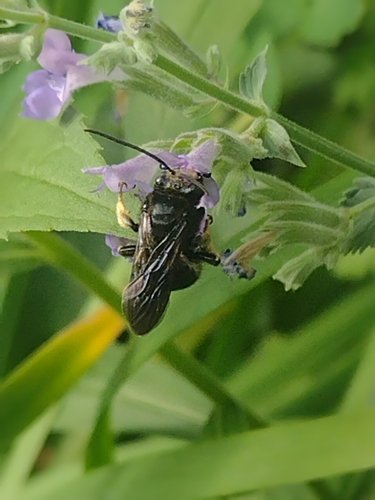
The Two-spotted Longhorn Bee is a small, fuzzy bee with two distinct spots on its back. These friendly bees love to visit flowers and help plants grow by spreading pollen.
Habitat: Grasslands
The Two-spotted Longhorn Bee is a medium-sized bee, typically dark brown to black with a fuzzy, golden-yellow thorax and a black abdomen. Females have two distinct white or pale yellow spots on the abdomen, and males possess exceptionally long, curved antennae that can be as long as their body.
Category
InsectsRarity
Common
Danger
1/5 · Very low
Snaps
14
Its scientific name, 'bimaculatus,' means 'two-spotted,' referring to the female's distinctive markings!
Male longhorn bees have antennae nearly as long as their body!
They are speedy pollinators, loving sunflowers and coneflowers in summer!
Unlike honeybees, each female digs her own cozy underground nest!
Two-spotted Longhorn Bee can carry large loads of pollen because of dense, branched hairs on their hind legs called scopa.
Two-spotted Longhorn Bee can build individual nests by digging burrows in the soil that helps protect their young from predators.
Two-spotted Longhorn Bee has a fuzzy body that helps them efficiently transfer pollen between flowers, aiding in plant reproduction.
They collect sweet nectar for energy and protein-rich pollen to feed their growing young.

Helianthus annuus
Collects nectar and pollen, aiding its reproduction.

Monarda fistulosa
Transfers pollen between flowers, helping the plant spread seeds.
Rudbeckia hirta
Feeds on nectar, carrying pollen from flower to flower.

Argiope aurantia
Often caught in the web of this common garden spider.
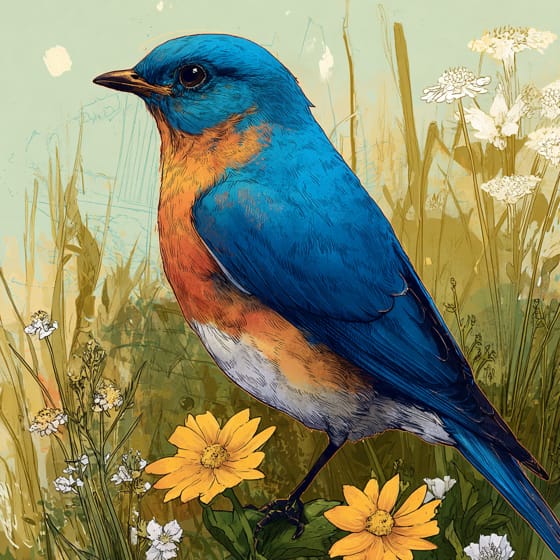
Sialia sialis
A tasty snack for this colorful bird when foraging.
Furry describes animals possessing a dense covering of soft hair or fur.
Marked with spots or patches of a different color.
Social animals live in organized groups, cooperating for survival benefits such as foraging, defense, and raising offspring.
Grassland habitats are terrestrial biomes dominated by grasses and herbaceous plants, supporting a variety of grazing animals.

This trait characterizes organisms whose diet consists entirely or primarily of plant material.

Describes plants that are particularly attractive and beneficial to a wide range of pollinating organisms.

Diurnal animals are primarily active during daylight hours, typically resting or sleeping at night.

Describes organisms that transfer pollen, enabling the fertilization and reproduction of plants.
No aliases listed yet.
Danger
1/5 · Very low
Watch bees from a distance and don't bother them while they are working.
The easiest way to identify Two-spotted Longhorn Bee is to use the Snappit nature identifier app.
15-22 mm
9-14 mm
30-60 days
18 km/h
They collect sweet nectar for energy and protein-rich pollen to feed their growing young.
Grasslands
Foraging
Zoom in to split clusters and explore where this object has been snapped.
Jun 14, 2026
Centennial ArboretumPhoto attribution
(c) Cecil Smith, some rights reserved (CC BY)
License: CC BY 4.0 ↗
Image may be shown cropped inside the card frame.

South Carolina, US
You might spot American Alligator, Anole, and Great Blue Heron.
View guide →

Texas, US
You might spot Anole, Monarch, and Pinkladies.
View guide →
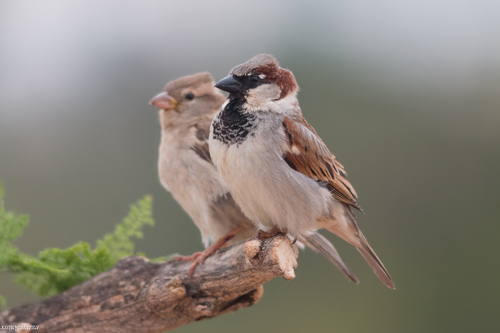
Pennsylvania, US
You might spot House Sparrow, Spotted Lanternfly, and American Robin.
View guide →

South Carolina, US
You might spot Brown Pelican, Boat-Tailed Grackle, and Great Egret.
View guide →

South Carolina, US
You might spot Anole, Asian Lady Beetle, and Gulf Fritillary.
View guide →

US
You might spot Brown Pelican, Boat-Tailed Grackle, and Great Egret.
View guide →
Take the discovery with you
Snap it with Snappit to identify it, learn what makes it special, and add the discovery to your collection.





.jpg&width=800)




