

White-Rumped Shama
copsychus malabaricus
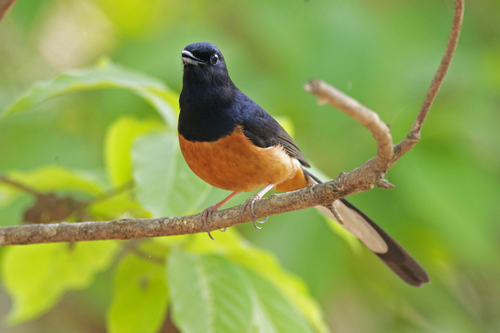
The White-Rumped Shama (Copsychus malabaricus) is a legendary songbird celebrated worldwide for its incredibly rich, flute-like melodies and remarkable mimicry. Native to the dense, shaded understories of South and Southeast Asian forests, this sleek, long-tailed member of the Old World flycatcher family has also captivated aviculturalists for centuries. Despite its shy nature in the wild, its powerful voice makes it unmistakable. Males boast stunning contrasts of glossy blue-black, rich rufous orange, and a signature white patch on the lower back that flares dramatically during flight. Known for their highly territorial behavior, they are fierce defenders of their leafy domains. Their introduction to places like Hawaii has also allowed global birders to experience their captivating presence outside their native range, cementing their status as one of the avian world's most accomplished and beloved vocalists.
Habitat: Found in the dense understory of broadleaf tropical forests, secondary growth woodlands, and bamboo thickets, typically close to the forest floor.
Males are easily identified by their striking plumage, featuring a glossy jet-black head, back, and wings, contrasted sharply by a rich orange-chestnut belly and breast. Their most defining features are an exceptionally long, graduated black tail with white outer feathers and a bright white rump patch that is highly visible when they fly or display. Females are noticeably duller, showing grayish-brown upperparts and a shorter tail. Both sexes possess a slender, dark bill, large dark eyes, and pinkish legs, measuring about 21 to 28 centimeters in total length including the impressive tail.
Category
BirdsRarity
Common
Danger
1/5 · Very low
Snaps
3
Due to their incredible singing abilities, they are highly sought-after in Southeast Asia for competitive songbird contests, where owners vie for massive cash prizes.
The white rump patch that gives the bird its name acts as a visual 'flash' signal to warn family members of approaching predators in dark forest depths.
Their introduction to Oahu, Hawaii, in 1931 was so successful that they are now one of the most common forest songbirds across the main Hawaiian islands.
Possesses an incredibly complex song and can mimic other birds, environmental noises, and even human whistling with flawless accuracy.
Uses its long, expressive tail as a rudder to make sharp, precise turns while darting through dense tropical foliage and tangled vines.
Performs dynamic visual displays by raising and fanning its long tail to expose white feathers, serving as a warning to rival males.
Primarily feeds on a wide variety of insects and other terrestrial invertebrates, supplemented occasionally by berries or small fruits.
Accipiter trivirgatus
The Crested Goshawk is a forest-dwelling bird of prey that actively hunts shamas in the dense canopy.
Copsychus saularis
Competes for nesting cavities, territory, and insect resources in overlapping woodland edges.
No trait badges are assigned for this object yet.
No aliases listed yet.
Collections for this object will appear here as more themes are added.
Danger
1/5 · Very low
No special safety notes yet.
The easiest way to identify White-Rumped Shama is to use the Snappit nature identifier app.
21+ cm
30+ cm
0.028+ kg
5+ years
35 km/h
Primarily feeds on a wide variety of insects and other terrestrial invertebrates, supplemented occasionally by berries or small fruits.
Found in the dense understory of broadleaf tropical forests, secondary growth woodlands, and bamboo thickets, typically close to the forest floor.
Zoom in to split clusters and explore where this object has been snapped.

Hawaii, US
You might spot Brown Anole, Gold Dust Day Gecko, and Red-Crested Cardinal.
View guide →

Hawaii, US
You might spot Koster's Curse and White-Rumped Shama.
View guide →
Hawaii, US
You might spot Gold Dust Day Gecko, Sea Turtle, and Brown Anole.
View guide →

Hawaii, US
You might spot White-Rumped Shama, Koster's Curse, and Red Button Ginger.
View guide →

Hawaii, US
You might spot Spathoglottis Plicata, Thatch Screwpine, and Brown Anole.
View guide →
Take the discovery with you
Snap it with Snappit to identify it, learn what makes it special, and add the discovery to your collection.







.jpg&width=800)









