





Woodland Pinkroot
spigelia marilandica
The Woodland Pinkroot has beautiful pink flowers that attract butterflies! It grows in shady spots of the forest and is fun to spot among the green leaves.
Habitat: Woodland areas with rich, moist soil, often near streams or shaded spots.
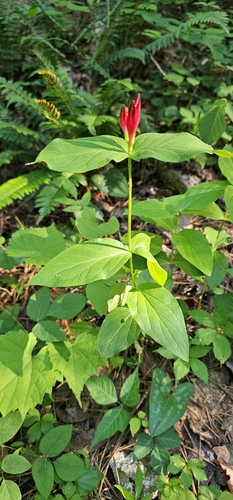
The Woodland Pinkroot has striking, upright clusters of tubular, red-orange flowers with bright yellow insides that create a vibrant contrast. Its lance-shaped, dark green leaves are arranged in opposite pairs along the stems. This combination makes it stand out in shady woodland areas.
Category
PlantsRarity
Common
Danger
0/5 · No known danger
Snaps
15
Despite its beauty, eating any part of this plant can make you very, very sick!
Hummingbirds love to visit its vibrant red-orange flowers for a sweet sip of nectar.
It's the only species of its kind, *Spigelia*, found naturally in the United States!
Its seeds can be flung several feet away when the seed pods burst open!
Woodland Pinkroot has bright red, tubular flowers that act like a beacon, guiding pollinators straight to its sweet nectar.
This plant can launch its seeds away from itself when pods burst, helping them find new places to grow.
Woodland Pinkroot contains special chemicals in its roots that make it taste bad or even toxic, deterring hungry animals.
Apis mellifera
Collects nectar and pollen from its bright flowers.

Archilochus colubris
Sips nectar from its tubular red blooms.
Bombus impatiens
Gathers pollen and nectar from the flowers.
Perennial plants live for more than two years, typically returning to grow and bloom each year from their roots.
Colorful describes organisms or objects displaying a wide range of bright and distinct colors.
This trait characterizes organisms whose diet consists entirely or primarily of plant material.
Forest habitats are terrestrial environments dominated by dense tree cover, supporting a high diversity of plant and animal life.

Describes organisms that transfer pollen, enabling the fertilization and reproduction of plants.
Danger
0/5 · No known danger
No special safety notes yet.
The easiest way to identify Woodland Pinkroot is to use the Snappit nature identifier app.
30-60 cm
30-45 cm
2.5-5 cm
Spring to summer
No
Moderate
Perennial
Zoom in to split clusters and explore where this object has been snapped.
May 3, 2026
Brierfield FurnacePhoto attribution
(c) Darrell Ragland, some rights reserved (CC BY)
License: CC BY 4.0 ↗
Image may be shown cropped inside the card frame.

Missouri, US
You might spot Painted-Cup Paintbrush and Great Spangled Fritillary.
View guide →

Mississippi, US
You might spot Southern White Rhinoceros, Zebra, and Tiger.
View guide →

Alabama, US
You might spot Eastern Gray Squirrel and Northern Mockingbird.
View guide →

Alabama, US
You might spot Anole and Eastern Carpenter Bee.
View guide →

Alabama, US
You might spot Red Buckeye, Gray Ratsnake, and Sycamore Tussock Moth.
View guide →

Tennessee, US
You might spot Black Maidenhair Fern and Great Blue Heron.
View guide →
Take the discovery with you
Snap it with Snappit to identify it, learn what makes it special, and add the discovery to your collection.








.jpg&width=800)



_001.jpg&width=800)




