

Conch Shell
Snap a shell from the beach and we'll compare its opening, hinge, ribs and shape. Then meet the animal that made it in the Snappit field guide.
Identify and collect rocks, shells and fossils with your phone.


Drag a photo here, or choose one below.
JPG, PNG or WebP · Up to 10 MB

Set an empty shell on a plain background and show the opening or hinge, with a coin for scale. Leave occupied shells and living animals where you found them.




Compare the suggested name with what you see in your photo. Then open its field-guide entry for fun facts and look-alikes to rule out.

Browse the field guide here, or save your finds as collectible cards in the Snappit app. Build collections and learn something new together.
From the Snappit field guide: whelks, cockles, scallops and the other beach treasures kids fill their pockets with. Open a card for a closer look.
Look past the shell's color to how it's built. Is there a spiral with an opening, a hinge where two halves met, or a single cap? Ribs and proportions stay useful long after waves have worn the surface smooth, and the opening usually tells you more than the decorated outer side.

On a spiral shell, the opening (the aperture) often tells you more than color does. Is it long and narrow, rounded, flared, toothed, or drawn out into a short canal? Those details separate the main shell groups even when the surface is faded or chipped.

If the shell has two matching halves, or you found one loose half, check the hinge along the top edge where the halves joined. Tiny hinge teeth, sockets or a broad plate help separate clams, mussels, oysters and cockles.

Shell collectors call the raised pattern on a shell its sculpture. Look for ribs fanning out from the top, rings running around the shell, fine grooves, knobs or a crosshatched texture. Even heavily bleached shells usually keep these patterns after the color bands are gone.

Size matters, because a young shell can look like a smaller species. Put a coin or ruler next to it for scale. Also note whether you found it on an open coast, a sheltered bay, an estuary, a river or a lake, then compare with a regional guide.
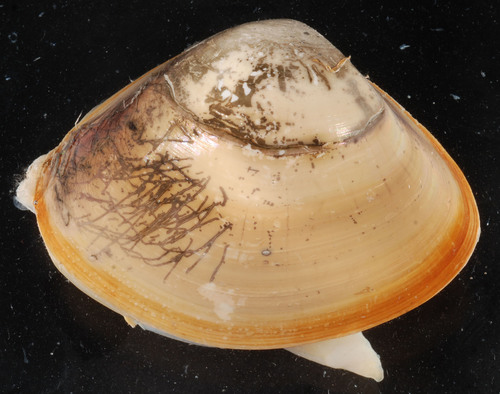
Compare real field-guide examples: Conch Shell · Cone Snail · Quahog Clam

A gastropod shell is made by one snail-like animal and usually coils or forms a cap. A bivalve shell comes from a two-shelled animal such as a clam, mussel or cockle. One loose half can look incomplete, so check for a hinge edge and the overall shape of each side.

Limpets make a cap with a wide opening underneath and no obvious spiral tower. Most snail shells coil, with the opening off to one side. A cap shape alone won't give you the species, so compare the opening, ribs and outline, and photograph occupied shells without moving them.

A shell fragment often keeps curved growth lines, ribs, a pearly inner surface, or layers along a broken edge. Stones can mimic one of those, so look for several together. Pieces that keep part of a hinge or spiral opening give far better clues than a smooth middle chip.

First decide whether you have a spiral shell or half of a two-part shell. On a spiral shell, look at the spire (the stacked turns above the opening) and the body whorl (the last and biggest turn). A tall, pointed spire points to different candidates than a low, swollen shell with a huge opening. Then check the outer lip: is it thin, thickened, flared or lined with small teeth? These details often survive even after the beach has scrubbed away most of the pattern and shine.
With bivalves, the most useful view is often the inside of the top edge. That's where the hinge sits, and its tiny teeth or sockets can tell you more than the outside color. Is the shell evenly rounded like a cockle, longer than tall like a mussel, or wedge-shaped with a straighter bottom edge? The beak, the oldest raised bump near the hinge, also helps you work out front from back when a loose half looks confusing.

Beach shells are often sun-bleached, wave-worn or broken, so identifying them is more about structure than pattern. A worn white shell may still show spiral grooves, growth rings, hinge teeth or a thickened lip. Broken pieces help if the opening, hinge, tip or rib pattern survives, but a flat middle fragment is tough because many unrelated shells break into similar curves. Freshwater shells can fool you too: some river and lake snails and mussels look like small marine shells, so compare your find with a guide for your region and water type.
If a hermit crab has moved in, keep the shell ID separate from the crab ID. Hermit crabs borrow empty snail shells and will use several kinds, depending on what's around. Leave an occupied shell where it is and snap it as you found it. Even with a clear view, shell shape usually narrows things to a group first; closely related species can share nearly the same outline, especially once they're worn.
For a spiral shell, photograph the opening from the side. For a bivalve half, show the inside top edge so the hinge teeth or plate are visible.

Skip extreme close-ups that crop off the tip or edges. A full-shell photo with a coin or ruler beside it keeps the shell's proportions honest.

The upload takes one JPG, PNG or WebP image up to 10MB, so pick your clearest shot. Use any extra views to choose it, not to upload.
Look at structure instead of pattern. The opening shape, hinge, rib strength, lip thickness and overall outline usually survive bleaching far better than color bands. A plain white shell can still be distinctive if your photo clearly shows those hard parts.
Often, yes, if the piece you have includes the opening, hinge, pointed tip or a strong rib pattern. Flat fragments from the middle are much harder, because lots of different shells break into similar curved pieces.
Start with the opening. Is it wide or narrow, smooth or toothed, and does it end in a short canal or notch? Then check how tall the spire is and how big the final whorl is. Those features sort shell groups quickly.
Check the shape and ribs. Cockles are usually rounded and strongly ribbed, with ribs fanning out from the beak, while many clams are smoother or more oval. A clear view of the inside hinge often tells you more than the outside alone.
Sometimes, but there's overlap. Freshwater mussels and snails can look like marine shells in simple outline, especially once they're worn. Where you found it is a big clue, so compare your result with a guide for your region and water type.
No. The hermit crab is just the current tenant, not the snail that built the shell. Snap the shell as you found it and leave it in place; never pull a crab out or move an occupied shell.
Yes. Snappit for iPhone and Android identifies shells, crabs, fish, birds, plants and more from one photo, with short facts kids can follow. Each find becomes a collectible card with a rarity tier in your family's private collection, and park and aquarium guides come with checklists of what to spot. No ads, no chat; it's free to download with free daily IDs, and an optional subscription unlocks unlimited snaps.
No, the upload takes one photo and has no location or notes field. If you took several views, pick the single clearest one showing the shell's opening, hinge or full outline, and keep the beach or river in mind when you compare results.
The Snappit appAges 4+ · No ads
Take what you learn here into Snappit and turn your next walk or day out into a shared adventure.
Save your discoveries as collectible cards in the app, with rarity tiers and themed collections to explore.
Short, friendly facts give young readers something to notice, ask about, and remember. The app is made for ages 4 and up, without ads.
Discover new collection themes, try the daily discovery, and earn badges as you keep exploring together.


Open a place guide to see its species checklist and plan what to look for on your next visit.
Explore place guides →