





azure bluet
Houstonia caerulea
The azure bluet is a small, pretty flower that blooms in spring. Its bright blue petals look like tiny stars in the grass, making nature even more beautiful!
Habitat: Grasslands
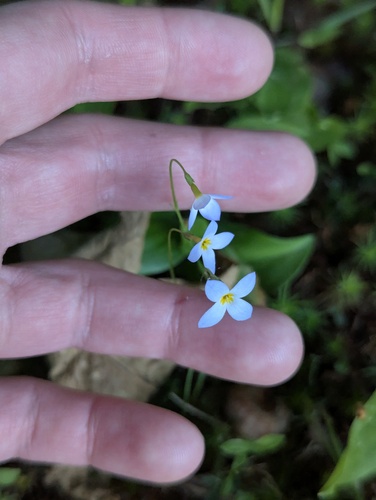
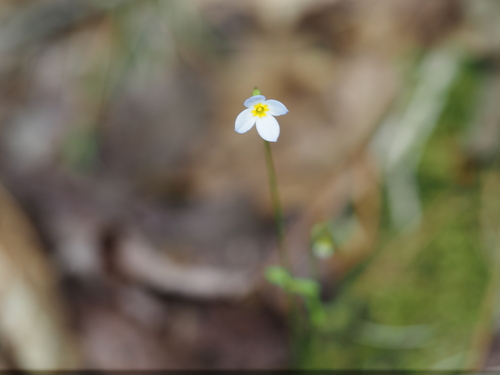
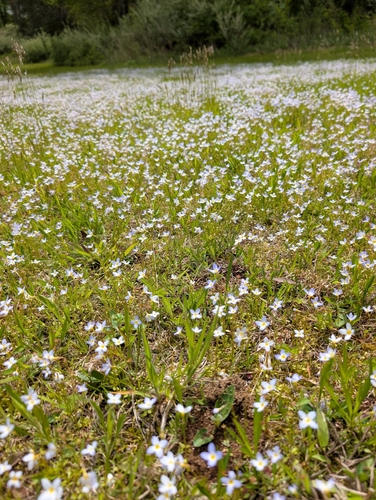
The azure bluet has delicate, star-shaped flowers, typically a pale sky-blue to almost white, with a bright yellow center. Its tiny blooms sit atop slender stems, forming a low carpet of color over mossy ground, contrasting with its deep green leaves.
Category
PlantsRarity
Common
Danger
1/5 · Very low
Snaps
102
Each little flower has four perfect petals, making it look like a tiny cross or propeller!
Find them in groups, and they can make the ground look like a scattered blue sky!
Its petals can be so pale blue they sometimes look almost pure white, like tiny stars!
These tiny flowers are sometimes called 'Quaker Ladies' because of their modest appearance!
Azure bluet has two different flower forms on separate plants, ensuring better mixing of genetic traits when insects visit.
Azure bluet can spread its roots and stems to form dense mats, helping it outcompete other small plants and retain moisture.
The azure bluet blooms very early in spring, giving it a head start on attracting the first active insect pollinators.
Apis mellifera
Gathers nectar and pollen from its tiny flowers.

Bombus impatiens
Visits bluet flowers for their sweet nectar.
Lasioglossum vierecki
A small native bee that collects pollen and nectar.
Flowering plants are any plants that produce flowers as part of their reproductive cycle.
Ornamental plants are cultivated primarily for their aesthetic appeal, enhancing landscapes and gardens with their attractive foliage, flowers, or form.
Cluster flowers are inflorescences where individual flowers are arranged closely together on a common stem.
Spring blooming plants produce their flowers during the spring season, often signifying the end of winter and the start of new growth.

Colorful describes organisms or objects displaying a wide range of bright and distinct colors.

Grassland habitats are terrestrial biomes dominated by grasses and herbaceous plants, supporting a variety of grazing animals.

Describes plants that are particularly attractive and beneficial to a wide range of pollinating organisms.
No aliases listed yet.
Danger
1/5 · Very low
Always look but don't pick flowers, so everyone can enjoy their beauty!
The easiest way to identify azure bluet is to use the Snappit nature identifier app.
5-20 cm
5-10 cm
0.5-1.5 cm
Spring to early summer
No
None
Perennial
Zoom in to split clusters and explore where this object has been snapped.
May 30, 2026
East Granby Historic DistrictPhoto attribution
no rights reserved
License: CC0 1.0 ↗
Image may be shown cropped inside the card frame.
May 28, 2026
Days Ferry Historic DistrictPhoto attribution
(c) Clay Gibbons, some rights reserved (CC BY)
License: CC BY 4.0 ↗
Image may be shown cropped inside the card frame.
May 15, 2026
Haddam Center Historic DistrictPhoto attribution
(c) Anthony, some rights reserved (CC BY)
License: CC BY 4.0 ↗
Image may be shown cropped inside the card frame.

Rhode Island, US
You might spot Common Mugwort, Duck, and Azure Bluet.
View guide →

Rhode Island, US
You might spot Common Eastern Bumble Bee and Osprey.
View guide →

Connecticut, US
You might spot Striped Wintergreen and Common Eastern Bumble Bee.
View guide →

Massachusetts, US
You might spot Eastern Newt, Purple Pitcher Plant, and Hobblebush.
View guide →

Connecticut, US
You might spot Bold Jumping Spider and American Tuliptree.
View guide →

Pennsylvania, US
You might spot Large Yellow Underwing and Eastern Black Carpenter Ant.
View guide →
Take the discovery with you
Snap it with Snappit to identify it, learn what makes it special, and add the discovery to your collection.







.jpg&width=800)



_001.jpg&width=800)




