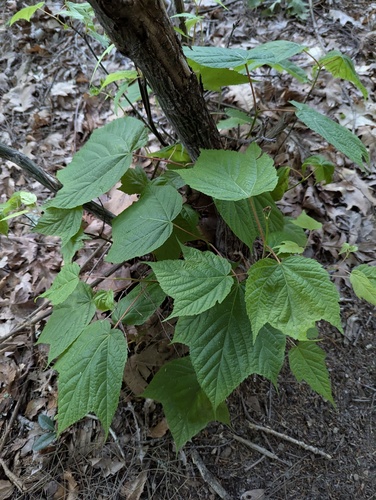



Eastern White Pine

The East Granby Historic District showcases Connecticut's rich agricultural and architectural past.
The East Granby Historic District showcases Connecticut's rich agricultural and architectural past.
Nestled in the picturesque rolling farmlands east of the Talcott Range, the East Granby Historic District is a expansive, predominantly rural and agricultural area spanning approximately two square miles in East Granby, Connecticut. This nationally recognized district, listed on the National Register of Historic Places in 1988, is celebrated for retaining one of the state's highest concentrations of surviving 18th and early 19th-century farmsteads and a remarkably unaltered historical landscape. It serves as a living testament to the evolution of rural settlement and subsistence farming in Connecticut.
Visitors can immerse themselves in the district's charm by exploring its 56 contributing resources, including a wealth of historic houses, barns, and tobacco sheds. Architectural styles range from classic Colonial and Georgian to elegant Greek Revival and more vernacular 19th-century farmhouses, offering a visual timeline of the region's building traditions. Notable structures include the Isaak Gillett House and the Ezekiel Phelps, Jr., House, both exemplary 18th-century five-bay, center-chimney colonials, and the architecturally significant East Granby Congregational Church, a Greek Revival masterpiece crafted from ashlar granite. The area's enduring agrarian character is further highlighted by its open fields and ancient stone walls, which define historic property boundaries.
A journey through the East Granby Historic District offers a unique opportunity to step back in time and appreciate the enduring beauty of New England's agricultural heritage. It's a memorable destination for anyone seeking to understand the architectural and social fabric of early America, providing a tranquil and educational experience amidst scenic rural vistas. The well-preserved farmsteads and the overall pastoral setting make it a truly special place to explore and connect with history. Take the ultimate field guide with you: use the Snappit app to identify birds, plants, and animals on your trip.
The area now encompassing the East Granby Historic District, originally known as Turkey Hills, was first settled in 1715 as part of Simsbury. The community grew, establishing the Turkey Hills Ecclesiastical Society in 1736, reflecting its increasing self-sufficiency. In 1786, it became a section of the newly formed town of Granby, and later, in 1858, East Granby was officially incorporated as a separate town, solidifying its identity and status. Throughout much of its history, East Granby's economy was deeply rooted in agriculture, shifting from subsistence farming to more market-oriented practices, including tobacco cultivation, by the mid-19th century. The district's importance in illustrating these patterns of rural development and its distinctive architectural heritage led to its listing on the National Register of Historic Places in 1988.
Take a scenic drive or walk along the primary roads (North Main Street, South Main Street, and East Street) to observe the diverse architectural styles of the historic homes. Pay attention to the expansive open fields, particularly north of Route 20, and the historic stone walls that crisscross the landscape.
While beautiful year-round, warmer months are ideal for walking and photography. Winter can offer a serene, snow-covered landscape, but some areas might be less accessible.
As a historic district encompassing public roads, accessibility will vary. Driving through the district is generally accessible. Sidewalks may not be continuous, and pedestrian exploration might involve uneven terrain in some areas.
The numerous 18th and 19th-century farmsteads along North Main Street, South Main Street, and East Street are central to the district. Don't miss the distinct Greek Revival architecture of the East Granby Congregational Church, and keep an eye out for well-preserved barns and tobacco sheds that speak to the area's agricultural past.
Each card links to a full Explore page with photos, traits, and fun facts.
Start with the big picture, then zoom in to explore individual wildlife observations around this place.
Plan your route
The district covers a substantial area, so consider driving the main roads (North Main Street, South Main Street, and East Street) to see the most significant structures.
Respect private property
Most historic homes are private residences, so admire them from public roads and areas.
Bring a camera
The preserved architecture and scenic rural landscape offer numerous photographic opportunities.
Allow for spontaneous stops
The charm of the district lies in its continuous historical fabric, so be prepared to pull over safely to appreciate specific farmsteads or views.
Visit the East Granby Historical Society: While not within the district itself, the Historical Society can offer additional context and resources for understanding the area's past.
Combine with other local attractions
Consider pairing your visit with other historical sites or natural areas in East Granby and the surrounding towns for a fuller experience.
May 30, 2026
Photo attribution
no rights reserved
License: CC0 1.0 ↗
Image may be shown cropped inside the card frame.
May 30, 2026
Photo attribution
no rights reserved
License: CC0 1.0 ↗
Image may be shown cropped inside the card frame.
May 30, 2026
Photo attribution
no rights reserved
License: CC0 1.0 ↗
Image may be shown cropped inside the card frame.
May 30, 2026
Photo attribution
no rights reserved
License: CC0 1.0 ↗
Image may be shown cropped inside the card frame.
May 30, 2026
Photo attribution
no rights reserved
License: CC0 1.0 ↗
Image may be shown cropped inside the card frame.

Maryland, US
You might spot White-Tailed Deer and Eastern Gray Squirrel.
View guide →
.jpg)
District of Columbia, US
You might spot Eastern Gray Squirrel, Duck, and House Sparrow.
View guide →

Illinois, US
You might spot American Robin, Canada Goose, and House Sparrow.
View guide →

Virginia, US
You might spot Spotted Lanternfly and Northern Cardinal.
View guide →
Take the discovery with you
Identify the wildlife you spot, learn as you go, and keep a collection of the adventure.