





bluebead lily
Clintonia borealis
The bluebead lily is a beautiful flower that grows in shady forests. Its bright blue berries are a special treat for birds and other animals!
Habitat: Forests
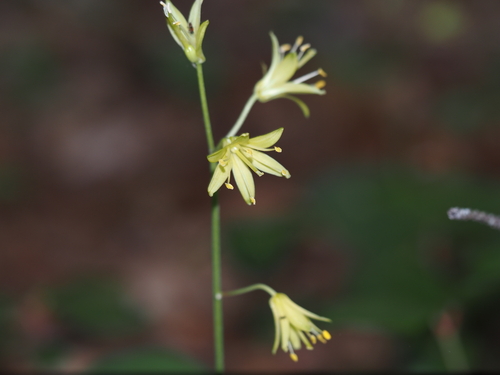
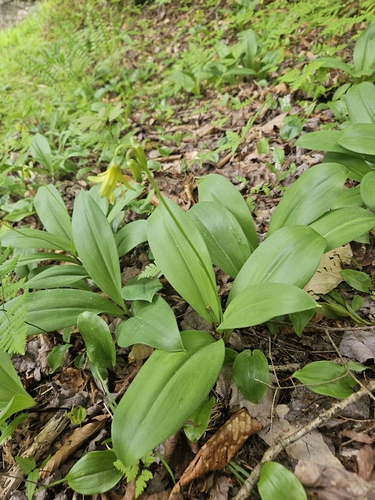
The bluebead lily has a single stem with glossy, broad, lance-shaped basal leaves and small, yellowish-green, bell-shaped flowers. Its most striking feature is its cluster of bright, iridescent blue berries, which look like tiny beads.
Category
PlantsRarity
Common
Danger
1/5 · Very low
Snaps
37
Even though it's called a lily, it's actually part of a different plant family!
Its name comes from its incredible, shiny blue berries, which are truly unique!
Some people call it 'corn lily' because its leaves look like small corn sprouts.
This hardy plant can live for decades, returning to the same spot every spring!
Bluebead lily has brilliant blue berries that attract birds to help spread its seeds far and wide!
Bluebead lily can thrive in the cool, shady understory of forests, perfect for growing where other plants struggle.
Bluebead lily has rhizomes (underground stems) that help it spread and form new clumps of plants.
Bombus impatiens
Attracted to the yellow-green flowers

Turdus migratorius
Consumes berries, helping disperse seeds

Odocoileus virginianus
Browses on the plant's leaves
Deciduous plants periodically shed all their leaves, typically during autumn or dry seasons.
Flowering plants are any plants that produce flowers as part of their reproductive cycle.
Shade tolerant plants are adapted to grow and thrive in areas with low light levels, requiring less direct sunlight.
Spring blooming plants produce their flowers during the spring season, often signifying the end of winter and the start of new growth.

Fruit-bearing plants produce fruits, which are the mature ovaries of flowering plants containing seeds.

Edible plants are those parts of a plant that are considered safe for human consumption.

Describes plants that are particularly attractive and beneficial to a wide range of pollinating organisms.

Forest habitats are terrestrial environments dominated by dense tree cover, supporting a high diversity of plant and animal life.
No aliases listed yet.
Danger
1/5 · Very low
Do not eat any berries you find without asking an adult first!
The easiest way to identify bluebead lily is to use the Snappit nature identifier app.
15-40 cm
10-20 cm
1-2 cm
Late spring to early summer
No
Mild
Perennial
Zoom in to split clusters and explore where this object has been snapped.
May 28, 2026
Days Ferry Historic DistrictPhoto attribution
(c) Clay Gibbons, some rights reserved (CC BY)
License: CC BY 4.0 ↗
Image may be shown cropped inside the card frame.
May 28, 2026
Plainfield Village Historic DistrictPhoto attribution
(c) Charlie Wanzer, some rights reserved (CC BY)
License: CC BY 4.0 ↗
Image may be shown cropped inside the card frame.

Massachusetts, US
You might spot Eastern Newt, Purple Pitcher Plant, and Hobblebush.
View guide →

Maine, US
You might spot American Bullfrog and Three-Toothed Cinquefoil.
View guide →

New York, US
You might spot American Toad and Intermediate Wood Fern.
View guide →

US
You might spot Pink Lady's Slipper and Canada Mayflower.
View guide →

New Hampshire, US
You might spot Eastern White Pine and White-Tailed Deer.
View guide →

Maine, US
You might spot Ghost Pipe, Pink Lady's Slipper, and Bluebead Lily.
View guide →
Take the discovery with you
Snap it with Snappit to identify it, learn what makes it special, and add the discovery to your collection.






.jpg&width=800)



_001.jpg&width=800)


