





Cape May Warbler
Setophaga tigrina
The Cape May Warbler is a small, colorful bird that loves to sing! It has bright yellow and green feathers and can be found flitting around trees in search of tasty insects.
Habitat: Forests
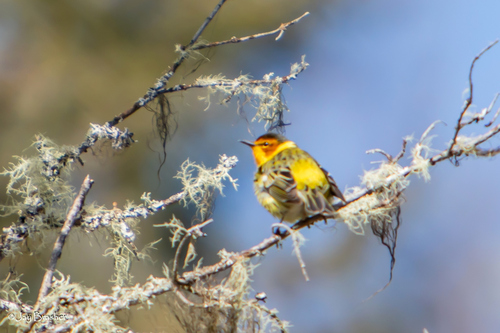
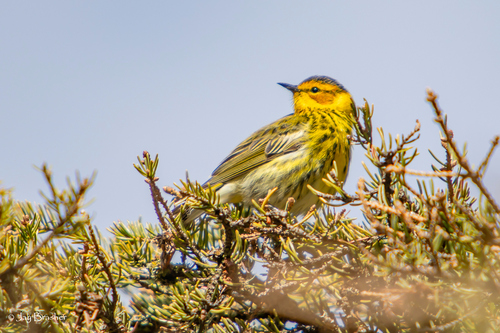
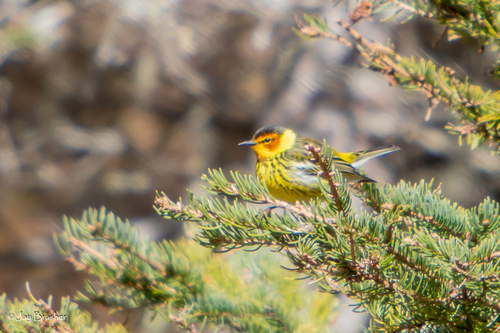
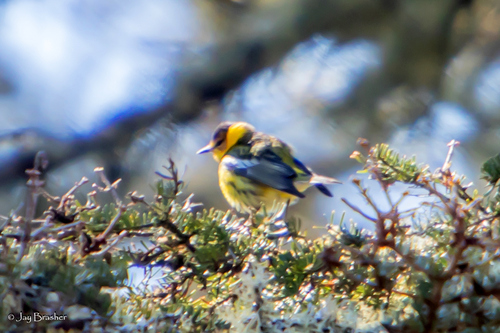
The Cape May Warbler male has a distinctive chestnut cheek patch, a vibrant yellow throat and breast with heavy black streaks, and bright olive-green upperparts. Two white wing bars contrast with dark wings, making it easily identifiable.
Category
BirdsRarity
Common
Danger
1/5 · Very low
Snaps
9
During their incredible migration, these small birds can fly for hours across vast stretches of open ocean!
One of the few warblers that regularly sips nectar, behaving almost like a tiny hummingbird!
The Cape May Warbler is sometimes called 'Spruce Budworm Warbler' because they love to eat this specific insect.
They get their scientific name, *tigrina*, because their bold, streaky chest resembles a tiger's stripes!
Cape May Warbler has a special tubular tongue that helps them sip nectar from flowers like a tiny straw.
Cape May Warbler can hang upside down on branches to find hidden insects because of its agile feet.
Cape May Warbler can fly thousands of kilometers between its breeding and wintering grounds, showing incredible endurance.
Primarily eats insects like caterpillars and spiders, but also sips sweet flower nectar and enjoys berries.
Feathered describes animals, primarily birds, possessing a covering of feathers.
Aerial creatures spend a significant portion of their lives airborne, utilizing flight for various activities such as hunting, migration, or nesting.
Singing animals produce complex vocalizations, often for purposes of attracting mates, defending territory, or communicating within their species.
Colorful describes organisms or objects displaying a wide range of bright and distinct colors.

This trait identifies organisms whose diet primarily consists of insects and other small invertebrates.

Forest habitats are terrestrial environments dominated by dense tree cover, supporting a high diversity of plant and animal life.

Diurnal animals are primarily active during daylight hours, typically resting or sleeping at night.

Migratory animals undertake seasonal movements from one region to another, typically in response to changes in climate or food availability.

Describes organisms that transfer pollen, enabling the fertilization and reproduction of plants.
No aliases listed yet.
Danger
1/5 · Very low
Always watch birds from a distance and be quiet so you don't scare them away.
The easiest way to identify Cape May Warbler is to use the Snappit nature identifier app.
11-13 cm
19-22 cm
0.008-0.015 kg
3-8 years
40 km/h
Primarily eats insects like caterpillars and spiders, but also sips sweet flower nectar and enjoys berries.
Forests
Zoom in to split clusters and explore where this object has been snapped.
May 13, 2026
Tobin Harbor Historic DistrictPhoto attribution
(c) Jay Brasher, some rights reserved (CC BY)
License: CC BY 4.0 ↗
Image may be shown cropped inside the card frame.
May 13, 2026
Tobin Harbor Historic DistrictPhoto attribution
(c) Jay Brasher, some rights reserved (CC BY)
License: CC BY 4.0 ↗
Image may be shown cropped inside the card frame.
May 13, 2026
Tobin Harbor Historic DistrictPhoto attribution
(c) Jay Brasher, some rights reserved (CC BY)
License: CC BY 4.0 ↗
Image may be shown cropped inside the card frame.
May 13, 2026
Tobin Harbor Historic DistrictPhoto attribution
(c) Jay Brasher, some rights reserved (CC BY)
License: CC BY 4.0 ↗
Image may be shown cropped inside the card frame.

Virginia, US
You might spot Spotted Lanternfly and Northern Cardinal.
View guide →

Michigan, US
You might spot Yellow Lady's Slipper and Ring-Billed Gull.
View guide →

Michigan, US
You might spot Prairie Trillium, Large White Trillium, and Wild Geranium.
View guide →

Ohio, US
You might spot Prothonotary Warbler and Bald Eagle.
View guide →

US
You might spot Great Barracuda, Gray Snapper, and Atlantic Sergeant Major.
View guide →

Michigan, US
You might spot Yellow-Rumped Warbler, Canadian Bunchberry, and Moose.
View guide →
Take the discovery with you
Snap it with Snappit to identify it, learn what makes it special, and add the discovery to your collection.




.jpg&width=800)


.jpg&width=800)






