





Carolina Springbeauty
Claytonia caroliniana
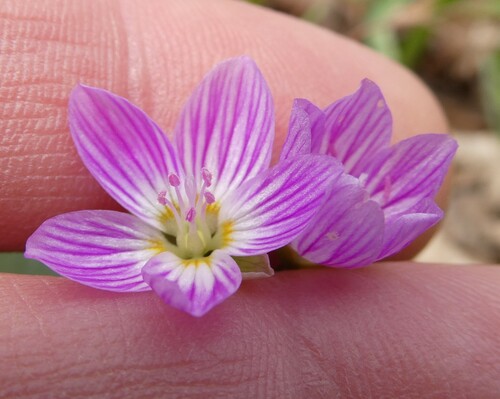
Carolina Springbeauty is a lovely little flower that blooms in spring. Its pink and white petals look like tiny stars and are often found in shady places.
Habitat: Forests
The Carolina Springbeauty is a small, delicate plant with slender stems and narrow, grass-like leaves. Its five-petaled flowers are typically white or pale pink, often adorned with distinctive darker pink or purple veins. These pretty stripes make it stand out against the forest floor.
Category
PlantsRarity
Common
Danger
1/5 · Very low
Snaps
11
Ants are super helpful! They carry the seeds away, helping new plants grow far.
Each little flower only opens when the sun is out, closing tightly on cloudy days!
Its yummy corm (like a tiny potato!) was a survival food for Native Americans!
This 'spring ephemeral' disappears completely by summer, only to return next year!
Carolina Springbeauty stores energy in an edible underground corm (like a tiny potato!) that helps it sprout super early in spring.
It can bloom before trees get their leaves, helping it soak up precious sunlight on the forest floor.
Carolina Springbeauty has delicate pink veins on its petals that help guide insects directly to its nectar and pollen.
Andrena claytoniae
Specialist bee relies on its pollen
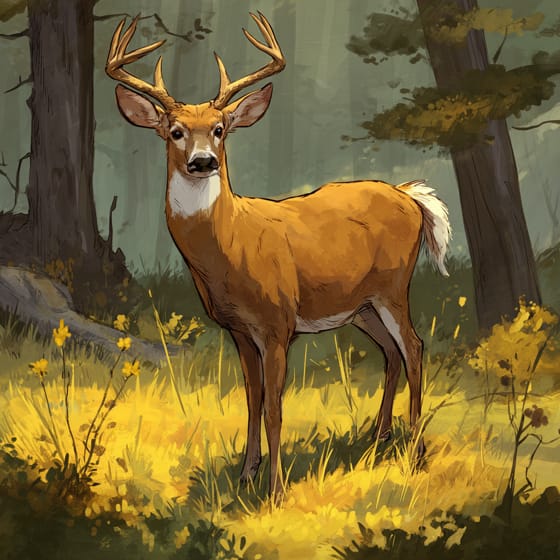
Odocoileus virginianus
Deer browse on its leaves and flowers
Apis mellifera
Generalist pollinator collects its nectar
Flowering plants are any plants that produce flowers as part of their reproductive cycle.
Shade tolerant plants are adapted to grow and thrive in areas with low light levels, requiring less direct sunlight.
Spring blooming plants produce their flowers during the spring season, often signifying the end of winter and the start of new growth.
Fragrant flowers emit a pleasant aroma, often to attract pollinators or for defense.

Colorful describes organisms or objects displaying a wide range of bright and distinct colors.

Describes plants that are particularly attractive and beneficial to a wide range of pollinating organisms.

Forest habitats are terrestrial environments dominated by dense tree cover, supporting a high diversity of plant and animal life.
No aliases listed yet.
Danger
1/5 · Very low
Always look but don't pick flowers, so everyone can enjoy them!
The easiest way to identify Carolina Springbeauty is to use the Snappit nature identifier app.
10-25 cm
5-15 cm
0.5-1.5 cm
Early spring
Yes
None
Perennial
Zoom in to split clusters and explore where this object has been snapped.
Apr 25, 2026
Stockbridge Common Historic DistrictPhoto attribution
no rights reserved
License: CC0 1.0 ↗
Image may be shown cropped inside the card frame.

New York, US
You might spot Allegheny Mountain Dusky Salamander.
View guide →

Massachusetts, US
You might spot Beluga Whale, Seal, and African Lion.
View guide →

New Hampshire, US
You might spot Eastern Hemlock, American Beech, and Partridgeberry.
View guide →

New Hampshire, US
You might spot American Toad, Hobblebush, and Eastern Hemlock.
View guide →

West Virginia, US
You might spot Common Merganser, Great Blue Heron, and Canada Goose.
View guide →
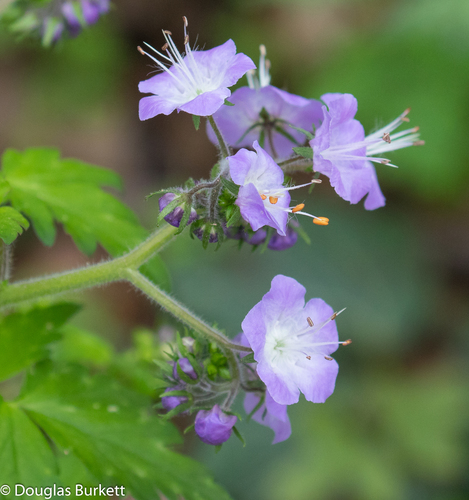
Kentucky, US
You might spot Purple Phacelia, Eastern Newt, and American Cancer-Root.
View guide →
Take the discovery with you
Snap it with Snappit to identify it, learn what makes it special, and add the discovery to your collection.







.jpg&width=800)


_001.jpg&width=800)



