





common soft brome
Bromus hordeaceus
Common soft brome is a grassy plant that grows in fields and meadows. Its soft leaves are fun to touch, and it can sway gently in the wind, making it look like it's dancing!
Habitat: Grasslands
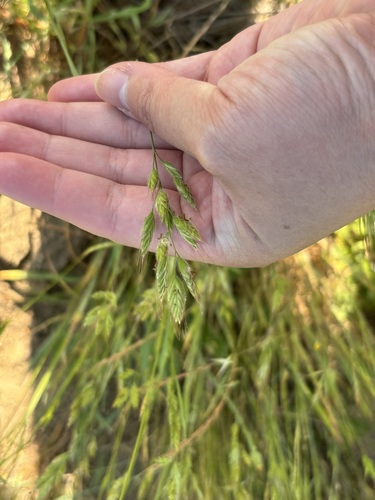
The common soft brome is a slender, upright grass with soft, velvety leaves and stems that give it a grayish-green appearance. Its compact, nodding flower heads start green, often developing a purplish tint before turning golden-brown when mature.
Category
PlantsRarity
Common
Danger
1/5 · Very low
Snaps
2
Each tiny seed has a pointy 'awn' that helps it burrow into the soil or hitch a ride!
It's an amazing survivor, able to thrive in poor soil and even salty conditions!
Its scientific name, Bromus hordeaceus, comes from Greek words meaning 'food' and 'barley-like'.
The entire plant feels incredibly soft and fuzzy, almost like touching a plush toy!
Common soft brome has tiny barbed seeds that stick to fur and clothes, helping it hitchhike to new places and spread its territory.
It can grow rapidly in disturbed areas, quickly establishing itself to outcompete other plants for space and sunlight.
Its mature seeds have tiny bristles (awns) that can deter grazing animals from eating them, protecting its future generations.
.JPG&width=800)
Sylvilagus floridanus
Young leaves are a food source.

Passer domesticus
Sparrows forage on its abundant seeds.
Microtus pennsylvanicus
Voles graze on stems and seeds.

Equus caballus
Common forage grass for horses.
Ornamental plants are cultivated primarily for their aesthetic appeal, enhancing landscapes and gardens with their attractive foliage, flowers, or form.
Grass-like plants are herbaceous plants that visually resemble true grasses, typically having long, narrow leaves.
Edible plants are those parts of a plant that are considered safe for human consumption.
Grassland habitats are terrestrial biomes dominated by grasses and herbaceous plants, supporting a variety of grazing animals.

Rapid growing plants exhibit accelerated growth rates, quickly increasing in size and biomass within a short period.
No aliases listed yet.
Danger
1/5 · Very low
Always be careful when walking in fields, and don't eat any plants unless an adult says it's safe!
The easiest way to identify common soft brome is to use the Snappit nature identifier app.
20-80 cm
Spring to early summer
No
None
Annual
Wind
Grasslands
Zoom in to split clusters and explore where this object has been snapped.
Mar 14, 2026
San Joaquin Experimental RangePhoto attribution
(c) Nina S. Zhao, some rights reserved (CC BY)
License: CC BY 4.0 ↗
Image may be shown cropped inside the card frame.
Take the discovery with you
Snap it with Snappit to identify it, learn what makes it special, and add the discovery to your collection.










.jpg&width=800)



_001.jpg&width=800)



