





Devilshead
Echinocactus horizonthalonius
The Devilshead is a unique cactus that looks like a little green ball with spines! It grows in the desert and can survive in very hot weather, making it a special plant for dry places.
Habitat: Desert
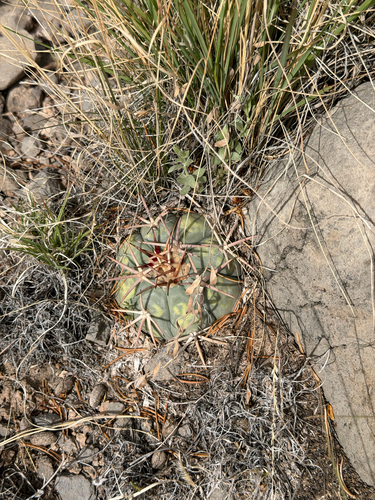
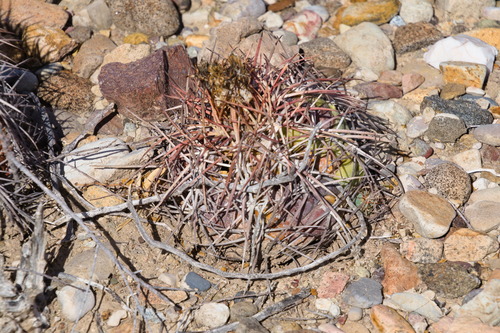
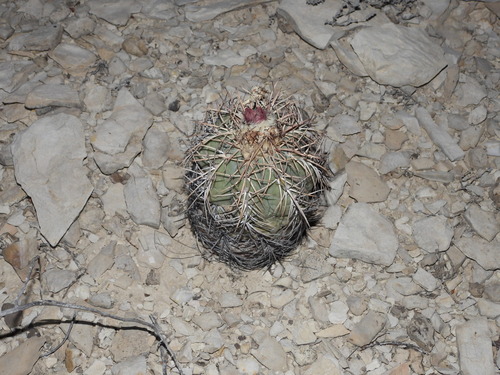
The Devilshead is a striking, solitary, globe-shaped cactus, ranging from blue-green to grayish-green. It has prominent, sharply angled ribs topped with stout, reddish-brown to black spines that often curve. Its vibrant pink to magenta flowers emerge from the crown, making it visually distinct.
Category
PlantsRarity
Common
Danger
2/5 · Low
Snaps
6
Despite its name and spines, the small, tart, red fruits are safe for humans to eat!
Its scientific name "Echinocactus" means "spiny cactus," perfectly describing its tough exterior!
The Devilshead's beautiful pink flowers often only open for a single day before closing again!
These amazing cacti can live for over 100 years, making them ancient desert dwellers!
Devilshead has a ribbed stem that expands and contracts like an accordion to store vast amounts of water during droughts.
Devilshead has long, hooked spines that create a formidable defense, deterring hungry desert animals from eating it.
Devilshead has a thick, waxy coating on its skin that reflects harsh sunlight and significantly reduces water loss.
Diadasia enavata
main pollinator of its flowers

Pecari tajacu
occasionally eats the cactus pads and fruits

Neotoma albigula
consumes fruits and sometimes cactus tissue

Larrea tridentata
often shares its arid desert habitat
Flowering plants are any plants that produce flowers as part of their reproductive cycle.
Spring blooming plants produce their flowers during the spring season, often signifying the end of winter and the start of new growth.
Drought-tolerant plants can survive and flourish in conditions with limited water availability.
Succulent plants have thickened, fleshy parts, usually leaves or stems, adapted to store water in arid climates.

Describes plants that are particularly attractive and beneficial to a wide range of pollinating organisms.

Desert habitats are arid regions characterized by extremely low precipitation and often extreme temperatures, supporting specialized flora and fauna.

This trait characterizes organisms with an exceptionally long lifespan compared to others of their kind.

Possessing sharp, pointed projections or spines on the body or surface.

Pertaining to species that are significantly smaller than typical or average for their kind.
No aliases listed yet.
Danger
2/5 · Low
Be careful not to touch the spines, as they can be sharp!
The easiest way to identify Devilshead is to use the Snappit nature identifier app.
10-25 cm
15-30 cm
4-7 cm
Spring to early summer
Yes
None
Perennial
Zoom in to split clusters and explore where this object has been snapped.
May 29, 2026
Alameda Park ZooPhoto attribution
(c) CK2AZ, some rights reserved (CC BY)
License: CC BY 4.0 ↗
Image may be shown cropped inside the card frame.
May 5, 2026
Rancho EstellePhoto attribution
(c) Mike Ostrowski, some rights reserved (CC BY-SA)
License: CC BY-SA 4.0 ↗
Image may be shown cropped inside the card frame.
Oct 27, 2022
Mariscal MinePhoto attribution
(c) Jared Shorma, some rights reserved (CC BY)
License: CC BY 4.0 ↗
Image may be shown cropped inside the card frame.

Texas, US
You might spot Texas Rainbow Cactus, Ocotillo, and Greater Earless Lizard.
View guide →

New Mexico, US
You might spot Vermilion Flycatcher, Turkey, and American Rubyspot.
View guide →

US
You might spot Creosote Bush, Great-Tailed Grackle, and Ocotillo.
View guide →

US
You might spot Mexican Palo Verde, Ocotillo, and Giant Reed.
View guide →

New Mexico, US
You might spot Canis Lupus Baileyi, Hawaiian Goose, and Ring-Tailed Lemur.
View guide →

New Mexico, US
You might spot Creosote Bush, Devilshead, and Lace-Spine Nipple Cactus.
View guide →
Take the discovery with you
Snap it with Snappit to identify it, learn what makes it special, and add the discovery to your collection.








.jpg&width=800)



_001.jpg&width=800)



