_Eristalis_arbustorum_on_Ammi_majus.jpg&width=800)





Eurasian Drone Fly
Eristalis arbustorum
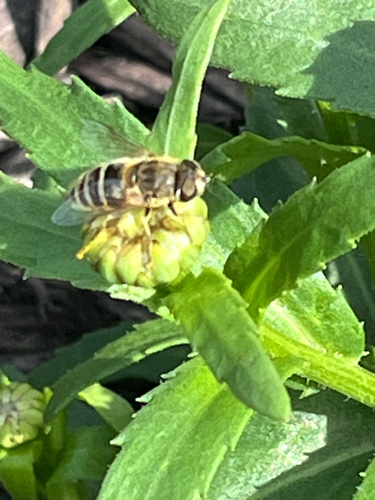
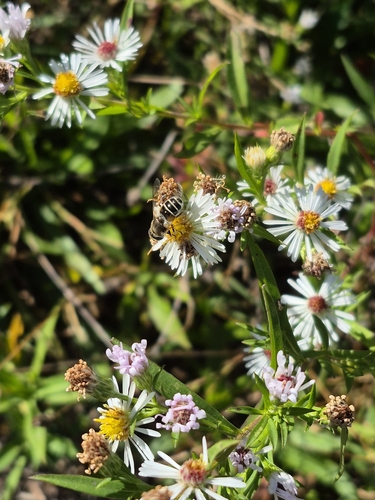
The Eurasian Drone Fly is a friendly insect that looks like a bee but doesn't sting! It loves to visit flowers and helps them grow by spreading pollen.
Habitat: Urban areas
The Eurasian Drone Fly is a medium-sized, stout fly with a hairy, dark body marked with yellow-orange stripes on its abdomen. It has large reddish-brown eyes and short antennae. Its single pair of wings visibly distinguishes it from the two-winged bees it mimics.
Category
InsectsRarity
Common
Danger
1/5 · Very low
Snaps
15
Even though they look like bees, drone flies cannot sting people!
Its babies are called 'rat-tailed maggots' because of their long breathing tube!
These flies visit over 20 different types of flowers to find their sugary meals.
They can taste with their feet when they land on a flower!
Eurasian Drone Fly can look like a bumblebee because of its striped body and hairy appearance that helps them avoid predators.
Eurasian Drone Fly can hover perfectly still in mid-air because of its powerful wing muscles that helps them feed on flowers.
Eurasian Drone Fly larvae can breathe underwater using a long 'tail' because of their unique siphon structure that helps them survive in murky water.
Adults feast on nectar and pollen from flowers, while their larvae filter-feed in watery places.
Age differences: Larvae (rat-tailed maggots) are detritivores, filtering microorganisms and decaying matter from stagnant water.

Taraxacum officinale
Carries pollen between flowers while feeding on nectar.
Mentha spicata
Visits spearmint flowers, helping to spread their pollen.
%2C_Parc_de_Woluw%C3%A9%2C_Brussels_(13042792905).jpg&width=800)
Parus major
A common garden bird that preys on adult drone flies.
Araneus diadematus
Often trapped in spider webs while visiting flowers.
Furry describes animals possessing a dense covering of soft hair or fur.
Social animals live in organized groups, cooperating for survival benefits such as foraging, defense, and raising offspring.
This trait characterizes organisms whose diet consists entirely or primarily of plant material.
Describes plants that are particularly attractive and beneficial to a wide range of pollinating organisms.

Diurnal animals are primarily active during daylight hours, typically resting or sleeping at night.

Describes a species whose presence and role have a disproportionately large effect on its environment.

This habitat trait indicates species that can coexist with humans in urban and suburban environments, utilizing man-made structures and green spaces.

Describes organisms that transfer pollen, enabling the fertilization and reproduction of plants.
Danger
1/5 · Very low
Don't try to catch or touch insects; just watch them from a distance!
The easiest way to identify Eurasian Drone Fly is to use the Snappit nature identifier app.
18-25 mm
10-15 mm
10-30 days
10 km/h
Adults feast on nectar and pollen from flowers, while their larvae filter-feed in watery places.
Urban areas
Foraging
Zoom in to split clusters and explore where this object has been snapped.
Jun 19, 2026
Mitchell Park Horticultural ConservatoryPhoto attribution
no rights reserved
License: CC0 1.0 ↗
Image may be shown cropped inside the card frame.
Oct 12, 2025
Forest Hill ParkPhoto attribution
(c) greatlakes25, some rights reserved (CC BY)
License: CC BY 4.0 ↗
Image may be shown cropped inside the card frame.

New Mexico, US
You might spot Tree Cholla, Colorado Pinyon, and House Finch.
View guide →

Ohio, US
You might spot Duck, Canada Goose, and Muscovy Duck.
View guide →

New York, US
You might spot Monarch and Common Eastern Bumble Bee.
View guide →

Virginia, US
You might spot Asian Lady Beetle, Spotted Lanternfly, and Christmas Fern.
View guide →
.jpg)
Maryland, US
You might spot Ivy-Leaved Toadflax, Duck, and Spotted Lanternfly.
View guide →

Wisconsin, US
You might spot Common Eastern Bumble Bee, Red-Belted Bumble Bee, and Duck.
View guide →
Take the discovery with you
Snap it with Snappit to identify it, learn what makes it special, and add the discovery to your collection.






.jpg&width=800)



