




Field Dodder
Cuscuta campestris
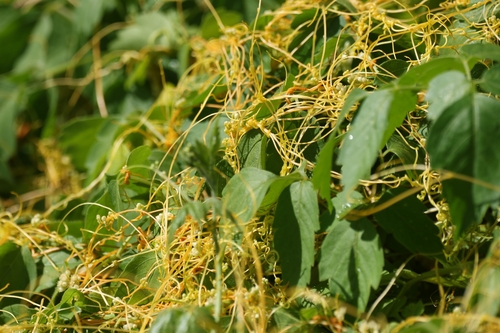
Field Dodder is a unique plant that doesn't have leaves or roots like most plants. Instead, it wraps around other plants to get nutrients and water. It has thin, yellow-orange stems that look like spaghetti!
Habitat: Grasslands
The Field Dodder is a thin, thread-like plant with distinct yellowish-orange or reddish stems that intricately twine around other plants. It famously lacks noticeable leaves and appears as a tangled mass, often compared to spaghetti or yarn. Its tiny, white to cream-colored flowers bloom in dense clusters along the stems, making it visually distinct from most green-leaved plants.
Category
PlantsRarity
Common
Danger
1/5 · Very low
Snaps
2
Field Dodder's seeds can stay alive in the soil for over ten years, patiently waiting to sprout!
It hardly has any green! It mostly relies on other plants for almost all of its food.
Its tiny seedlings can wiggle around for days, searching for a host plant to grow on!
Many people call it 'Witch's Hair' or 'Devil's Guts' because of its tangled, stringy look!
Field Dodder can detect chemical signals from nearby plants, helping it find and attach to a suitable host.
Field Dodder has special suckers called haustoria that pierce host plants to steal their nutrients and water.
Field Dodder cuts off its connection to the ground once it has successfully latched onto a host plant.

Medicago sativa
Steals nutrients from this crop

Trifolium pratense
Often found wrapping around clover

Solanum lycopersicum
A common host plant in gardens
Apis mellifera
Honey bees visit its tiny flowers
Flowering plants are any plants that produce flowers as part of their reproductive cycle.
Grassland habitats are terrestrial biomes dominated by grasses and herbaceous plants, supporting a variety of grazing animals.
Rapid growing plants exhibit accelerated growth rates, quickly increasing in size and biomass within a short period.
Describes a relationship between two different species where they live in close association, often benefiting one or both.
This trait describes organisms that live on or in a host organism, obtaining nutrients at the host's expense.
Vampiric organisms are those that obtain nutrients by feeding on the blood or bodily fluids of other animals.

Invasive species are non-native organisms that cause harm to the environment, economy, or human health.
No aliases listed yet.
Danger
1/5 · Very low
Do not touch or eat any plants without asking an adult first.
The easiest way to identify Field Dodder is to use the Snappit nature identifier app.
50-300 cm
100-500 cm
0.2-0.4 cm
Summer to fall
No
None
Perennial
Zoom in to split clusters and explore where this object has been snapped.
Jun 5, 2026
Liliuokalani Botanical GardenPhoto attribution
(c) Damien Wallace, some rights reserved (CC BY)
License: CC BY 4.0 ↗
Image may be shown cropped inside the card frame.

Hawaii, US
You might spot Yellow ʻilima, Red-Tailed Tropicbird, and White Leadtree.
View guide →

Hawaii, US
You might spot Zebra Dove and Red-Crested Cardinal.
View guide →

Hawaii, US
You might spot Bottlenose Dolphin, Sea Lion, and Sea Turtle.
View guide →
Take the discovery with you
Snap it with Snappit to identify it, learn what makes it special, and add the discovery to your collection.








.jpg&width=800)


_001.jpg&width=800)




