





Goutweed
Aegopodium podagraria
Goutweed is a green plant with pretty leaves that can spread quickly in gardens. It likes to grow in shady places and can be a fun plant to discover while exploring nature!
Habitat: Urban areas
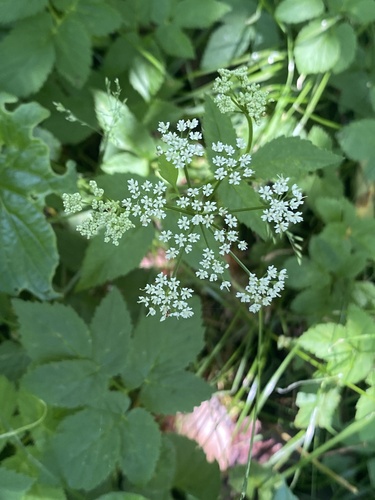
The Goutweed has bright green leaves, often variegated with creamy white edges, growing in clumps from a central stem. Its small white flowers form flat-topped clusters resembling delicate umbrellas, emerging above the foliage. This plant stands out with its bold foliage patterns.
Category
PlantsRarity
Common
Danger
1/5 · Very low
Snaps
34
Despite its invasive nature, some gardeners intentionally plant Goutweed as ground cover!
In medieval times, Goutweed was believed to cure gout, hence its common name!
Its other name, 'Bishop's Weed,' comes from its historical use near old cathedrals!
Its scientific name, *Aegopodium*, means 'goat's foot' because of its distinctive leaf shape!
Goutweed can rapidly spread with special underground stems called rhizomes, helping it quickly claim new territory.
Goutweed has the ability to grow vigorously in deep shade or full sun, helping it adapt to almost any environment.
Even if cut back, Goutweed can regrow quickly from small root fragments, helping it bounce back from damage.
Apis mellifera
Collects nectar and pollen from flowers.
Eristalis tenax
Visits flowers for nectar, aiding reproduction.

Arion ater
Common garden slug grazes on its leaves.

Odocoileus virginianus
Occasionally browses on young goutweed shoots.
Aromatic plants produce and emit fragrant volatile organic compounds, often for defense or to attract pollinators.
Deciduous plants periodically shed all their leaves, typically during autumn or dry seasons.
Flowering plants are any plants that produce flowers as part of their reproductive cycle.
Biennial plants complete their life cycle over two growing seasons, typically forming foliage in the first year and flowering/seeding in the second.

Shade tolerant plants are adapted to grow and thrive in areas with low light levels, requiring less direct sunlight.

Edible plants are those parts of a plant that are considered safe for human consumption.

Rapid growing plants exhibit accelerated growth rates, quickly increasing in size and biomass within a short period.

This habitat trait indicates species that can coexist with humans in urban and suburban environments, utilizing man-made structures and green spaces.

Invasive species are non-native organisms that cause harm to the environment, economy, or human health.
No aliases listed yet.
Danger
1/5 · Very low
Always check with an adult before touching or eating any plants.
The easiest way to identify Goutweed is to use the Snappit nature identifier app.
30-100 cm
30-90 cm
0.2-0.3 cm
Late spring to mid-summer
Yes
None
Perennial
Zoom in to split clusters and explore where this object has been snapped.
May 30, 2024
Morris ArboretumPhoto attribution
(c) josephine schirling, some rights reserved (CC BY)
License: CC BY 4.0 ↗
Image may be shown cropped inside the card frame.

Pennsylvania, US
You might spot American Robin, Red-Winged Blackbird, and Lesser Celandine.
View guide →

Vermont, US
You might spot Asian Bittersweet, Alder Buckthorn, and Eastern Newt.
View guide →

New York, US
You might spot American Robin, Pond Slider, and Northern Cardinal.
View guide →

New York, US
You might spot Dame's Rocket, American Pokeweed, and American Toad.
View guide →

Maryland, US
You might spot American Cancer-Root and Rue Anemone.
View guide →

Connecticut, US
You might spot American Robin, Eastern Poison Ivy, and Duck.
View guide →
Take the discovery with you
Snap it with Snappit to identify it, learn what makes it special, and add the discovery to your collection.







.jpg&width=800)


_001.jpg&width=800)


