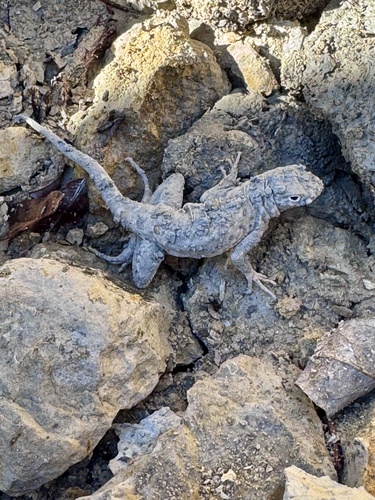


Greater Earless Lizard
cophosaurus texanus
The Greater Earless Lizard is a fascinating and highly active reptile native to the arid rocky terrains of the southwestern United States and northern Mexico. Instantly recognizable by its lack of external ear openings, this adaptation protects its hearing from the abrasive sands and rocky debris of its desert home. It is a diurnal, heat-tolerant species, often seen basking atop rocks or darting across gravelly flats at astonishing speeds. When startled, this lizard exhibits a unique behavior: it curls its tail over its back, displaying a bold black-and-white striped underside to confuse predators. Its spirited nature and striking movements make it a favorite sight for desert hikers and nature enthusiasts.
Habitat: Typically found in arid and semi-arid regions, particularly rocky hillsides, limestone canyons, desert washes, and gravelly flats with sparse vegetation.
This medium-sized lizard, typically measuring between 8 and 18 cm in length, features a flattened body with a gray to grayish-brown coloration that perfectly mimics the surrounding limestone and granite rocks. It lacks external ear openings, presenting a completely smooth head profile. Males display vibrant blue or green patches on their bellies, bordered by two distinct, backward-curved black bars, while females are less colorful but develop beautiful peach or orange-pink flushes along their sides when gravid. The underside of their tail is distinctly marked with prominent black and white bands, which are highly visible when the tail is raised.
Category
ReptilesRarity
Common
Danger
1/5 · Very low
Snaps
3
Gravid females signal their reproductive state to males by developing brilliant pink or orange-yellow colors on their sides, which fade after egg-laying.
The absence of external ear openings is an evolutionary trait to keep sand out of their ears while digging or running through loose gravel.
To deter predators, they perform 'tail-wagging' displays, raising and waving their black-and-white banded tail to redirect attacks away from their body.
Lacks external ear openings, which prevents sand, grit, and debris from entering and damaging the middle ear when burrowing.
Curls and wags its zebra-striped tail over its back when threatened to distract predators away from its head and vital organs.
Maintains activity in extreme desert heat by adjusting its body posture on hot rocks and utilizing high heat tolerance.
Feeds primarily on a variety of small invertebrates, including insects and arachnids, which it actively hunts during the day.

Geococcyx californianus
Preyed upon by roadrunners which actively hunt lizards on the desert floor.

Masticophis flagellum
Frequents the same rocky habitats and is a swift, active predator of these lizards.
Pogonomyrmex barbatus
The lizard opportunistically feeds on these abundant ground-dwelling insects.
No trait badges are assigned for this object yet.
No aliases listed yet.
Collections for this object will appear here as more themes are added.
Danger
1/5 · Very low
No special safety notes yet.
Compare toes, scales, head shape, crests and tail proportions. Many lizards can drop and regrow their tails, so a short tail isn't always a species trait. Lizard Identifier: upload a photo and compare the visible details.
8+ cm
0.005+ kg
3+ years
15 km/h
Feeds primarily on a variety of small invertebrates, including insects and arachnids, which it actively hunts during the day.
Typically found in arid and semi-arid regions, particularly rocky hillsides, limestone canyons, desert washes, and gravelly flats with sparse vegetation.
Pursuit
Zoom in to split clusters and explore where this object has been snapped.

Texas, US
You might spot Texas Rainbow Cactus, Ocotillo, and Greater Earless Lizard.
View guide →

Arizona, US
You might spot Saguaro and Graham's Nipple Cactus.
View guide →
New Mexico, US
You might spot Pyrrhuloxia, Curve-Billed Thrasher, and Great Blue Heron.
View guide →

Texas, US
You might spot Greater Earless Lizard and Tree Cholla.
View guide →
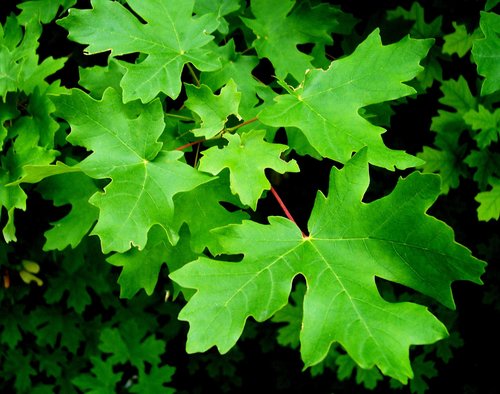
Texas, US
You might spot Bigtooth Maple, Texas Madrone, and Scarlet Leather Flower.
View guide →
Take the discovery with you
Snap it with Snappit to identify it, learn what makes it special, and add the discovery to your collection.