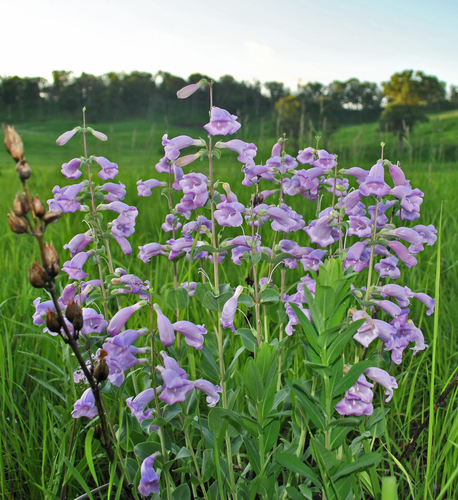


Large-Flowered Beardtongue
penstemon grandiflorus
The Large-Flowered Beardtongue is an exceptionally showy, upright perennial wildflower native to the sandy prairies and plains of central North America. Belonging to the plantain family, this species is highly celebrated for its towering, dramatic spikes of large, lavender to pale blue blossoms that paint the prairie landscape in late spring. It is a resilient pioneer species, often colonizing disturbed sandy soils where other plants struggle to take root. This plant acts as a vital early-season food source for native pollinators, especially bumblebees and hummingbirds, who readily visit its cavernous nectar-rich blooms. Gardeners and conservationists alike cherish this beardtongue for its striking architectural form, drought tolerance, and outstanding ecological value in prairie restoration projects. Its ability to thrive in harsh, dry environments with minimal nutrient requirements highlights its evolutionary success in the volatile environments of the Great Plains.
Habitat: Typically found in well-drained, sandy soils of prairies, barrens, dunes, and open disturbed areas across the central North American plains.
This plant features robust, unbranched stems that grow upright to a height of 50 to 100 cm. Its thick, fleshy, oval-shaped leaves are distinctively blue-grey or glaucous due to a waxy coating, and the upper leaves clasp tightly around the central stem. The flowers are the defining visual feature: large, inflated, tubular bells up to 5 cm long, arranged in pairs or clusters along the upper half of the stem. These blossoms are typically a pale lavender, soft pinkish-purple, or light blue, featuring a two-lipped opening with delicate purple guide lines decorating the interior of the throat. A prominent, sterile stamen (the 'beardtongue') lined with fuzzy yellow hairs is nestled inside the bloom.
Category
PlantsRarity
Common
Danger
1/5 · Very low
Snaps
1
Indigenous peoples historically used various parts of the plant to make medicinal teas for treating toothaches and fevers.
Its species name, grandiflorus, literally translates to 'large-flowered', pointing to its status as having some of the largest blossoms in the Penstemon genus.
The common name 'beardtongue' refers to the sterile stamen (staminode) inside the flower, which is heavily covered in yellow hairs, resembling a bearded tongue.
The thick, waxy, bluish-grey leaves have a unique adaptation: they clasp directly around the stem, often looking as though the stem is growing right through them.
The leaves possess a thick, glaucous waxy coating that reflects sunlight and reduces transpiration, enabling survival in hot, arid sand prairies.
Flowers are marked with delicate, deep-purple nectar guides that lead visiting bees directly to the pollen and nectar center of the tube.
A robust, deep taproot system secures the plant in shifting sandy soils and taps into deep underground moisture reserves during drought.
As a photosynthetic plant, it synthesizes its own food using sunlight, water, and carbon dioxide while absorbing essential minerals through its root system.

Archilochus colubris
Feeds on the nectar of the large tubular flowers, assisting in pollination.
Bombus fervidus
Visits the flowers for pollen and nectar, crawling inside the wide corolla tube to pollinate the plant.

Odocoileus virginianus
Occasionally browses on the young, fleshy leaves and flower stalks in early spring.
No trait badges are assigned for this object yet.
No aliases listed yet.
Collections for this object will appear here as more themes are added.
Danger
1/5 · Very low
No special safety notes yet.
The easiest way to identify Large-Flowered Beardtongue is to use the Snappit nature identifier app.
50-100 cm
3-8 years
As a photosynthetic plant, it synthesizes its own food using sunlight, water, and carbon dioxide while absorbing essential minerals through its root system.
Typically found in well-drained, sandy soils of prairies, barrens, dunes, and open disturbed areas across the central North American plains.
Zoom in to split clusters and explore where this object has been snapped.

Wisconsin, US
You might spot Sundial Lupine, Canadian Lousewort, and Cream Wild-Indigo.
View guide →

North Dakota, US
You might spot Moose, Ring-Necked Pheasant, and Field Bindweed.
View guide →

Nebraska, US
You might spot Monarch and Prairie Blue-Eyed Grass.
View guide →
Take the discovery with you
Snap it with Snappit to identify it, learn what makes it special, and add the discovery to your collection.












.jpg&width=800)



_001.jpg&width=800)




