





Marine Blue
Leptotes marina
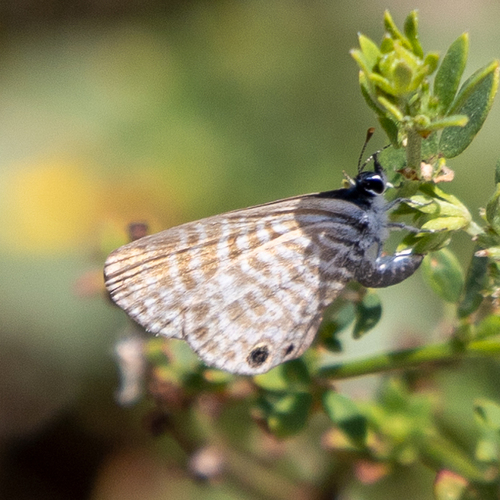
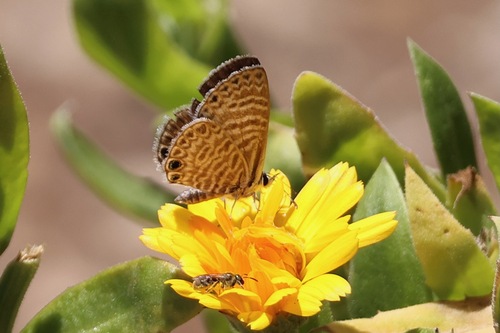
The Marine Blue is a small butterfly with beautiful blue wings. It loves to flutter around flowers and is often seen in sunny places. This little insect is a joy to watch as it dances in the air!
Habitat: Coastal areas
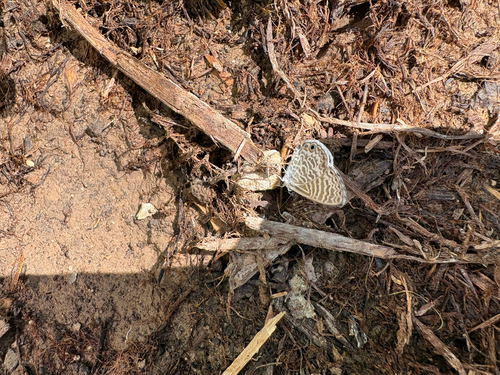
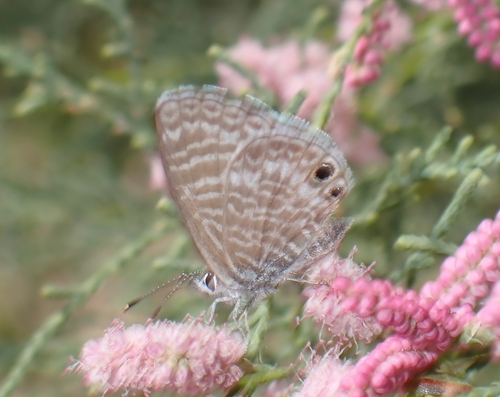
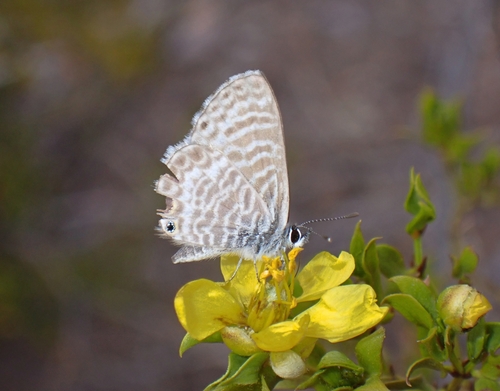
The Marine Blue has iridescent blue-violet upper wings that shift color in sunlight, contrasting with silvery-white undersides featuring small black spots. It also has delicate, thin tails on its hindwings, making it distinct among small butterflies.
Category
InsectsRarity
Common
Danger
1/5 · Very low
Snaps
31
Some Marine Blue caterpillars have a special gland that offers sweet liquid to ants!
The adult butterflies love visiting sunny spots to warm up their blue wings before they fly.
The caterpillars often change color to perfectly match the flowers or pods they are eating.
These tiny butterflies are known to fly hundreds of kilometers, even across open ocean!
Marine Blue has tiny tails on its hindwings that can fool predators into attacking the wrong end, helping them escape.
Marine Blue's iridescent blue wings change color with light, helping them blend perfectly with the sky or stand out to mates.
Marine Blue can grow from egg to adult butterfly very quickly, allowing them to have many generations in one year.
Adults sip nectar from flowers, while caterpillars munch on leaves, flowers, or seeds of certain plants.
Age differences: Larvae eat plant parts; adults feed on flower nectar.
Astragalus nuttallianus
Larvae feed on its leaves and flowers.
Anolis carolinensis
A common predator of adult butterflies.
Formica pallidefulva
Ants sometimes tend larvae for their sweet secretions.
Social animals live in organized groups, cooperating for survival benefits such as foraging, defense, and raising offspring.
Colorful describes organisms or objects displaying a wide range of bright and distinct colors.
This trait characterizes organisms whose diet consists entirely or primarily of plant material.
Describes plants that are particularly attractive and beneficial to a wide range of pollinating organisms.

Coastal habitats are dynamic environments located along the interface between land and sea, influenced by tides, waves, and saltwater.

Diurnal animals are primarily active during daylight hours, typically resting or sleeping at night.

Pertaining to species that are significantly smaller than typical or average for their kind.

Describes organisms that transfer pollen, enabling the fertilization and reproduction of plants.
No aliases listed yet.
Danger
1/5 · Very low
Always watch butterflies from a distance and don't try to catch them.
The easiest way to identify Marine Blue is to use the Snappit nature identifier app.
20-30 mm
10-15 mm
10-20 days
12 km/h
Adults sip nectar from flowers, while caterpillars munch on leaves, flowers, or seeds of certain plants.
Coastal areas
Foraging
Zoom in to split clusters and explore where this object has been snapped.
Jun 6, 2026
Venice Canal Historic DistrictPhoto attribution
(c) Roberto Daniel Avila, some rights reserved (CC BY)
License: CC BY 4.0 ↗
Image may be shown cropped inside the card frame.
Jun 6, 2026
San Diego Botanic GardenPhoto attribution
(c) Rachel Lee Harper, some rights reserved (CC BY)
License: CC BY 4.0 ↗
Image may be shown cropped inside the card frame.
Jun 4, 2026
BricktownPhoto attribution
(c) Emily Geest, some rights reserved (CC BY)
License: CC BY 4.0 ↗
Image may be shown cropped inside the card frame.
May 17, 2026
Rancho EstellePhoto attribution
(c) Bao Pham, some rights reserved (CC BY)
License: CC BY 4.0 ↗
Image may be shown cropped inside the card frame.
May 17, 2026
Homer Wilson RanchPhoto attribution
(c) Bao Pham, some rights reserved (CC BY)
License: CC BY 4.0 ↗
Image may be shown cropped inside the card frame.

New Mexico, US
You might spot Tree Cholla, Colorado Pinyon, and House Finch.
View guide →

Arizona, US
You might spot Christmas Cholla and California Barrel Cactus.
View guide →

California, US
You might spot Western Fence Lizard and Eastern Fox Squirrel.
View guide →
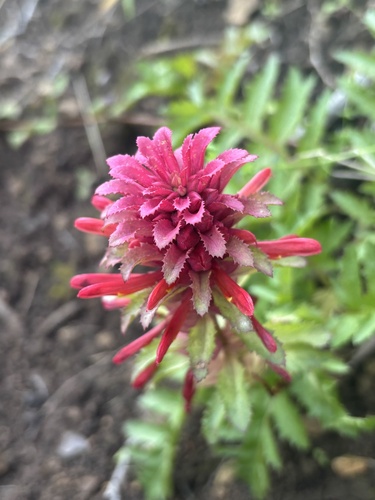
California, US
You might spot Warrior's Plume, Western Leatherwood, and White Globe Lily.
View guide →

Arizona, US
You might spot Great-Tailed Grackle, Stinknet, and Northern Mockingbird.
View guide →

California, US
You might spot Eastern Fox Squirrel, Bee, and House Sparrow.
View guide →
Take the discovery with you
Snap it with Snappit to identify it, learn what makes it special, and add the discovery to your collection.







.jpg&width=800)



