


Mountain Pride
penstemon newberryi
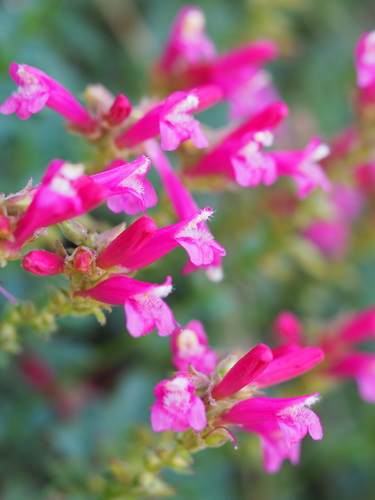
Mountain Pride (Penstemon newberryi) is a striking, low-growing perennial subshrub native to the high-elevation rocky landscapes of the western United States. A member of the plantain family, it is renowned for injecting brilliant splashes of vivid pink and magenta into the stark, gray granite environments of the Sierra Nevada and Cascade ranges. As a hardy alpine specialist, Mountain Pride forms dense, sprawling mats that creep over boulders and anchor deeply into seemingly barren rock crevices. Its stunning, tubular blooms are a crucial nectar source for high-altitude pollinators during the brief summer window. Both a testament to resilience and an alpine beauty, this penstemon is a favorite among hikers and botanists exploring the rugged mountainous terrain.
Habitat: Found in rocky, high-elevation mountain habitats, often growing directly from granite crevices or steep ledges.
This bushy, mat-forming plant typically reaches 10 to 30 centimeters in height. Its stems are woody at the base, covered in small, opposite, leathery leaves that are dark green, oval-shaped, and distinctively toothed along the edges. The most striking visual identifier is its inflorescence: dense clusters of tubular, bilaterally symmetrical flowers ranging from deep pink to bright red-magenta. The flowers, roughly 2.5 to 3.5 centimeters long, have a slightly hairy texture on the outside and feature upper and lower lips that provide a perfect landing pad and entry point for specific pollinators.
Category
PlantsRarity
Common
Danger
1/5 · Very low
Snaps
Be the first to snap!
Its brightly colored, tubular flowers act as an evolutionary lock-and-key mechanism, specifically tailored to the long bills of hummingbirds to ensure effective pollen transfer.
Mountain Pride frequently grows in such sheer, solid granite environments that it appears to be blooming straight out of the bare rock.
The species was scientifically named in honor of John Strong Newberry, a prominent American geologist, physician, and explorer of the 19th century.
Unlike many delicate alpine flowers, Mountain Pride forms a tough, woody base that allows it to survive being buried under heavy mountain snowpack for over half the year.
Adapted to grow in rocky environments, its resilient roots can penetrate tiny fissures in solid granite to access trapped moisture and organic matter.
Its thick, leathery, and waxy leaves significantly reduce water loss through transpiration, allowing the plant to survive intense alpine sunlight and dry winds.
The tubular shape and vibrant pink-red color of its flowers are perfectly adapted to attract hummingbirds, matching their bill shape and visual preferences for highly efficient pollination.
As a photosynthetic plant, Mountain Pride produces its own food using sunlight, water, and carbon dioxide.

Calypte anna
Hummingbirds are drawn to the red-pink tubular flowers to consume nectar, acting as the plant's primary pollinator.
Ochotona princeps
Small alpine mammals harvest the foliage of Mountain Pride to dry and cache in their haypiles for winter sustenance.

Odocoileus hemionus
Deer occasionally browse on the leaves and woody stems of the plant while foraging in subalpine environments.
No trait badges are assigned for this object yet.
No aliases listed yet.
Collections for this object will appear here as more themes are added.
Danger
1/5 · Very low
No special safety notes yet.
Start with the whole plant, then compare leaf arrangement, leaf edges, stems and any flowers or fruit. Opposite leaves grow in pairs; alternate leaves come one at a time along the stem. These details tell you far more together than a single green leaf does. Plant Identifier: upload a photo and compare the visible details.
10-30 cm
5-20 years
As a photosynthetic plant, Mountain Pride produces its own food using sunlight, water, and carbon dioxide.
Found in rocky, high-elevation mountain habitats, often growing directly from granite crevices or steep ledges.
Photosynthesis
Zoom in to split clusters and explore where this object has been snapped.
Recent snaps will appear here as new observations are added.
California, US
You might spot Sequoia, Whiskerbrush, and Black Bear.
View guide →

California, US
You might spot Sequoia, Mule Deer, and Black Bear.
View guide →

California, US
You might spot Sequoia, Mule Deer, and Black Bear.
View guide →

California, US
You might spot Purple Mountain-Heath, Mountain Hemlock, and Satin Lupine.
View guide →

California, US
You might spot Snowplant and Douglas's Squirrel.
View guide →

California, US
You might spot Sequoia, Mule Deer, and Yellow-Bellied Marmot.
View guide →
Take the discovery with you
Snap it with Snappit to identify it, learn what makes it special, and add the discovery to your collection.


















