



Virginia opossum
Didelphis virginiana
The Virginia opossum (Didelphis virginiana) is a cat-sized marsupial that lives from Costa Rica to southern Canada and is often called North America’s only marsupial. Females carry their tiny young in a pouch and later on their backs. It is a nocturnal omnivore with 50 teeth and a gripping tail, famous for “playing possum” when it is attacked.
Also known as Possum, North American Opossum
Rarity: Common
1 min–6 h time it can stay limp
50 teeth, the most of any North American land mammal
≈93% tail length vs head and body
13 teats in the pouch
11 amino acids in a venom-blocking peptide
34.8 °C body temperatureStill debated
0 ticks found in 32 wild opossum stomachs
Tap a pin on the model or a part below.
50 teeth
50:1 rods to cones
≈93% as long as the head and body
No claw on the thumb-like toe
13 teats inside
≈85 days riding with mum
1.9–6 kg weight
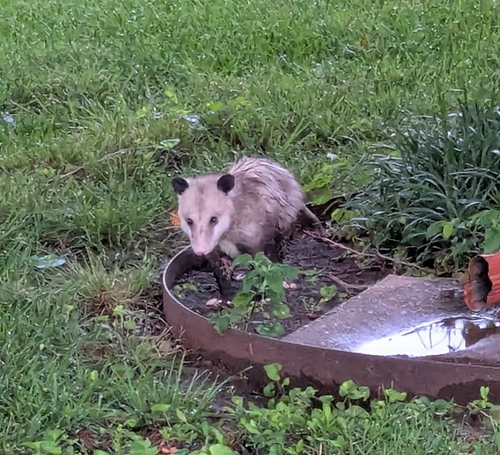
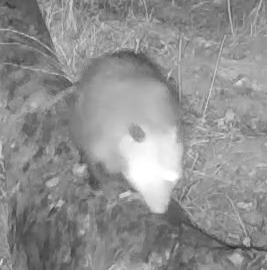
Four looks of the Virginia opossum. Pick one to repaint the model.
What an opossum is telling you, and when it might need help.
Photos from Wikimedia Commons. Some of them can repaint the 3D model.
Measured by scientists and wildlife agencies, with comparisons you can picture.
Tap Myth or Fact for each claim, then check the answer.
0 of 8 answered
Rabies is very rare in opossums, and they are thought to resist it well, but it is not impossible: wild white-eared opossums, close relatives in Brazil, have been found with it. Never touch a wild opossum.[5, 1, 17, 9]
The idea comes from a lab study in which opossums killed most young ticks trying to feed on them, later turned into estimates of about 5,500 ticks a week. But a 2021 study found no ticks in 32 wild opossum stomachs, and none of 23 earlier diet studies had found any.[13, 14]
The tail can hold an opossum only for a short time, when at least half of it grips a thick branch. Opossums sleep in dens such as hollow trees and brush piles.[3, 5, 7]
Its heart and breathing slow down, but it stays fully aware. In one study, its heart slowed even more when a dog came back.[8]
Despite the scaly tail, opossums are marsupials that raise their young in a pouch. They are more closely related to kangaroos than to any other North American mammal.[5, 3]
They have 50 teeth. Wildlife agencies in North Carolina and Virginia both point to this record.[1, 2]
Pregnancy lasts only 12–13 days. The tiny, honeybee-sized babies then finish growing in the pouch.[7, 2]
Proteins in their blood block parts of the venom, so they can even eat venomous snakes with little risk. Resistant does not mean completely immune.[1, 10]
Superlatives and record holders, each checked against its source.
From a honeybee-sized newborn to a youngster on its own in about 100 days.
12–13 days
pregnancy
Then the tiny babies are born and crawl straight into the pouch.[7, 2]
0.13 g
newborn weight
About 14 mm long, blind and not fully formed, but with strong front legs for climbing to the pouch.[7, 3]
13
teats
Up to 25 babies can be born, but there are usually only 13 teats. Babies that don’t find one don’t survive.[7, 5]
50–70 days
on the teat
The teat swells in the baby’s mouth, so it stays firmly attached while it grows.[7, 5]
≈85 days
riding on mum
Too big for the pouch, the young cling to their mother’s back and fur.[1, 3]
93–105 days
weaned
The young start on solid food at about 85 days and soon head off alone. Some stay in the den until about 120 days.[7]
Found a baby opossum? Don’t touch or feed it. If it is alone and smaller than about 18 cm (7 inches, not counting the tail), in the pouch of a dead mother, or hurt, call a licensed wildlife rehabilitator.
Babies in late winter, piggyback rides in spring and a fruit feast in autumn.
Two pouched marsupials from opposite sides of the world, and the masked neighbour that shares the opossum’s bins.
| Virginia opossum | Common brushtail possum | Raccoon | |
|---|---|---|---|
| Scientific name[19, 20, 16] | Didelphis virginiana | Trichosurus vulpecula | Procyon lotor |
| Pouch[7, 20, 16] | Yes (marsupial) | Yes (marsupial) | No |
| Lives in[7, 20, 16] | Costa Rica to southern Canada | Australia; brought to New Zealand in 1840 | North and Central America; introduced to parts of Europe and Asia |
| Weight[7, 20, 16] | 1.9–6 kg | 1.2–4.5 kg | 1.8–10.4 kg |
| Pregnancy[7, 20, 16] | 12–13 days | about 18 days | 63–65 days |
| Young per litter[7, 20, 16] | 4–25 born | 1 | 3–7 |
| Active[6, 21, 16] | At night | At night | At night |
| Average wild lifespan[7, 20, 16] | 1.5–2 years | about 7 years | about 5 years (once past youth) |
| IUCN status[22, 23, 24] | Least Concern | Least Concern | Least Concern |
In North America, “possum” usually means the Virginia opossum. In Australia, possums such as the brushtail are a different group of marsupials.
No. The Virginia opossum is common and has spread far to the north. Its biggest dangers are cars and cold winters.
IUCN Red List
Least Concern (LC)
Found from Costa Rica to southern Ontario. Before European settlement it reached only about as far north as Kentucky, Indiana and Ohio. It has since spread into places such as Michigan and Massachusetts, helped by people’s buildings and food.[19, 22, 7, 25, 15]
IUCN Red List: Least Concern (checked via Wikidata and GBIF)
12 questions. Every answer is somewhere on this page.
Question 1 of 12Score 0
Answer: 50. 50 teeth, more than any other North American land mammal.
Answer: 12–13 days. Only 12–13 days. The babies finish growing in the pouch.
Answer: A honeybee. Newborns are about 14 mm long and weigh 0.13–0.20 g.
Answer: 13. Usually 13, even though up to 25 babies can be born.
Answer: None. None at all. Ticks don’t seem to be a preferred food.
Answer: It drops by about half. It fell by 46%, from 222 to 120 beats per minute, in wild opossums.
Answer: Yes, it stays fully aware. It stays aware: its heart slowed even more when a dog came back.
Answer: It works like a thumb and has no claw. The opposable, clawless toe helps the foot grip branches.
Answer: No, the tail holds them only briefly. The tail can take their weight only for a short time. They sleep in dens.
Answer: Frostbite on their bare ears. Their almost hairless ears and tails often get frostbite.
Answer: 1.5–2 years. Most live only about 1.5–2 years in the wild.
Answer: Keep pets away and leave it alone. It is probably playing dead: frightened but aware. Give it space and it will leave when it feels safe.
Diet, food web, safety and badges from the Snappit field guide.
Opossums eat almost anything, from fruits and insects to small animals and trash.
Primary Foods

CoyoteEaten by
A common predator of opossums.

Great Horned OwlEaten by
A significant nocturnal bird predator.
Blacklegged TickParasite
Ticks try to feed on opossums, but opossums kill most of them and rarely eat them.
Danger 2/5 · Low
If you see an opossum, admire it from a safe distance. Never touch or feed one, even if it looks dead: it may be playing possum. If you find a baby or a hurt one, tell an adult, who can call a wildlife rehabilitator.
Compare ears, muzzle, tail, feet and coat markings. Size is hard to judge without something nearby for scale, and young mammals may not have adult coloring yet. Mammal Identifier: upload a photo and compare the visible details.
33-55 cm
1.9-6 kg
1.5-4 years
Opossums eat almost anything, from fruits and insects to small animals and trash.
Forests
Foraging
4-25
Not usually. They are shy and would rather hiss, show their 50 teeth, run away or play dead than fight. But any wild animal may bite if it is grabbed or cornered, so never touch, corner or feed one.
Rabies is very rare in opossums, but not impossible: wild opossums of a related species in Brazil have been found with it. Hissing and drooling are a normal bluff, not a sign of rabies on their own. If any wild animal bites or scratches someone, tell an adult and get medical advice straight away.
Probably not. The idea came from a 2009 lab study in which opossums killed most of the young ticks that tried to feed on them, later turned into estimates of about 5,500 ticks a week. But a 2021 study found no ticks in 32 wild opossum stomachs, and none of 23 earlier diet studies had found any.
Leave it alone and keep pets and children away. The opossum is frightened but aware, and it will get up and leave when it feels safe. That can take from about a minute to a few hours.
Don’t touch or feed it. Mother opossums usually carry their young with them. If a baby is alone and smaller than about 18 cm (not counting the tail), is in the pouch of a dead mother, or looks hurt, call a licensed wildlife rehabilitator.
Almost anything: insects, worms, snails, slugs, mice, eggs, fruit and carrion. Insects and carrion are key foods, and in autumn they eat lots of fruit. They also raid open bins and pet food left outside.
Most wild Virginia opossums live only about 1.5–2 years. In captivity they usually reach 3–4 years, with reports of 8–10. On one island with few predators, opossums aged more slowly and lived longer.
In North America, “possum” is the everyday name for the Virginia opossum. The word opossum comes from a Virginia Algonquian word and was first used in English in 1610. In Australia, “possums” are a different group of marsupials, such as the common brushtail possum.
Zoom in to split clusters and explore where this object has been snapped.
Jun 3, 2026
Oklahoma AquariumPhoto attribution
(c) Justine Anderson, some rights reserved (CC BY)
License: CC BY 4.0 ↗
Image may be shown cropped inside the card frame.
Dec 25, 2025
Sioux County CourthousePhoto attribution
(c) Colin Croft, some rights reserved (CC BY)
License: CC BY 4.0 ↗
Image may be shown cropped inside the card frame.
Take the discovery with you
Snap it with Snappit to identify it, learn what makes it special, and add the discovery to your collection.


 Forest
 Keystone Species
 Nocturnal