





Osage-orange
Maclura pomifera
The Osage-orange tree is known for its bright green, bumpy fruit that looks like a big orange! It has strong wood and beautiful leaves that turn yellow in the fall.
Habitat: Grasslands
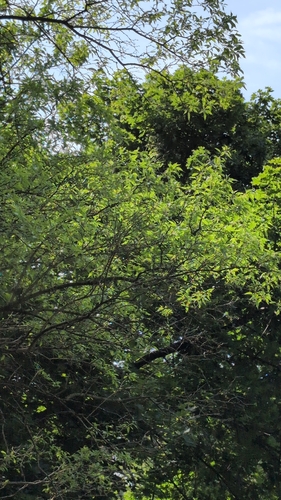
The Osage-orange tree has glossy, oval leaves and sharp thorns along its branches. Its bark is deeply furrowed and turns an orange-brown with age. Most distinctively, it produces large, bumpy, citrus-green fruits that resemble brains.
Category
PlantsRarity
Common
Danger
1/5 · Very low
Snaps
14
Its wood is one of the densest in North America, even denser than oak!
People once planted these thorny trees as 'living fences' to keep livestock in.
The bright orange heartwood of this tree glows under a blacklight!
You can extract a vibrant yellow dye from the tree's bark and roots!
Osage-orange has sharp thorns that help it defend its branches from grazing animals.
Osage-orange produces incredibly dense and durable wood that resists decay, making it last a long time.
Its huge, hard fruits evolved to be spread by large, now-extinct megafauna like mammoths.
Deciduous plants periodically shed all their leaves, typically during autumn or dry seasons.
Shade tolerant plants are adapted to grow and thrive in areas with low light levels, requiring less direct sunlight.
Broadleaf trees are angiosperms characterized by flat, wide leaves that are typically shed annually in temperate climates.
Fruit-bearing plants produce fruits, which are the mature ovaries of flowering plants containing seeds.

Fall color refers to the seasonal change in foliage pigmentation, primarily in deciduous plants, displaying vibrant hues.

Grassland habitats are terrestrial biomes dominated by grasses and herbaceous plants, supporting a variety of grazing animals.

Timber refers to wood that has been prepared for use in building and carpentry.

Describes a species whose presence and role have a disproportionately large effect on its environment.
Danger
1/5 · Very low
Don't eat the fruit, as it's not safe for people.
The easiest way to identify Osage-orange is to use the Snappit nature identifier app.
600-1800 cm
600-1200 cm
0.3-0.5 cm
Late spring to early summer
No
Mild
Perennial
Zoom in to split clusters and explore where this object has been snapped.
Jun 4, 2026
John J. Tyler ArboretumPhoto attribution
no rights reserved
License: CC0 1.0 ↗
Image may be shown cropped inside the card frame.

Alabama, US
You might spot American Beautyberry, White-Tailed Deer, and Peppervine.
View guide →

West Virginia, US
You might spot Spotted Lanternfly and Eastern Box Turtle.
View guide →

Tennessee, US
You might spot Pond Slider, White-Tailed Deer, and Great Blue Heron.
View guide →

Texas, US
You might spot Silverleaf Nightshade and Green Comet Milkweed.
View guide →

Illinois, US
You might spot Osage-Orange, Cutleaf Teasel, and Red Clover.
View guide →

Missouri, US
You might spot Eastern Carpenter Bee, Duck, and American Robin.
View guide →
Take the discovery with you
Snap it with Snappit to identify it, learn what makes it special, and add the discovery to your collection.









.jpg&width=800)


_001.jpg&width=800)



