.jpg&width=800)





Pale Green Assassin Bug
Zelus luridus
The Pale Green Assassin Bug is a cool insect that loves to hide in plants. It has a long body and sharp mouthparts to catch its food. These bugs are great at helping control other insect populations!
Habitat: Forests
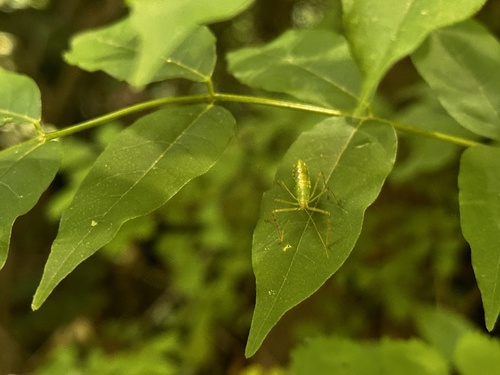
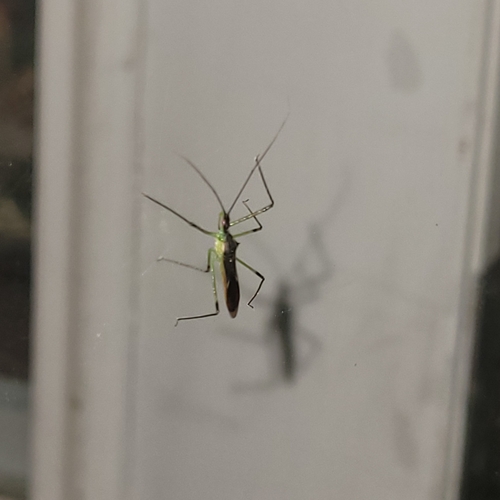
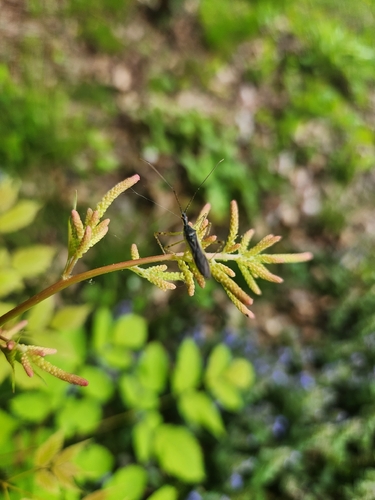
The Pale Green Assassin Bug is slender and entirely pale green, helping it blend with foliage. It has a distinctive long, cone-shaped head and a short, stout proboscis tucked beneath its body. Its long, delicate legs are adapted for grasping prey.
Category
InsectsRarity
Common
Danger
2/5 · Low
Snaps
78
Assassin bugs earned their name because they are ambush predators, sneaking up on unsuspecting prey!
The Pale Green Assassin Bug can turn its head almost all the way around, like an owl, to spot prey!
Their sticky leg hairs are so strong, they can even hold onto insects much larger than themselves!
Their tiny mouthparts are like straws, perfectly designed for sipping the 'juices' from other bugs!
Pale Green Assassin Bug has sticky front legs that help them capture and hold onto wiggly prey, making escape almost impossible.
Pale Green Assassin Bug can inject venom with its sharp proboscis, quickly paralyzing prey so it can drink their body fluids.
Pale Green Assassin Bug has a pale green body that helps them camouflage perfectly among leaves and stems, ambushing prey unnoticed.
This insect is a hunter, eating smaller bugs it catches on plants.
Myzus persicae
A common pest, perfect prey.
Trichoplusia ni
Feeds on various garden plants.

Empoasca fabae
Agricultural pest, easy target.
Araneus diadematus
Spider webs can trap them.
Solitary animals live alone for most of their lives, only interacting with others for mating or parental care.
Camouflaged describes organisms that possess coloring or patterns that allow them to blend into their environment.
This trait identifies organisms whose diet primarily consists of insects and other small invertebrates.
An ambush predator hunts by patiently waiting and concealing itself, then launching a sudden attack when unsuspecting prey comes within range.

Forest habitats are terrestrial environments dominated by dense tree cover, supporting a high diversity of plant and animal life.

This trait identifies organisms whose diet consists entirely or primarily of animal tissue.

Diurnal animals are primarily active during daylight hours, typically resting or sleeping at night.

Describes a species whose presence and role have a disproportionately large effect on its environment.

Venomous organisms produce toxins that are injected into another animal, typically through a bite or sting.

Describes organisms that transfer pollen, enabling the fertilization and reproduction of plants.
No aliases listed yet.
Danger
2/5 · Low
Do not touch insects without asking an adult, as some can bite.
The easiest way to identify Pale Green Assassin Bug is to use the Snappit nature identifier app.
20-30 mm
12-18 mm
30-90 days
This insect is a hunter, eating smaller bugs it catches on plants.
Forests
Ambush
6
Zoom in to split clusters and explore where this object has been snapped.
Jun 7, 2026
SkylandsPhoto attribution
(c) gwt2102, some rights reserved (CC BY)
License: CC BY 4.0 ↗
Image may be shown cropped inside the card frame.
Jun 3, 2026
Glendale Historic DistrictPhoto attribution
no rights reserved
License: CC0 1.0 ↗
Image may be shown cropped inside the card frame.
May 29, 2026
Sudbury Dam Historic DistrictPhoto attribution
no rights reserved
License: CC0 1.0 ↗
Image may be shown cropped inside the card frame.

Rhode Island, US
You might spot Common Mugwort, Duck, and Azure Bluet.
View guide →

Rhode Island, US
You might spot Common Eastern Bumble Bee and Osprey.
View guide →

Connecticut, US
You might spot Striped Wintergreen and Common Eastern Bumble Bee.
View guide →

Connecticut, US
You might spot Bold Jumping Spider and American Tuliptree.
View guide →

Vermont, US
You might spot Japanese Knotweed and Red-Bellied Woodpecker.
View guide →

Virginia, US
You might spot Spotted Lanternfly and Northern Cardinal.
View guide →
Take the discovery with you
Snap it with Snappit to identify it, learn what makes it special, and add the discovery to your collection.








.jpg&width=800)


