





Scaly-breasted Munia
Lonchura punctulata
The Scaly-breasted Munia is a small, colorful bird with a unique scaly pattern on its chest. These friendly birds love to eat seeds and can often be seen in groups, chirping happily in the trees.
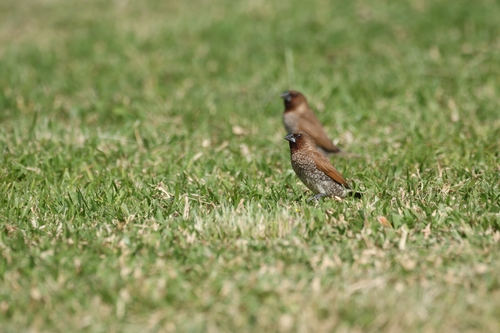
Habitat: Grasslands
The Scaly-breasted Munia is a small, stout bird featuring a chocolate-brown head and back. Its most striking feature is the dark brown 'scaly' pattern across its white chest and flanks, giving it its name. It also has a thick, silvery-grey bill.
Category
BirdsRarity
Common
Danger
1/5 · Very low
Snaps
11
Baby munias show special mouth markings to tell parents where to put food!
Many munias will sometimes sleep together in a massive feathered group for safety!
Scaly-breasted Munias have spread across the world, thriving in many new places!
They are sometimes called 'Spice Finches' because of their warm brown colors!
Scaly-breasted Munia can quickly locate hidden seeds because its sharp vision and quick movements help them find food sources.
Scaly-breasted Munia has a strong flocking instinct that helps them stay safe from predators and find food more efficiently in groups.
Scaly-breasted Munia can construct dome-shaped nests because their agile feet and bill allow them to interweave grass blades and plant fibers.
These birds mainly munch on tiny seeds, especially from grasses and weeds.

Accipiter nisus
a common raptor that hunts small birds.

Oryza sativa
a common agricultural crop that provides a food source.

Rattus rattus
an opportunistic predator of eggs and nestlings.
Setaria viridis
a widespread weed grass providing abundant seeds.
Feathered describes animals, primarily birds, possessing a covering of feathers.
Social animals live in organized groups, cooperating for survival benefits such as foraging, defense, and raising offspring.
Singing animals produce complex vocalizations, often for purposes of attracting mates, defending territory, or communicating within their species.
Colorful describes organisms or objects displaying a wide range of bright and distinct colors.

Grassland habitats are terrestrial biomes dominated by grasses and herbaceous plants, supporting a variety of grazing animals.

This trait characterizes organisms whose diet consists entirely or primarily of plant material.

Diurnal animals are primarily active during daylight hours, typically resting or sleeping at night.
Danger
1/5 · Very low
Enjoy watching birds from a distance and don't try to touch them.
The easiest way to identify Scaly-breasted Munia is to use the Snappit nature identifier app.
10-12 cm
15-18 cm
0.01-0.016 kg
3-7 years
35 km/h
These birds mainly munch on tiny seeds, especially from grasses and weeds.
Grasslands
Zoom in to split clusters and explore where this object has been snapped.
Jun 5, 2026
Liliuokalani Botanical GardenPhoto attribution
(c) Damien Wallace, some rights reserved (CC BY)
License: CC BY 4.0 ↗
Image may be shown cropped inside the card frame.

California, US
You might spot Western Fence Lizard and California Brittlebush.
View guide →

Florida, US
You might spot Crested Anole, Brown Anole, and Peters's Rock Agama.
View guide →

Hawaii, US
You might spot Tiger, Giant Anteaters, and Spider Monkey.
View guide →

Alabama, US
You might spot Red Buffalo-Bur, Eastern Box Turtle, and Anole.
View guide →

California, US
You might spot Eastern Fox Squirrel, Bee, and House Sparrow.
View guide →

California, US
You might spot Western Fence Lizard, Eastern Fox Squirrel, and Duck.
View guide →
Take the discovery with you
Snap it with Snappit to identify it, learn what makes it special, and add the discovery to your collection.




.jpg&width=800)







