





Sea Thrift
Armeria maritima
Sea Thrift is a pretty plant with pink flowers that grows near the sea. It likes sandy soil and can be found along coastlines. Bees love to visit Sea Thrift for its sweet nectar.
Habitat: Coastal areas
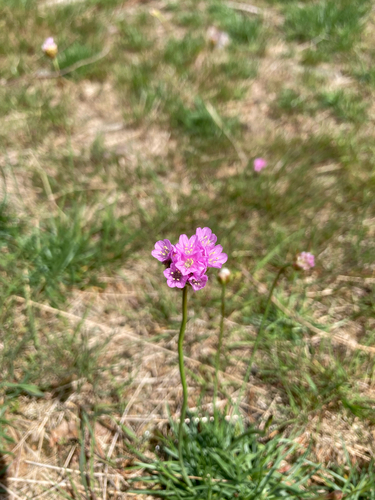
The Sea Thrift has dense, grass-like leaves forming a cushion at its base. From this cushion emerge slender stems topped with globe-shaped clusters of small, delicate pink or purple flowers. These vibrant blooms stand out strikingly against its often rocky coastal habitat.
Category
PlantsRarity
Common
Danger
1/5 · Very low
Snaps
5
Despite its delicate look, Sea Thrift can live for many years, happily clinging to rocky cliffs!
Its common name 'thrift' means to thrive, showing how well it grows in tough spots!
Sea Thrift is a 'pioneer plant', often the first to grow in new, harsh coastal areas.
Some people call it 'lady's cushion' because its dense leaves look like a soft pillow on the ground.
Sea Thrift can grow in salty soil because its special roots and leaves tolerate high salt levels, helping it thrive where others can't.
Its short, compact growth and strong, flexible stems help Sea Thrift withstand powerful coastal winds without breaking or being uprooted.
Sea Thrift has narrow, almost succulent-like leaves that help it store water and reduce moisture loss in dry, exposed coastal environments.
Apis mellifera
Gathers nectar from its vibrant pink flowers.
Bombus lucorum
Visits flowers for nectar, contributing to seed production.
Pieris rapae
Feeds on nectar, helping to spread pollen.
Cluster flowers are inflorescences where individual flowers are arranged closely together on a common stem.
Spring blooming plants produce their flowers during the spring season, often signifying the end of winter and the start of new growth.
Fragrant flowers emit a pleasant aroma, often to attract pollinators or for defense.
Salt tolerant plants can withstand and grow in conditions with elevated salinity levels in the soil or water.

Coastal habitats are dynamic environments located along the interface between land and sea, influenced by tides, waves, and saltwater.
Danger
1/5 · Very low
Enjoy Sea Thrift from a distance and avoid picking its flowers to let bees and butterflies enjoy them.
The easiest way to identify Sea Thrift is to use the Snappit nature identifier app.
10-30 cm
15-30 cm
1-2.5 cm
Spring to Summer
Yes
None
Perennial
Zoom in to split clusters and explore where this object has been snapped.
May 18, 2022
Palmerton Historic DistrictPhoto attribution
(c) Nico Carl, some rights reserved (CC BY)
License: CC BY 4.0 ↗
Image may be shown cropped inside the card frame.

California, US
You might spot Harbor Seal, Ochre Sea Star, and Sea Thrift.
View guide →

Alaska, US
You might spot Brown Bear, American Beaver, and Arctic Raspberry.
View guide →
Alaska, US
You might spot Brown Bear, American Beaver, and Arctic Raspberry.
View guide →

California, US
You might spot Douglas's Ground Squirrel and Button's Banana Slug.
View guide →

US
You might spot Button's Banana Slug, Ochre Sea Star, and Bat Star.
View guide →
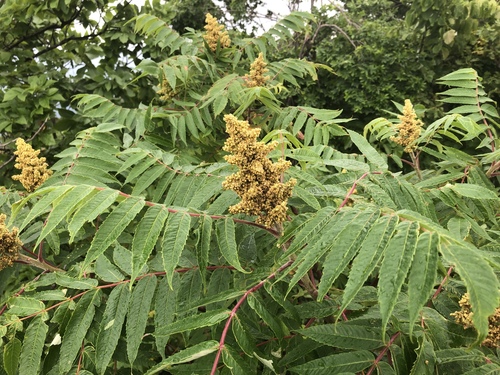
Pennsylvania, US
You might spot Staghorn Sumac, Spotted Lanternfly, and Butterfly Bush.
View guide →
Take the discovery with you
Snap it with Snappit to identify it, learn what makes it special, and add the discovery to your collection.








.jpg&width=800)


_001.jpg&width=800)




