





Smooth Brome
Bromus inermis
Smooth Brome is a tall, grassy plant that grows in fields and meadows. It has soft leaves and can sway gently in the wind, making it look like it's dancing!
Habitat: Grasslands
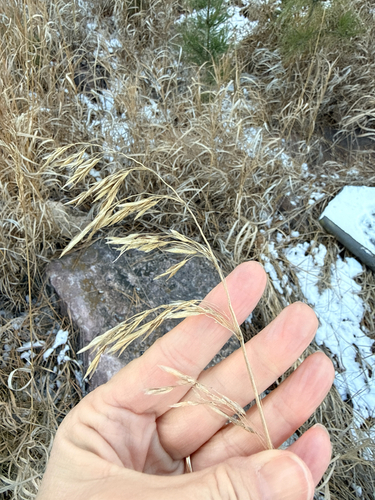
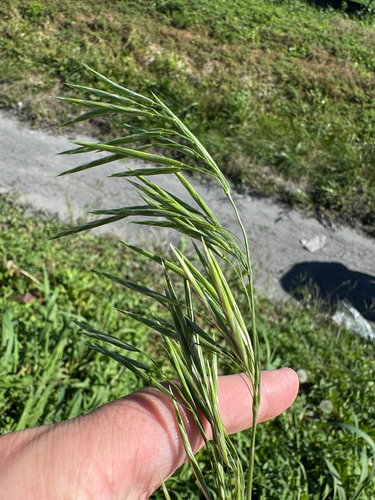
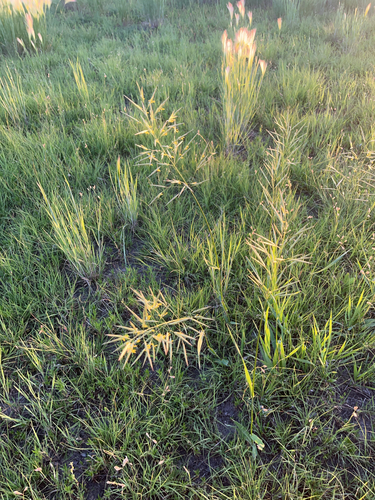
The Smooth Brome is a tall, slender grass with smooth, hairless stems and leaves. Its seed heads are open, branching panicles, often purplish when young, turning golden-brown. It lacks hairs on its leaf sheaths, distinguishing it from other brome grasses.
Category
PlantsRarity
Common
Danger
1/5 · Very low
Snaps
12
Farmers often plant it to feed cows, horses, and other farm animals.
It can live for many years because it's a perennial grass!
Its name 'brome' comes from a Greek word meaning 'oats'!
Its roots can grow super deep, helping it find water far underground!
Smooth Brome can spread underground using special roots called rhizomes, helping it quickly colonize new areas.
It has deep, robust roots that help it find water and survive even in dry conditions.
Smooth Brome's dense root system helps to hold soil in place, preventing erosion.

Bos taurus
Common forage for livestock.

Equus caballus
Important pasture grass for horses.

Odocoileus virginianus
Provides food for grazing wild animals.
Microtus pennsylvanicus
Dense growth provides cover for small mammals.
Melanoplus femurrubrum
Common insect herbivore.
Ornamental plants are cultivated primarily for their aesthetic appeal, enhancing landscapes and gardens with their attractive foliage, flowers, or form.
Grass-like plants are herbaceous plants that visually resemble true grasses, typically having long, narrow leaves.
Drought-tolerant plants can survive and flourish in conditions with limited water availability.
This human use trait identifies species that yield natural fibers, used by humans for textiles, rope, paper, and other manufactured goods.

This human use trait describes species cultivated or domesticated by humans for agricultural purposes, including crops and livestock.

Fall color refers to the seasonal change in foliage pigmentation, primarily in deciduous plants, displaying vibrant hues.

Grassland habitats are terrestrial biomes dominated by grasses and herbaceous plants, supporting a variety of grazing animals.

Rapid growing plants exhibit accelerated growth rates, quickly increasing in size and biomass within a short period.
No aliases listed yet.
Danger
1/5 · Very low
Always stay on paths when exploring fields to protect plants and animals.
The easiest way to identify Smooth Brome is to use the Snappit nature identifier app.
30-150 cm
1.5-3 cm
Late spring to early summer
No
None
Perennial
Wind
Zoom in to split clusters and explore where this object has been snapped.
Jan 16, 2026
Reptile GardensPhoto attribution
(c) Jane Weeden, some rights reserved (CC BY)
License: CC BY 4.0 ↗
Image may be shown cropped inside the card frame.
Oct 3, 2025
Dawson County CourthousePhoto attribution
(c) Nick T., some rights reserved (CC BY-SA)
License: CC BY-SA 4.0 ↗
Image may be shown cropped inside the card frame.
Jun 19, 2025
Box Butte County CourthousePhoto attribution
no rights reserved
License: CC0 1.0 ↗
Image may be shown cropped inside the card frame.

Michigan, US
You might spot Eastern Gray Squirrel, Tree-Of-Heaven, and House Sparrow.
View guide →

New York, US
You might spot Common Eastern Bumble Bee and American Robin.
View guide →

New York, US
You might spot Bald Eagle, Common Eastern Bumble Bee, and Tree-Of-Heaven.
View guide →

Michigan, US
You might spot Eastern Gray Squirrel, Rock Pigeon, and House Sparrow.
View guide →

Illinois, US
You might spot Beluga Whale, Pacific White-Sided Dolphin, and Sea Otter.
View guide →
Illinois, US
You might spot Beluga Whale, Pacific White-Sided Dolphin, and Sea Otter.
View guide →
Take the discovery with you
Snap it with Snappit to identify it, learn what makes it special, and add the discovery to your collection.









.jpg&width=800)



_001.jpg&width=800)




