





Sonoran Bumble Bee
Bombus sonorus
The Sonoran Bumble Bee is a fuzzy, friendly insect that helps flowers grow by spreading pollen. They are great at buzzing around and are often seen in gardens during the warm months.
Habitat: Desert
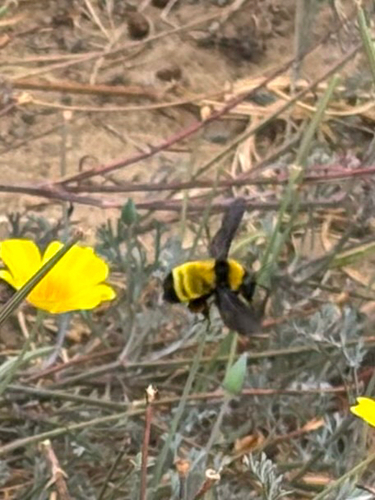
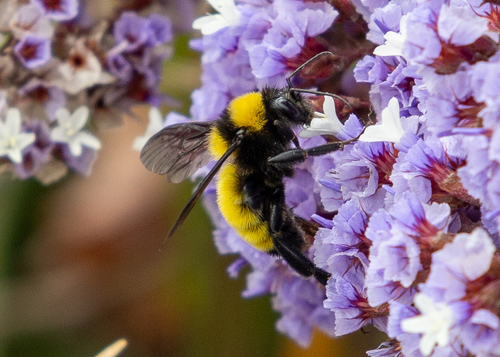
The Sonoran Bumble Bee is a large, fuzzy insect with a black body, distinguished by bright yellow hairs on its head and upper thorax. It often has a unique rusty-orange or yellow band across its mid-abdomen, making it visually distinct from other dark bees in its desert habitat.
Category
InsectsRarity
Common
Danger
2/5 · Low
Snaps
8
A queen Sonoran Bumble Bee can lay hundreds of eggs, starting a whole new colony each year.
Bumble bees have tiny, hairy eyes that help them catch and carry more pollen grains!
Some bumble bees create small wax pots inside their nest to store extra nectar for future use.
These bees can navigate using landmarks and even the sun's position, like a tiny GPS!
Sonoran Bumble Bee can shake pollen free from flowers using special wing muscle vibrations, which helps them collect more food for their colony.
Sonoran Bumble Bee has powerful flight muscles that help them warm up their bodies to fly even when the desert air is cool in the mornings.
Sonoran Bumble Bees sip sugary nectar for energy and gather protein-rich pollen from desert flowers.

Larrea tridentata
Visits its bright yellow flowers for nectar and pollen.

Prosopis glandulosa
Helps fertilize this important desert tree's blossoms.

Lanius ludovicianus
Sometimes captured by this predatory bird for a meal.
Crithidia bombi
A gut parasite that can weaken and shorten the bee's life.
Furry describes animals possessing a dense covering of soft hair or fur.
Social animals live in organized groups, cooperating for survival benefits such as foraging, defense, and raising offspring.
This trait characterizes organisms whose diet consists entirely or primarily of plant material.
Describes plants that are particularly attractive and beneficial to a wide range of pollinating organisms.

Desert habitats are arid regions characterized by extremely low precipitation and often extreme temperatures, supporting specialized flora and fauna.

Diurnal animals are primarily active during daylight hours, typically resting or sleeping at night.

Describes a species whose presence and role have a disproportionately large effect on its environment.

Describes organisms that transfer pollen, enabling the fertilization and reproduction of plants.
No aliases listed yet.
Danger
2/5 · Low
Be gentle and calm around bees; they usually won't sting if you don't bother them.
The easiest way to identify Sonoran Bumble Bee is to use the Snappit nature identifier app.
25-50 mm
10-25 mm
20-365 days
18 km/h
Sonoran Bumble Bees sip sugary nectar for energy and gather protein-rich pollen from desert flowers.
Desert
Foraging
Zoom in to split clusters and explore where this object has been snapped.
Jun 18, 2026
South Coast Botanic GardenPhoto attribution
(c) Kylie Etter, some rights reserved (CC BY)
License: CC BY 4.0 ↗
Image may be shown cropped inside the card frame.
Jun 6, 2026
Venice Canal Historic DistrictPhoto attribution
(c) Roberto Daniel Avila, some rights reserved (CC BY)
License: CC BY 4.0 ↗
Image may be shown cropped inside the card frame.

California, US
You might spot Eastern Fox Squirrel, Bee, and House Sparrow.
View guide →

California, US
You might spot Western Fence Lizard, Duck, and Black Phoebe.
View guide →

US
You might spot Sea Otter, Magellanic Penguin, and Zebra Shark.
View guide →

US
You might spot Creosote Bush, Great-Tailed Grackle, and Ocotillo.
View guide →

Texas, US
You might spot Pond Slider, Anole, and Monarch.
View guide →

California, US
You might spot Eastern Fox Squirrel, Western Fence Lizard, and Duck.
View guide →
Take the discovery with you
Snap it with Snappit to identify it, learn what makes it special, and add the discovery to your collection.






.jpg&width=800)



