





Surinam Cockroach
pycnoscelus surinamensis
The Surinam Cockroach is a fascinating insect that loves to hide in dark places. They are often found in groups and can even glide short distances when they jump!
Habitat: Surinam Cockroaches are typically found in warm, humid environments such as forests and under leaf litter.
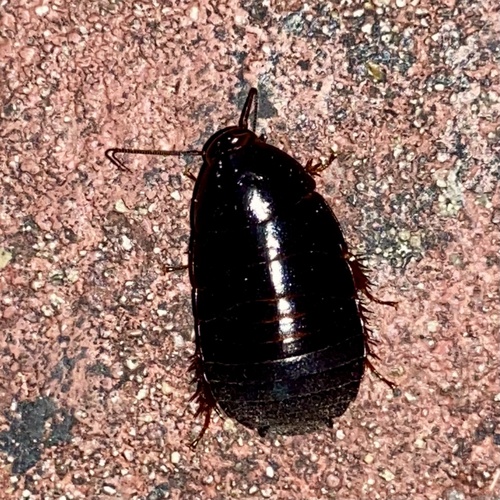
The Surinam Cockroach is a shiny, dark brown to black insect with a distinctive yellowish-orange, shell-like shield (pronotum) covering its head. Its body is broadly oval, flattened, and features fully developed wings that typically extend beyond the abdomen, though it is primarily a burrowing species.
Category
InsectsRarity
Common
Danger
1/5 · Very low
Snaps
4
Almost every Surinam Cockroach you find is a female, as males are super rare!
Their babies hatch *inside* the mother's body, not from outside eggs!
These insects can hide deep underground, sometimes up to a foot beneath the surface!
They munch on decaying leaves, helping to recycle nutrients back into the soil!
Surinam Cockroach can reproduce without a male because of parthenogenesis that helps them quickly colonize new areas.
Surinam Cockroach has strong, spiky legs that help them tunnel through soil and leaf litter for shelter and food.
Surinam Cockroach can fly short distances, helping them escape danger or find new food sources at night.
These busy insects are detritivores, munching on decaying plants and organic matter.
Social animals live in organized groups, cooperating for survival benefits such as foraging, defense, and raising offspring.
Camouflaged describes organisms that possess coloring or patterns that allow them to blend into their environment.
Describes organisms that break down dead organic material, recycling nutrients back into the ecosystem.
Forest habitats are terrestrial environments dominated by dense tree cover, supporting a high diversity of plant and animal life.

Nocturnal animals are primarily active during the nighttime hours, typically resting or sleeping during the day.
Danger
1/5 · Very low
Always wash your hands after handling insects.
The easiest way to identify Surinam Cockroach is to use the Snappit nature identifier app.
30-40 mm
18-25 mm
240-365 days
These busy insects are detritivores, munching on decaying plants and organic matter.
Surinam Cockroaches are typically found in warm, humid environments such as forests and under leaf litter.
Foraging
6
Zoom in to split clusters and explore where this object has been snapped.
Oct 8, 2025
Crowley Historic DistrictPhoto attribution
(c) Shannon Foreman, some rights reserved (CC BY)
License: CC BY 4.0 ↗
Image may be shown cropped inside the card frame.

Alabama, US
You might spot Anole, Bee, and Bristle Thistle.
View guide →

Alabama, US
You might spot Anole, Bee, and Bristle Thistle.
View guide →

Texas, US
You might spot Honey Mesquite, Anacua, and Alamo Vine.
View guide →

Louisiana, US
You might spot Pectoral Sandpiper, Sprague's Pipit, and Anole.
View guide →

Alabama, US
You might spot Anole, Bee, and Bristle Thistle.
View guide →

Florida, US
You might spot Brown Anole, Green Treefrog, and Southern Toad.
View guide →
Take the discovery with you
Snap it with Snappit to identify it, learn what makes it special, and add the discovery to your collection.












.jpg&width=800)



