_-_MacGregor_Point_Provincial_Park_01.jpg&width=800)





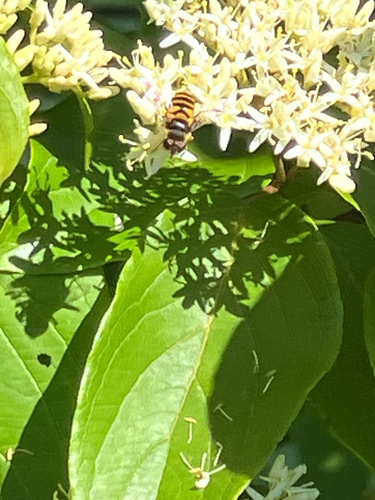
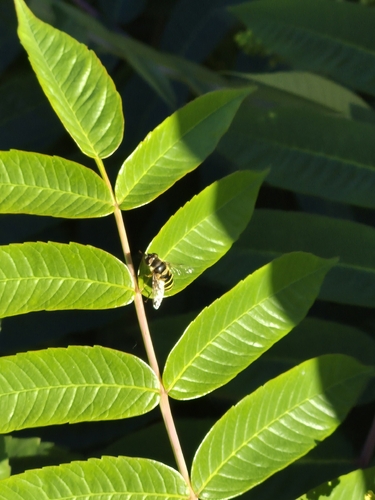
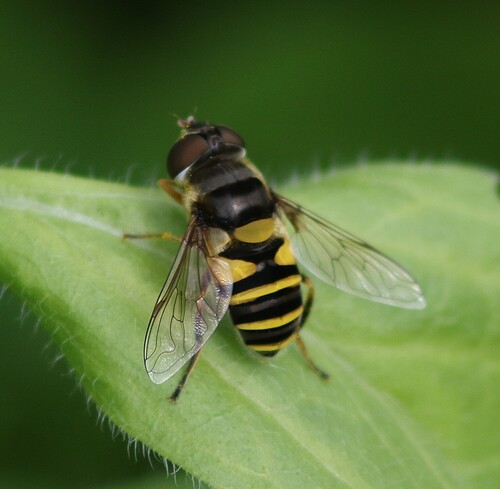
Transverse-banded Flower Fly
Eristalis transversa
The Transverse-banded Flower Fly is a friendly insect that looks like a bee but is actually a fly! They love to visit flowers and help plants grow by spreading pollen.
Habitat: Urban areas
The Transverse-banded Flower Fly has a robust, hairy body with distinct yellow and black stripes across its abdomen, closely mimicking a bee or wasp. It features large reddish-brown eyes and clear, iridescent wings. Its pattern is key to distinguishing it visually.
Category
InsectsRarity
Common
Danger
1/5 · Very low
Snaps
13
Adult flower flies mostly sip sweet nectar, but they also eat protein-rich pollen for energy and growth!
Its larvae, known as “rat-tailed maggots,” live in polluted water with a long, snorkel-like breathing tube!
These flies are expert flyers, able to change direction instantly and even fly backward with amazing skill!
Unlike bees which have four wings, flower flies only have two wings, making them true flies!
Transverse-banded Flower Fly can avoid predators by mimicking the appearance of stinging bees and wasps, which helps them stay safe.
Transverse-banded Flower Fly can perform incredible hovering flight, remaining stationary in mid-air, which helps them precisely navigate flowers for nectar.
Transverse-banded Flower Fly has hairy bodies that collect pollen, helping them transfer it between plants as they feed on nectar, aiding plant reproduction.
Adults sip nectar and pollen from flowers, while larvae munch on decaying matter underwater.
Age differences: Larvae are aquatic filter-feeders, consuming decaying organic matter and microorganisms, unlike nectar-feeding adults.

Taraxacum officinale
visits its bright yellow flowers for nectar and pollen.
Solidago canadensis
helps transfer pollen between its numerous small flowers.
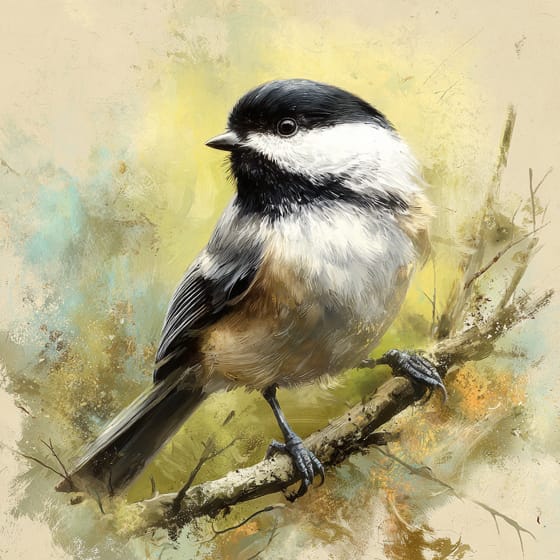
Poecile atricapillus
a common bird predator in North American habitats.
Marked with parallel bands or lines of color.
Social animals live in organized groups, cooperating for survival benefits such as foraging, defense, and raising offspring.
Colorful describes organisms or objects displaying a wide range of bright and distinct colors.
This trait characterizes organisms whose diet consists entirely or primarily of plant material.

Describes plants that are particularly attractive and beneficial to a wide range of pollinating organisms.

Diurnal animals are primarily active during daylight hours, typically resting or sleeping at night.

This habitat trait indicates species that can coexist with humans in urban and suburban environments, utilizing man-made structures and green spaces.

Describes organisms that transfer pollen, enabling the fertilization and reproduction of plants.
No aliases listed yet.
Danger
1/5 · Very low
Flower flies are harmless and won't sting, so you can watch them safely!
The easiest way to identify Transverse-banded Flower Fly is to use the Snappit nature identifier app.
15-20 mm
9-13 mm
15-45 days
8 km/h
Adults sip nectar and pollen from flowers, while larvae munch on decaying matter underwater.
Urban areas
Foraging
Zoom in to split clusters and explore where this object has been snapped.
Jun 13, 2026
Norvin Green State ForestPhoto attribution
no rights reserved
License: CC0 1.0 ↗
Image may be shown cropped inside the card frame.
Jun 12, 2026
Cleveland Cultural GardensPhoto attribution
(c) greatlakes25, some rights reserved (CC BY)
License: CC BY 4.0 ↗
Image may be shown cropped inside the card frame.
May 25, 2026
Sheepscot Historic DistrictPhoto attribution
no rights reserved
License: CC0 1.0 ↗
Image may be shown cropped inside the card frame.

Ohio, US
You might spot Spotted Lanternfly and Eastern Fox Squirrel.
View guide →

Iowa, US
You might spot Common Eastern Bumble Bee and North American Luna Moth.
View guide →

New York, US
You might spot Monarch and Common Eastern Bumble Bee.
View guide →
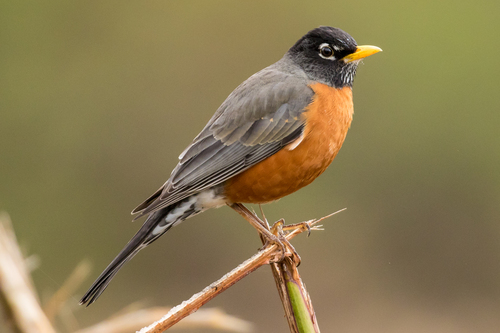
Virginia, US
You might spot American Robin, Red Fox, and Northern Cardinal.
View guide →

Connecticut, US
You might spot American Nursery Web Spider and Common Eastern Bumble Bee.
View guide →

Rhode Island, US
You might spot Great Blue Heron, Painted Turtle, and Sensitive Fern.
View guide →
Take the discovery with you
Snap it with Snappit to identify it, learn what makes it special, and add the discovery to your collection.







.jpg&width=800)



