





Trumpet Vine
Campsis radicans
The Trumpet Vine is a beautiful plant with bright orange flowers that look like trumpets. It attracts hummingbirds and butterflies with its sweet nectar.
Habitat: Urban areas, Coastal areas
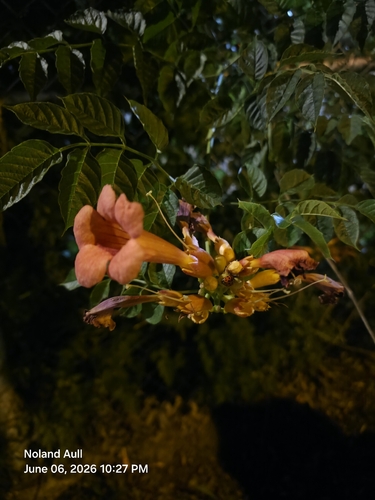
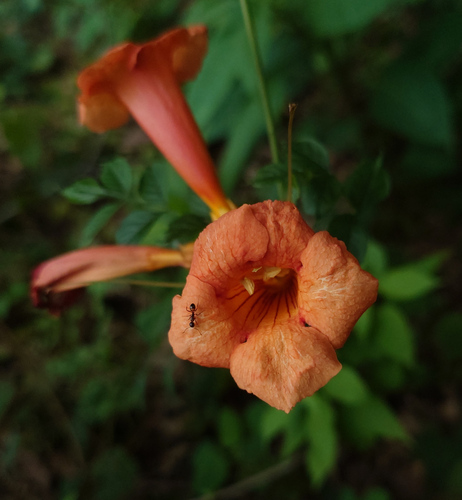
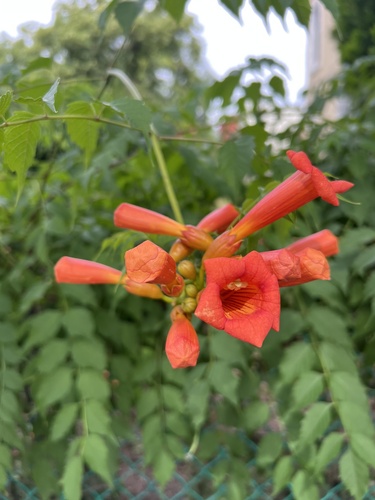
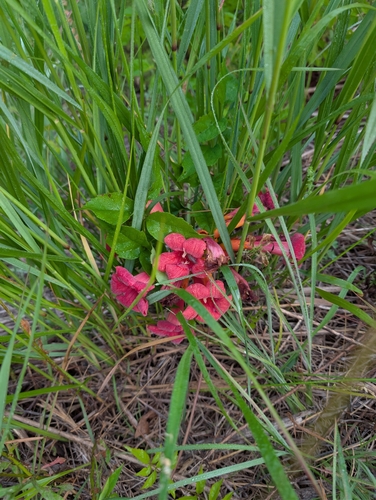
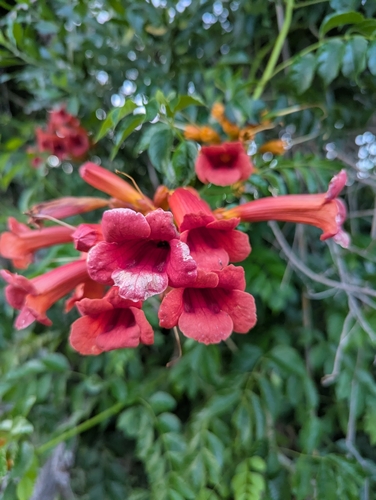
The Trumpet Vine has striking, fiery orange-red or yellow trumpet-shaped flowers, often appearing in clusters. Its woody stems climb vigorously, attaching with aerial rootlets, creating a dense, leafy curtain on structures.
Category
PlantsRarity
Common
Danger
2/5 · Low
Snaps
110
Ancient Native Americans used parts of this vine to weave sturdy baskets and ropes.
Its super-strong vines can grow over 10 feet in just one summer!
Some people call it 'cow-itch vine,' but it usually won't make you itch!
The sticky sap helps it cling to trees and walls like super glue!
Trumpet Vine can climb very high using special aerial rootlets that grip surfaces tightly, helping it reach precious sunlight.
Trumpet Vine has bright, tubular flowers packed with sweet nectar, acting like a beacon to attract hummingbirds for pollination.
Trumpet Vine has long seed pods that split open to release many papery, winged seeds, allowing wind to carry them far away.

Archilochus colubris
sips nectar from its deep, tubular flowers
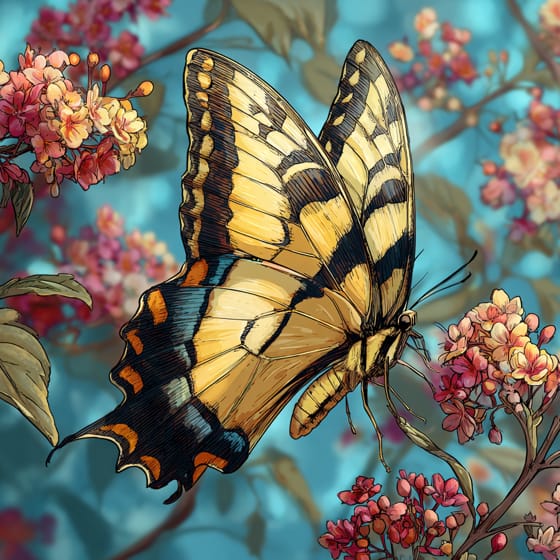
Papilio glaucus
visits flowers for nectar
Apis mellifera
gathers nectar and pollen from blooms
Climbing or vine plants are characterized by a growth habit that allows them to ascend upwards by twining, tendrils, or adhesive roots.
Bell-shaped flowers possess petals fused or arranged to form a cup-like or campanulate structure resembling a bell.
Cluster flowers are inflorescences where individual flowers are arranged closely together on a common stem.
A shrub is a woody plant smaller than a tree, typically with multiple stems branching from or near the ground.

A tube flower has petals fused together at the base, forming a distinct tubular structure that typically holds nectar deep within.

Everblooming plants produce flowers continuously or in repeated flushes over a long period.

Fragrant flowers emit a pleasant aroma, often to attract pollinators or for defense.

Coastal habitats are dynamic environments located along the interface between land and sea, influenced by tides, waves, and saltwater.

This habitat trait indicates species that can coexist with humans in urban and suburban environments, utilizing man-made structures and green spaces.
Danger
2/5 · Low
Enjoy looking at the beautiful flowers, but avoid touching them as some parts of the plant can cause skin irritation.
The easiest way to identify Trumpet Vine is to use the Snappit nature identifier app.
300-1200 cm
180-300 cm
5-9 cm
Summer to early fall
No
Mild
Perennial
Zoom in to split clusters and explore where this object has been snapped.
Jun 7, 2026
Lexington CemeteryPhoto attribution
(c) Noland Aull, some rights reserved (CC BY)
License: CC BY 4.0 ↗
Image may be shown cropped inside the card frame.
Jun 6, 2026
FruitvalePhoto attribution
(c) geotrope, some rights reserved (CC BY-SA)
License: CC BY-SA 4.0 ↗
Image may be shown cropped inside the card frame.
Jun 6, 2026
Bartholdi ParkPhoto attribution
(c) Frederick Nunley, some rights reserved (CC BY)
License: CC BY 4.0 ↗
Image may be shown cropped inside the card frame.
Jun 6, 2026
The State Botanical Garden of GeorgiaPhoto attribution
(c) Leila Dasher, some rights reserved (CC BY)
License: CC BY 4.0 ↗
Image may be shown cropped inside the card frame.
Jun 4, 2026
Chesapeake ArboretumPhoto attribution
(c) Alex, some rights reserved (CC BY)
License: CC BY 4.0 ↗
Image may be shown cropped inside the card frame.

Alabama, US
You might spot Elf Orpine, Canada Goose, and Leatherleaf Mahonia.
View guide →

Tennessee, US
You might spot House Sparrow, Northern Mockingbird, and Gulf Fritillary.
View guide →

Michigan, US
You might spot Eastern Gray Squirrel, Tree-Of-Heaven, and House Sparrow.
View guide →

Alabama, US
You might spot Anole, Eastern Gray Squirrel, and Asian Lady Beetle.
View guide →

District of Columbia, US
You might spot Eastern Gray Squirrel, Duck, and House Sparrow.
View guide →
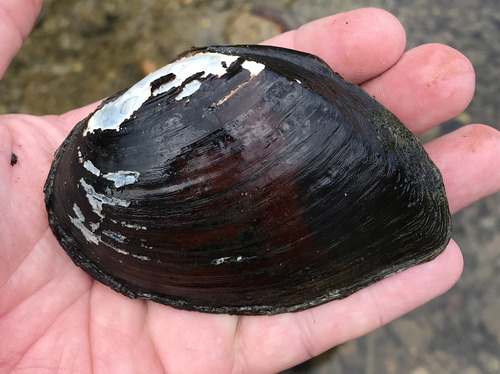
Alabama, US
You might spot Elephantear, Three-Ridge Mussel, and Rough Fatmucket.
View guide →
Take the discovery with you
Snap it with Snappit to identify it, learn what makes it special, and add the discovery to your collection.








.jpg&width=800)


_001.jpg&width=800)




